



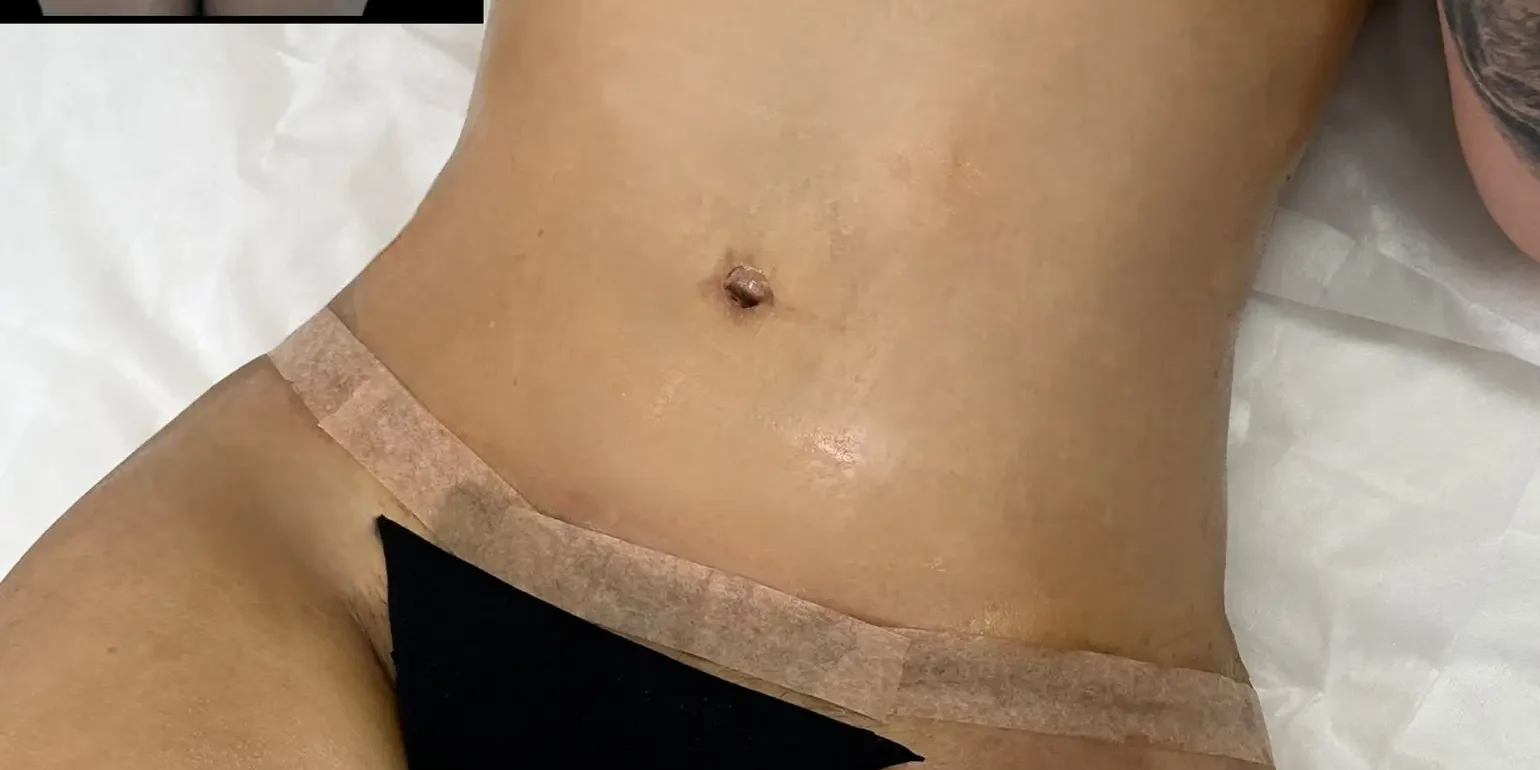
After a cesarean section, many women have two main questions before a Mommy MakeoverWhat will happen to the existing scar and whether the fold that appears just above it can be corrected?
In many cases, the tummy tuck The existing cesarean scar can be used if it is low enough. If the scar is higher than ideal, the new incision is placed as low as possible on the bikini line to remove the old scar along with any excess skin.
The goal is clear: to achieve a single, low, and discreet scar, not two. Furthermore, during the same surgery, the skin fold or "shelf" over the scar can be corrected, and muscle separation caused by pregnancy can be repaired.
The good news: When the cesarean scar is horizontal and located in the usual lower area, it can typically be integrated into the abdominoplasty incision. Instead of creating a separate, second scar, the existing scar is reused and extended laterally as needed for skin resection.
Cesarean section and abdominoplasty scar
Dr. Aslani explains the surgical approach when there is a previous cesarean scar and how its integration is planned within an abdominoplasty or Mommy Makeover.
Are you worried about your C-section scar?
The position of the scar, excess skin, and the lower abdominal fold must be assessed individually. At Cirumed, we review your photographs and anatomy to explain what can be corrected in your case.
Quick facts
Procedure: Mommy Makeover or abdominoplasty after cesarean section.
Cesarean scar: it is used if it is low enough or removed if it is higher than ideal.
Objective of the incision: a single low scar, hidden in the bikini line.
Common problem: fold or “shelf” above the cesarean scar.
Important: Muscle repair treats separation caused by pregnancy, not by cesarean section.
⚡ The essentials — what you need to know
If the cesarean scar is low, it can be incorporated into the abdominoplasty scar.
If the scar is too high, the new incision can be placed lower to remove the old scar.
The goal is to leave a single, low, and discreet scar, not to add a second scar.
The fold over the cesarean scar is usually corrected by removing excess skin and releasing the adhered area.
Abdominal diastasis is caused by pregnancy and can be repaired during the same abdominoplasty.
The final position of the scar depends on the anatomy and how much skin can be safely removed.
Can a Mommy Makeover remove a C-section scar?
In most cases, yes. If the cesarean scar is low enough, it can be used as part of the abdominoplasty incision. If it's higher, the new incision is placed lower, along the bikini line, to remove the old scar along with any excess skin. The goal is usually a single, low, and hidden scar.
Cesarean section, scar and abdomen: what really changes
A cesarean scar can create a small adhesion in the lower abdomen. Over time, the skin and tissue above it may sag and form a visible fold.
Many patients describe it as a small "step," "pouch," or fold above the scar. It doesn't always improve with diet or exercise because it's not just a fat issue: excess skin and the scar pulling the tissue inward also play a role.
An abdominoplasty within a Mommy Makeover can directly address this problem: removing excess skin, releasing the adhered area, repositioning abdominal tension, and planning a final scar as low as possible.
1. The cesarean scar: to use or to remove
The decision depends on the location of your current scar. If the cesarean scar is low and well-placed, it can be used as part of the abdominoplasty incision.
If the scar is higher than ideal, a new, lower incision is planned, usually along the bikini line. This allows the old scar to be removed along with any excess skin.
The goal in both cases is the same: to avoid two scars, leaving only one low, discreet scar that is easy to cover with underwear or a bikini.
In a standard horizontal cesarean section, the scar is usually located in the same low area where the incision for an abdominoplasty is planned. Therefore, in many cases, a new incision is not created above it: the existing scar is reused and extended laterally. If the previous scar is somewhat high, the final scar can be planned lower when the anatomy and the amount of skin to be removed allow it.
Cesarean section vs. abdominoplasty: how the scars are related
The relationship between the two scars depends primarily on their position and orientationThis summary helps explain why a standard horizontal scar usually integrates easily and why a vertical scar needs a different approach.
It usually sits low, at the bikini line. In many cases, it can be reused as part of an abdominoplasty.
The incision is also planned to be low and horizontal. The previous scar can be integrated and extended laterally.
It cannot be incorporated in the same way as a horizontal line. It requires individual planning according to the scar and anatomy.
Cesarean section scar vs abdominoplasty scar
Visual comparison to show how scar planning changes depending on its position and how it can be integrated within an abdominoplasty.
2. The fold over the scar: the cesarean “shelf”
Many women develop a small fold of skin and tissue just above the cesarean scar. This is often called a "C-section shelf."
This fold appears because the scar can pull the skin inward, while the overlying tissue remains looser. Therefore, even if the patient loses weight, the fold may still be present.
Abdominoplasty corrects this problem from its origin: it removes excess skin, releases the adhered area, and smooths the transition of the lower abdomen.

3. Muscle repair: it comes from pregnancy, not from the cesarean section
It's important to differentiate between two things. The scar is from the cesarean section, but the separation of the abdominal muscles is usually caused by pregnancy.
During pregnancy, the abdominal wall stretches to accommodate the growing uterus. This can separate the rectus abdominis muscles and lead to diastasis recti, regardless of whether the delivery was vaginal or by cesarean section.
In a Mommy Makeover, the abdominoplasty can address the scar, underbelly fold, and muscle repair in the same procedure, provided it is safe for the patient.
4. What happens if the cesarean scar is vertical or atypical?
The above explanation applies especially to the cesarean scar horizontal and lowwhich is the most common. A vertical, oblique, or unusually positioned scar cannot be integrated in the same way within a horizontal incision.
In these cases, the plan is decided on an individual basis. The orientation of the scar, the amount of skin that can be removed, the planned position of the new incision, and the most reasonable scarring outcome for that anatomy are all taken into account.
Therefore, an atypical scar does not necessarily preclude an abdominoplasty, but it does require a specific assessment before defining the surgical design.
Cirumed Experience
Cirumed Clinic Marbella regularly works with international patients seeking body contouring surgery, abdominoplasty and Mommy Makeover.
Dr. Alexander Aslani's approach is based on planning each case individually: scar position, amount of excess skin, muscle repair, waistline, and safety of the surgical combination.
In a patient with a previous cesarean section, the goal is not only to improve the scar, but to harmonize the entire lower abdomen within a safe and proportionate result.
What does this mean for you as a patient?
For you, it means that a cesarean scar doesn't have to prevent a good result from an abdominoplasty or Mommy Makeover.
The assessment analyzes whether your scar can be incorporated, whether it should be removed, or whether it is necessary to place the new incision lower to achieve a more discreet final scar.
We also check for any skin folds over the scar, excess skin, or diastasis recti. The final decision depends on your individual anatomy, not a standard template.
Cirumed Principle: We aim for a low and discreet scar whenever it is anatomically safe.
FAQ
In many cases, the existing scar can be incorporated into the abdominoplasty design. If it's low, it can be reused; if it's higher, it can be removed along with the excess skin, and a new, lower scar can be planned when the anatomy allows.
Normally not. When the cesarean scar is horizontal and low, it's often reused as part of the abdominoplasty incision and extended laterally as needed. The goal is to end up with a single, low scar, not to add a second, separate scar.
It is a small fold of skin and tissue that appears over the scar. It usually occurs because the scar pulls the skin inward while the overlying tissue remains looser.
Diastasis recti is usually caused by pregnancy, not by cesarean section. It can occur after both vaginal delivery and cesarean section, and can be repaired during abdominoplasty.
It is placed as low as possible on the bikini line, but the exact position depends on your anatomy and how much skin can be safely pulled back.
In addition to having healed properly, it is best to have finished having children, because a new pregnancy can affect the result, especially muscle repair.
The position or appearance of the scar can often be improved because the old scar is incorporated into the abdominoplasty design, and some of the underlying skin is removed. If the scar is too high, in some cases the final scar can be placed lower. The result depends on each patient's anatomy and healing process.
A vertical scar cannot be integrated in the same way within a horizontal abdominoplasty incision. These cases are planned individually according to the scar's orientation, the available skin, and the abdominal anatomy.
Are you worried about your C-section scar?
Send us your photos via video consultation. The Cirumed team can assess whether your scar can be used, removed, or integrated into an abdominoplasty or Mommy Makeover.




