




Author: Dr. Alexander Aslani
After pregnancy, many women notice that their abdomen doesn't return to its flat state even after weight loss or exercise. In many cases, the problem isn't just skin or fat, but rather the separation of the rectus abdominis muscles, known as diastasis recti.
Rectus plication is the foundation of muscle repair in an abdominoplasty. However, modern surgery goes beyond simply "closing the muscles": it allows the technique to be adapted to each patient's anatomy through wide plication, advancement of the external oblique, mesh reinforcement, or techniques designed to improve muscle quality.
This article explains when muscle repair is needed, what options currently exist, and how it fits within a tummy tuck, a Mommy Makeover or a combined body contouring surgery.
Surgical video: advanced muscle repair in abdominoplasty.
This video shows a surgical example of abdominal wall repair within a abdominoplasty. To maintain good loading performance, we recommend embedding the video with Elementor and enabling delayed loading or cover preview.
Are you considering this procedure?
The decision depends on your health, anatomy, and goals. At Cirumed, we evaluate each case individually to determine which option is safe and realistic.
Quick facts
Procedure: abdominal muscle repair / rectus plication.
Common indications: abdominal diastasis, bulging abdomen and loss of abdominal wall tension after pregnancy or weight changes.
Possible techniques: wide plication, advancement of the external oblique, mesh reinforcement and intramuscular fat infiltration.
It is usually performed as part of: abdominoplasty, Mommy Makeover, or combined surgery.
Key: the exact technique depends on the anatomy and muscle quality of each patient.
⚡ The essentials — what you need to know
Muscle repair is often necessary when there is abdominal diastasis, that is, separation of the rectus muscles.
Rectus plication is the main technique for bringing the muscles closer together and restoring tension to the abdominal wall.
Pregnancy is one of the most frequent causes, because the abdominal muscles stretch to allow the growth of the uterus.
Modern surgery allows for a more extensive and personalized repair than traditional techniques.
In some cases, external oblique advancement can be added to reinforce the corset effect and improve waist definition.
Not all patients need the same technique: the decision depends on the muscle separation, the quality of the tissue and the objectives of each case.
What is rectus plication in an abdominoplasty?
Rectus plication is a surgical technique that brings together abdominal muscles separated by diastasis recti. It is usually performed as part of an abdominoplasty or Mommy Makeover to restore tension to the abdominal wall, improve a protruding abdomen, and strengthen the waistline. In modern surgery, this repair can be tailored to each individual's anatomy.
Why might the abdomen open up after pregnancy?
During pregnancy, the abdomen gradually stretches to accommodate the growing uterus. This process can affect the skin, fat, and deep abdominal muscles. In some women, the rectus abdominis muscles separate and do not fully return to their original position after childbirth.
This separation is known as diastasis recti. It doesn't always correct itself with exercise, because it's not simply a matter of lack of muscle tone. When there is a true separation of the midline, the abdominal wall loses tension and the abdomen may continue to appear bulging even after regaining the weight.
Therefore, in many Mommy Makeover patients, abdominoplasty involves more than just removing excess skin. It can also include muscle repair to restore support and firmness to the abdominal wall.
Are you considering this procedure?
The decision depends on your health, anatomy, and goals. At Cirumed, we evaluate each case individually to determine which option is safe and realistic.
Wide plication: repairing more than a small separation
The plication of the rectus muscles is the basis of the abdominal muscle repairIt consists of bringing the rectus muscles closer together and fixing them to restore tension in the midline.
In older techniques, the repair focused on closing a limited separation. Currently, in suitable patients, a more extensive plication can be performed, working on a larger area of the abdominal wall to achieve a flatter abdomen, greater support, and better waist definition.
The extent of the repair always depends on the anatomy, muscle quality, and the security of the closure. In some cases, if there is significant weakness of the abdominal wall, reinforcement with mesh may be considered.
2. Advancement of the external oblique: the corset effect
In some patients, closing the midline is not enough to achieve the desired waist definition. In these cases, advancement of the external oblique muscle may be considered.
This technique allows the lateral abdominal muscles to be moved towards the midline, creating a corset-like effect. The goal is to improve lateral abdominal tone, slim the waist, and enhance the results of an abdominoplasty.
It does not replace plication when diastasis is present, but it can complement it in selected cases. It is particularly beneficial when combined with 360-degree liposuction or body contouring surgery, provided the patient's anatomy allows it.
3. Intramuscular fat infiltration: when the problem is muscle quality
Not all patients have the same problem. In some, the separation between the muscles is not very wide, but the muscle quality or abdominal wall tension is not optimal.
In specific cases, intramuscular fat grafting into the rectus abdominis muscle may be considered. This technique does not replace plication when diastasis recti is present, but it can serve as a complement when the goal is to improve muscle quality.
It is important not to confuse this technique with fat grafting in the buttocks. Although both use the term "intramuscular," the anatomy is completely different. In the buttocks, intramuscular injection is not safe due to the deep vascular risk. In the rectus abdominis, the anatomical context and safety profile are distinct.
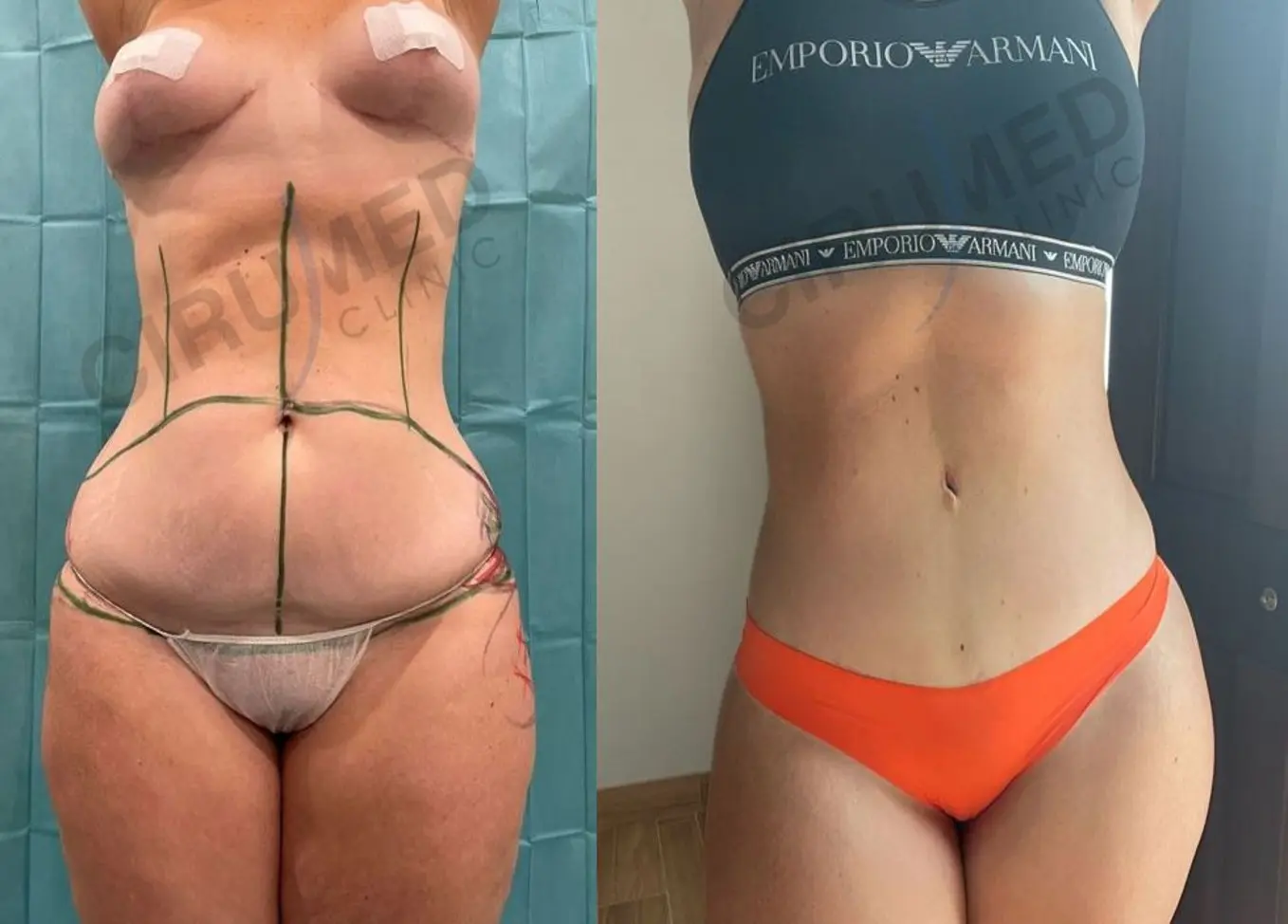
Do you have diastasis recti or a protruding abdomen after pregnancy?
If after pregnancy you notice your abdomen is open, weak or bulging, there may be an abdominal diastasis or a loss of muscle wall tension.
During a video consultation, Dr. Aslani's team can review your case, your photographs, and your goals to advise you on whether you need a rectus plication, a more extensive repair, external oblique advancement, mesh reinforcement, or a combination within an abdominoplasty or Mommy Makeover.
Cirumed Experience
El Dr. Alexander Aslani He is the founder and Medical Director of Cirumed Clinic MarbellaHer practice focuses on body contouring surgery, advanced abdominoplasty, and Mommy Makeover. Lipo 360 and combined body remodeling techniques.
The key is not just performing a plication, but knowing what type of muscle repair each patient needs. The abdominal wall, waist, skin, fat, and lateral musculature must be analyzed as a unit.
Therefore, each case is planned individually, prioritizing safety, proportion, and realistic expectations.
What does this mean for you as a patient?
For you as a patient, this means that muscle repair shouldn't be approached as a one-size-fits-all, standard technique. Two women can have similar symptoms after pregnancy and require different approaches.
One patient may only need to approximate the rectus muscles. Another may require a more extensive plication. Another may benefit from a corset effect by advancing the external oblique. And in some cases, the main problem may be more related to muscle quality than to the exact distance between the muscles.
The goal is not only to close the diastasis, but to reconstruct the abdomen in a balanced, safe, and consistent way with the rest of the body contour.
Cirumed Principle: Safety always determines the indication, never convenience.
FAQ
Yes. During pregnancy, the abdominal wall stretches to accommodate the growing uterus. In some women, the rectus abdominis muscles separate and do not fully return to their original position after childbirth. This separation is called diastasis recti and may require surgical repair.
Rectus plication is the cornerstone of abdominal muscle repair. It involves bringing the separated muscles together and fixing them to restore tension to the abdominal wall. In modern surgery, it can be performed more extensively or combined with other techniques.
Not always. It's performed when there's diastasis recti or loss of muscle tone that warrants it. Some patients only need skin and fat removed, while others require complete muscle repair.
Yes. It can be more limited, more extensive, or combined with techniques such as external oblique advancement or mesh reinforcement. The choice depends on the anatomy, muscle quality, and goals of each patient.
It is an advanced technique that shifts the lateral abdominal muscles toward the midline to create a corset-like effect. It can improve waist definition and complement abdominal plication in selected patients.
In expert hands and with proper patient selection, yes. As with any combined surgery, safety depends on planning, technique, control of surgical time, and adequate recovery.
Do you want a personalized assessment?
Dr. Aslani's team will review your case and explain which options are safe and realistic for your anatomy.




