

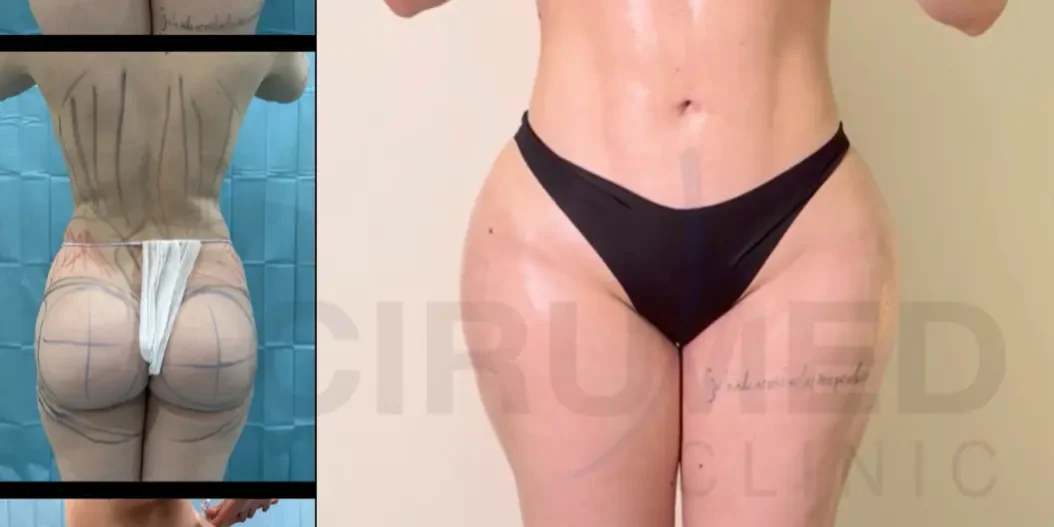
Leg thickness and hourglass shape are more related than many patients imagine. In a BBL, it's not enough to simply decide how much volume to add to the hips or buttocks: the final width must be in proportion to the thighs and the rest of the body.
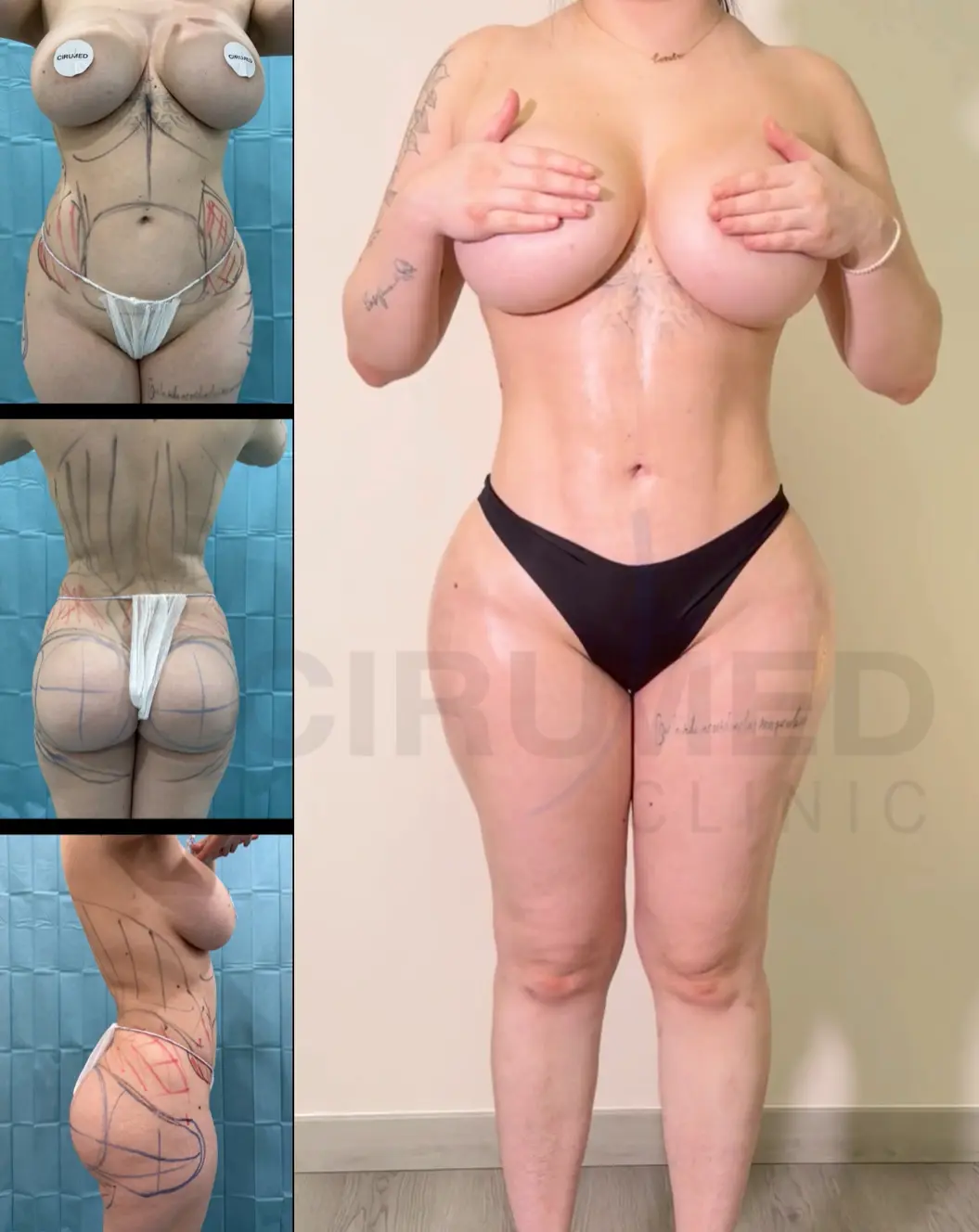
This clinical case demonstrates why relatively strong legs allowed for the creation of wider, more rounded hips without making the upper body appear heavy. The goal was not to maximize volume, but rather to create a seamless transition between waist, hip, buttocks, and thigh.
Before and after: the hip-to-leg ratio is the core of the case
Quick facts about the case
Objective
Key factor
Procedure
Main idea
Why leg thickness influences hourglass shape
An hourglass figure relies on the contrast between a narrower waist and wider hips, but that contrast doesn't end at the hips. Visually, the eye continues the line up to the thigh. That's why very wide hips on very thin legs can appear disconnected from the rest of the body.
Conversely, when there is sufficient volume and structure in the thighs, a more rounded hip can be integrated more naturally. The planning process doesn't aim for all patients to achieve the same width, but rather to find the point where the waist, hips, buttocks, and legs function as a single silhouette.
The hip-thigh line: a proportion that is also studied in literature
Modern gluteal cosmetic surgery does not evaluate the buttocks in isolation. A publication on gluteal contouring already pointed out that its visual frame is determined by the hips, thighs and lower backFurthermore, a specific study on thigh aesthetics analyzed how the relationship between thigh and buttocks affects the perception of the result and found a preference for wider and more continuous transitions between both areas.
This reinforces an important planning concept: increasing hip width without considering thigh width can disrupt the continuity of the silhouette. That's why at Cirumed, lateral width is determined based on each patient's complete anatomy, not on a specific centimeter measurement or standard volume.
Study on thigh aesthetics and gluteal augmentation · Publication on gluteal contour and adjacent anatomical units
When the legs are very thin, excessively wide hips can create a lack of harmony.
During a consultation, one of the most important decisions is determining how far to increase lateral width. In a patient with very thin legs, taking the hips to one extreme can create excessive contrast: too much volume at the top and little continuity below.
This effect doesn't mean that a thin patient can't achieve an hourglass figure. It means that the degree of expansion must be adapted to her body structure. The priority is to achieve a balanced curve, not to reproduce the same silhouette on every body.
stronger legs
Very thin legs
Individual planning
Why this patient was able to have a more pronounced hourglass shape
This patient had an anatomical feature that was favorable for the desired result: her legs were thick enough to complement her very rounded hips. This allowed for a wider lateral area to be augmented without the result appearing to be placed on overly narrow legs.
In other words, the aesthetic goal and the anatomy were compatible. The projection and width could be increased because the lower body maintained a consistent proportion. This anatomical compatibility is one of the reasons why two patients requesting "the same BBL" may require completely different plans.
What did the Supercharged BBL contribute in this case?
The procedure was a Supercharged BBLA combination of gluteal implants and the patient's own fat. The implant provides a stable base for projection, while the fat allows for smooth transitions, rounding of the hips, and adaptation of the contour to the patient's anatomy.
In a patient seeking a pronounced hourglass figure, the challenge lies not only in projecting the buttocks backward. It's also necessary to control lateral width, the waist-to-hip ratio, and continuity with the thigh. Therefore, the treatment plan is developed as a comprehensive body contouring treatment.
What does this mean for a patient who wants more hip size?
If your goal is a very defined waist and rounded hips, the question shouldn't just be "how much volume can I add?". A proper assessment should analyze how much volume your body can incorporate without disrupting the proportions with your legs.
Having thin legs does not prevent you from doing a BBLYou can simply change the design: the amount of lateral expansion, the areas where the fat is placed, and the degree of projection should be adapted to your structure. Similarly, stronger legs can allow for a more graphic silhouette without losing continuity.
The most suitable result is the one that seems to belong to your body, not the one that exactly reproduces the measurements of another patient.
How to plan the relationship between waist, hip and leg
1. Waist
2. Hip
3. Gluteus
4. Legs
There is no single ideal ratio for all patients
Studies on gluteal aesthetics show that the perception of an attractive result depends on several simultaneous elements: waist and hip width, projection, musculature, subcutaneous fat, and relationship with neighboring structures. A comparative study using photography, anthropometry, and magnetic resonance imaging found that buttocks considered aesthetically pleasing combined, among other factors, a narrower waist, wider hips, and greater development of the gluteus maximus.
This data is useful as an anatomical reference, but it should not be considered a universal formula. Surgical planning must take into account each patient's height, pelvis, fat distribution, musculature, thighs, and individual preferences.
See study on anatomy and characteristics of buttocks considered aesthetically favorable
The key: the hip doesn't end where the leg begins
The width of the hips should be in proportion to the thickness of the legs. In this case, relatively strong legs allowed for a wider and more expressive hourglass shape to be created without the result losing balance.
This doesn't mean that thicker legs are "better" or that thin legs are a problem. It means that the design has to be adapted to the anatomy. Body contouring surgery works best when it enhances existing proportions rather than imposing an identical shape on different bodies.
Related reading
These pages expand on related concepts without changing the main focus of this case: how leg thickness influences hip width, which can be harmoniously integrated.
BBL Buttock Augmentation
See BBL buttock augmentation
Supercharged BBL
See Supercharged BBL
Leg contour
Read about leg contouring
FAQ
Does leg thickness affect how much the hips can be widened?
Can I achieve an hourglass figure if I have thin legs?
What is the relationship between hip and leg in a BBL?
Why was this patient a good candidate for a very pronounced hourglass shape?
What is a Supercharged BBL?
Can all patients achieve the same hip width?
Personalized planning with Dr. Alexander Aslani
This case is part of Cirumed Clinic Marbella's clinical experience in body contouring and buttock augmentation surgery. The photographs show an individual result and do not guarantee that another patient will achieve the same shape or volume.
In the assessment, Dr. Aslani studies the relationship between waist, pelvis, hip, buttocks and legs to define what degree of projection and width can be proportionately integrated into each anatomy.