




La revision surgery for failed buttock implants It is one of the most complex areas of gluteal surgery. When implants are visible, palpable, displaced, or placed in the wrong anatomical plane, the problem ceases to be merely aesthetic. It becomes a structural failure requiring specialized reconstruction.
This case illustrates an extreme situation: a patient came to Cirumed with both gluteal implants clearly visible through the skin, severe contour deformity, physical discomfort, and significant psychological distress. The solution was not a quick implant replacement, but a staged gluteal reconstruction, performed in two surgeries six months apart.
If your case is not limited to failed buttock implants and you are looking for a complete correction of a previous buttock augmentation, you can read our page on BBL revision surgery in Cirumed.Quick tips: the most important things you need to know
- Severe buttock implant failures cannot be corrected like a buttock augmentation with implants primary.
- An implant placed superficially to the gluteal muscle is a structural failure, not an acceptable technical variation.
- When implants are visible, it is usually necessary to remove them, allow tissue recovery, and then reconstruct.
- Fat grafting can improve tissue quality even when available volume is limited.
- In extreme cases, a two-stage strategy is safer and more predictable than trying to solve everything in a single surgery.
Clinical case: visible and failed gluteal implants corrected by staged revision surgery.
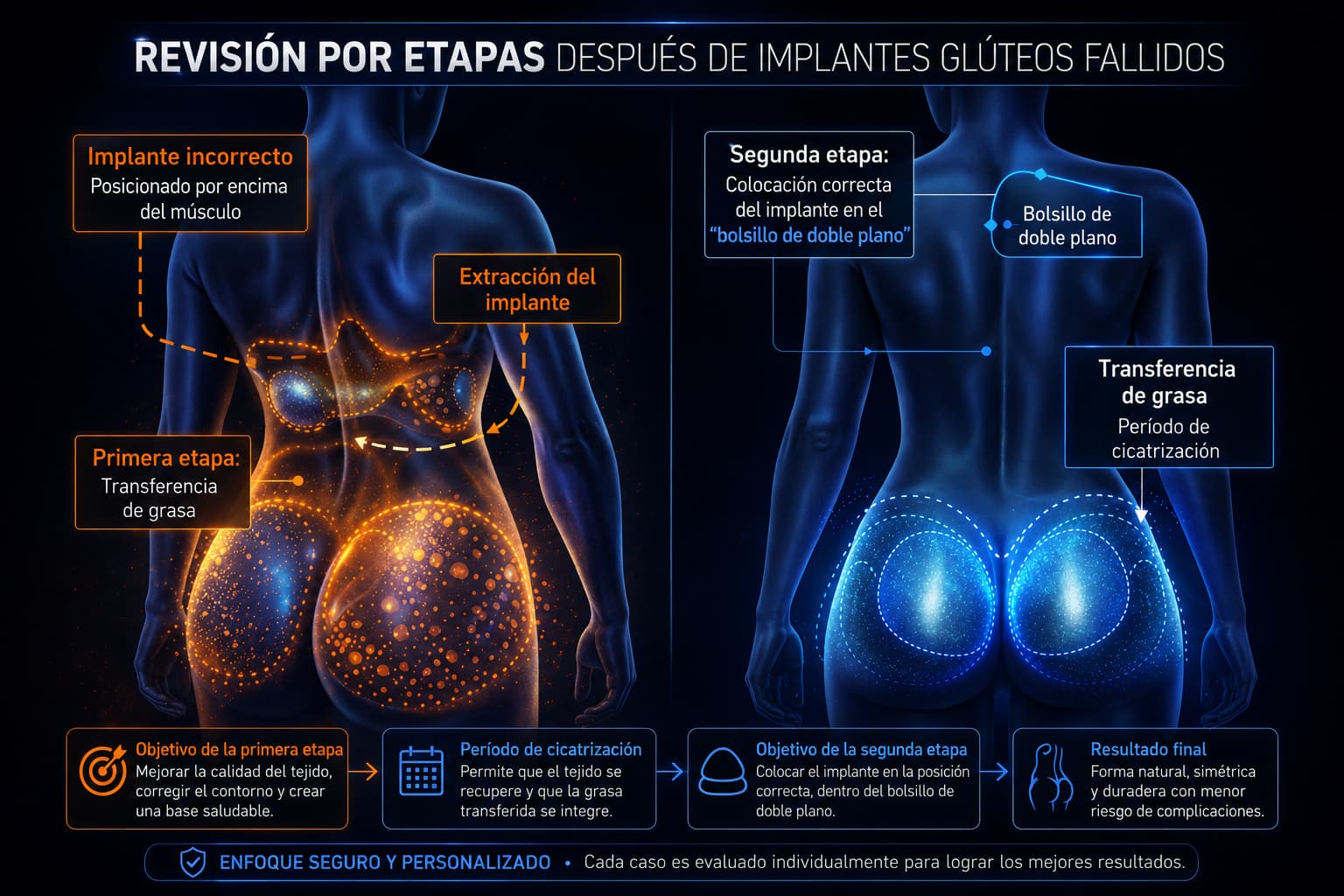
Diagram: failed gluteal implants located in an unsafe plane or with insufficient coverage.
The problem that almost no one talks about openly
The failure of a buttock augmentation with implants is one of the least discussed complications in cosmetic surgery. Many patients who have previously undergone surgery at other centers spend years searching for a surgeon who will honestly assess their case and not promise a quick fix when the tissue is already compromised.
In this case, the deformity was evident. Both implants were visible and palpable through the skin. The contour was rigid, angular, with sharp edges and virtually no soft tissue coverage. The patient also experienced discomfort, functional limitations, and significant emotional distress from living with an unsafe and unnatural result.
Why it's not just a simple implant change
When implants are visible through the skin, the problem is usually not just the size or shape of the implant. It typically indicates tissue thinning, scarring, poor surgical pocket creation, and loss of secure anatomical support. Therefore, before deciding on a new technique, it's important to fully understand the differences between various procedures. BBL with or without implants.
Why buttock implants fail differently than breast implants
The gluteal implants They must be placed within or beneath the gluteal muscle. They should never be superficial, lying under the skin. This is not an aesthetic preference, but a biomechanical necessity.
The gluteal region endures constant mechanical stress: pressure from sitting, forces from walking, and continuous tissue movement. Techniques that may be acceptable in certain breast augmentation scenarios are not transferable to the buttocks. A shallow or poorly defined pocket can lead to implant visibility, palpable edges, displacement, and long-term deformity.
In this patient, it was not possible to determine with certainty whether the implants had initially been placed in a subcutaneous plane or whether they had herniated from a poorly created intramuscular pocket. However, the clinical finding was clear: functionally, the implants were in a plane incompatible with a safe, stable, and aesthetically pleasing outcome.
What made this case extreme?
Standard revision techniques were insufficient. In mild cases, the pocket position can be corrected, coverage improved with fat grafting, or the implant adjusted. However, this patient presented with severe tissue compromise, scarring, implant visibility, and virtually no coverage.
Clinical findings
- Both implants are visible through the skin
- Very defined implant edges
- Extremely thin soft tissue coverage
- Severe deformity of the gluteal contour
- Pain, discomfort, and psychological distress
Objectives of the review
- Remove unsafe implants
- To allow tissue recovery
- Improve the quality of coverage
- Create a new secure pocket
- Restore a natural gluteal contour
For this reason, the responsible strategy was to perform a two-stage gluteal implant removal and reconstruction. In patients who still have good coverage, a more limited strategy may suffice, but in extreme cases, safety must be the priority.
Why not correct everything in a single surgery?
Attempting to remove failed implants, close damaged pockets, create new pockets, and insert new implants in a single surgery can be dangerous when tissues are severely compromised. The area undergoes dissection, mechanical tension, and vascular stress simultaneously.
This “two-front war” increases the risk of wound dehiscence, seroma, muscle ischemia, new malposition, and long-term instability. In the correction of visible gluteal implants, patience is not optional. It is essential for safety.
Key surgical principle
First, the tissue is recovered. Then it is reconstructed. In complex revision surgery, the biological basis must be respected before attempting to restore aesthetics. This logic also explains why choosing between BBL, implants or hybrid technique It always depends on the actual anatomy of each patient.
Are you living with visible or failed buttock implants?
The first step is an honest assessment to determine if your case can be corrected in a single operation or if a staged surgery is safer.
First surgery: removal of implants, cleaning of the pocket and tissue recovery
The first procedure focused exclusively on removing the failed implants and cleaning the damaged pockets. No new implants were placed at this stage. This decision was essential to reduce stress on the tissues and allow the gluteal region to recover biologically.
Although the patient had limited donor fat, an autologous fat graft was performed. The goal was not only to add volume. In secondary surgery, the fat can improve tissue quality, reduce some skin redundancy, and provide a more favorable surface for future reconstruction.
Following the initial surgery, a mandatory six-month recovery period was prescribed. This interval allows for the swelling to subside, blood flow to normalize, and the internal scar tissue to mature. Shortening this timeframe could compromise the final result.
Second surgery: definitive reconstruction with a new secure pocket
Six months later, the final reconstruction was performed. A completely new pocket was created using a controlled, dual-plane technique, developed and published by the Dr. Alexander AslaniThis technique aims to provide muscle coverage, implant stability, and long-term structural support.
The end result was a significant transformation: the edges of the implants were no longer visible, the gluteal contour became smooth and natural, and the patient reported physical improvement and psychological relief. In reconstructions of this type, experience with techniques such as the Supercharged BBL and hybrid growth may be especially relevant.
First time
Removal of failed implants, pocket cleaning and fat grafting to improve tissue recovery.
Recovery period
Six months to allow inflammation, vascularization, and internal scarring to stabilize.
Second time
Creation of a new surgical pocket and definitive gluteal reconstruction.
end goal
Secure coverage, smooth contour, stable position and natural projection.
Is staged buttock revision surgery right for you?
Not all patients with implant problems require two-stage surgery. Some cases can be corrected in a single procedure. However, when there is severe tissue thinning, visible margins, or significant pocket failure, a staged approach is usually safer.
It usually benefits from staged surgery.
- Implants visible or palpable through the skin
- Implants in an incorrect anatomical plane
- Thinning or severe scarring
- Previous failed review attempts
- Priority for long-term security and stability
A simpler correction may suffice
- Moderate asymmetry without tissue involvement
- Small pocket problems without displacement
- Good soft tissue coverage
- Implants not visible through the skin
- Realistic expectations about the limits of a review
The role of fat grafting in the revision of failed gluteal implants
Fat grafting is an important tool in secondary gluteal surgery. Even when available fat is limited, it can improve tissue smoothness, camouflage irregularities, and promote the biological recovery of compromised skin and scars.
In some patients, reconstruction can be combined later with a type of approach buttock augmentation (BBL)In other cases, especially when donor fat is scarce, implants are still necessary to achieve significant projection. The correct strategy depends on the anatomy, tissue quality, and aesthetic goal.
In selected cases, a hybrid surgery with smaller implants may also be considered, as occurs in some procedures of Supercharged BBL with small implantsor with high-projection implants when the anatomy requires it.
Main point
In revision surgery, fat is not only used to add volume. It often serves as a reconstructive tool to improve the tissue environment before the final correction.
Why experience matters in secondary buttock augmentation surgery
Secondary buttock augmentation requires different planning than primary augmentation. The surgeon must assess scarring, tissue thickness, pocket integrity, implant position, and the patient's expectations before recommending a strategy.
A proposed "quick fix" for a severe deformity, without a thorough tissue assessment, should be considered a red flag. Complex gluteal revision requires expertise in implant removal, pocket reconstruction, fat grafting, and long-term stability.
When the goal is to reconstruct shape and projection, a large implant isn't always necessary. In some cases, a buttock augmentation with small implant or an approach of high-projection buttock implants It may be sufficient if the anatomy allows it.
Dr. Alexander Aslani — Cirumed Clinic Marbella
- More than 16 years of specialized practice in gluteal surgery.
- More than 7.000 buttock procedures performed.
- Co-developer of the double plane technique for gluteal augmentation.
- Technique published in international scientific journals.
- Experience in complex secondary gluteal surgery and salvage reconstruction.
Have you had failed buttock implants?
The first step is knowing what is actually possible. In some cases, a single-stage correction may be sufficient. In others, a staged buttock surgery is the safest path to a stable and natural result.
Video consultations available for international patients.
Frequently asked questions about failed buttock implants
Can failed buttock implants always be corrected?
In most cases, yes. However, the complexity depends on the severity of the problem. Mild asymmetry or a small pocket adjustment can be corrected in a single surgery. In contrast, visible implants, severe scarring, and compromised tissue usually require staged surgery.
How long does a two-stage gluteal exam take?
The entire process typically lasts between 7 and 9 months. The first surgery involves removing the implants and preparing the tissues. This is followed by an approximately six-month recovery period before the final reconstruction is performed.
Is fat grafting necessary if I only want to remove the implants?
Not always. However, in cases of severe tissue thinning, fat grafting can improve the quality of coverage, reduce irregularities, and prepare better conditions for future reconstruction.
Will I need new implants in the second surgery?
It depends on your anatomy, the amount of donor fat available, and your goals. Patients with little fat often need implants to achieve projection. If there is enough fat available, a fat-only reconstruction can be considered.
How do I know if my surgeon can handle a complex buttock revision?
Look for demonstrable experience in high-volume gluteal surgery, revision cases, published techniques, and honest communication about treatment limitations. Revision surgery is not the same as primary gluteal augmentation.
Can visible buttock implants be corrected in a single operation?
Sometimes yes, but not in severe cases with thin tissue, significant scarring, or risk of exposure. Attempting a one-stage correction when tissues are damaged can increase the risk of dehiscence, seroma, and re-malposition.
What alternative is there if I don't want to get implants again?
In some cases, a BBL (Brazilian Breast Lift) using the patient's own fat may be considered, but this depends on the amount of fat available and the degree of deformity. When the patient has little donor fat or requires significant projection, it may be necessary to combine fat and implants to reconstruct the shape.




