




Know when not to get buttock implants It's just as important to know when to do it. This patient came to our clinic assessed as a candidate for implants. After the anatomical evaluation, we recommended against them, and the final result was superior to what implants would have provided. Below, we explain the complete clinical reasoning.
The essential things you need to know
- This patient came to the consultation having been assessed as a candidate for gluteal implants. After the anatomical evaluation, we recommended against them.
- Combining aggressive liposuction of the lower back with buttock implants carries a risk of scarring that is frequently underestimated in surgical planning.
- Aggressive liposuction of the lumbar region generates a very powerful secondary projection, making implants structurally unnecessary in the correct anatomy.
- Un BBL without implantsExecuted with precision, it produced a silhouette transformation that implants would have complicated rather than improved.
- The best surgical result does not come from adding more; it comes from choosing the correct technique for the individual anatomy.
Case summary Dr. Alexander Aslani, Cirumed Clinic Marbella
The consultation: a patient who was waiting for implants
Most of the patients who visit us for body contouring have already formed an opinion about what they need. They've researched procedures, watched videos, and arrive with a clear direction in mind. In many cases, that direction is correct. In some, it isn't.
This patient came in with a clear goal: a more projected and voluminous buttocks. Her anatomy made her a plausible candidate for buttock implants on paper. She expected to leave the consultation with an implant plan.
She came up with a different plan and a better result. Understanding why requires understanding a risk that rarely comes up in conversations with patients: the incompatibility between aggressive liposuction and buttock implants in the same surgical session.
The risk of scarring: when not to place buttock implants in the same session
Buttock implants are placed through an incision in the central crease between the buttocks. This is a surgically demanding area: it is under constant tension with movement, accumulates moisture, and the surrounding tissue has a comparatively poor blood supply compared to other implant placement sites in the body.
When aggressive liposuction is added to the same surgical field, especially in the lumbar region, flanks, and lateral gluteal area, the risk profile changes significantly. The mechanism is as follows: extensive liposuction in the lumbar and lateral gluteal areas disrupts the small blood vessels that nourish the skin in that area. This creates an area of reduced blood flow precisely in the tissue that is supposed to heal around the incision and implant cavity.
⚠ High risks when combining aggressive liposuction with buttock implants
- Wound dehiscence: The incision reopens under tension because the tissue does not have enough blood supply to heal.
- Delayed healing: prolonged healing that increases exposure time and the risk of infection
- Seroma and fluid accumulation: altered drainage in the treated area
- Implant exposure: In severe cases, failure to heal may cause the implant to become visible or require removal.
Why this matters in your surgical plan
This is not a theoretical risk. It is a documented complication pattern that occurs specifically when surgeons attempt to perform both procedures in the same session without considering the vascular demands of each. The ambition to do everything in a single session can directly compromise the safety of both outcomes. Proper patient selection and honest communication are what prevent it.
Secondary projection: what liposuction can achieve that implants can't
Secondary projection is the visual enhancement of the buttocks created not by adding volume to the buttocks themselves, but by removing volume from the surrounding structures. When the lumbar region is aggressively and precisely sculpted, the lower back, flanks, and the area immediately above the sacrum make the buttocks appear to project further back, even before a single milliliter of fat has been transferred.
This occurs because projection is a relative measurement. The eye perceives gluteal projection in relation to the contour of the lumbar region behind and above it. A deeply sculpted lumbar region creates a visual drop that makes the buttocks stand out prominently, not because the buttocks have grown, but because the surrounding frame has receded.
Why secondary projection changes the equation
Aggressive liposuction of the lower back creates a visual recession above the buttocks, amplifying the perceived projection. The same volume of transferred fat appears much larger when the lower back is well-sculpted than when it is not.
In patients with suitable anatomy, secondary projection alone can surpass the benefits of an implant without any of the associated scarring risks. Therefore, the combination of powerful secondary projection plus fat transfer is the most effective implant-free strategy available.
The anatomical assessment that changed the plan
In this case, the anatomical evaluation revealed several key factors that shifted the recommendation away from implants:
- Sufficient donor fat: Not abundant, but sufficient for a well-directed implant-free procedure with strategic placement
- Favorable lumbar anatomy: Sufficient malleable tissue in the lumbar region and posterior flank would generate a powerful secondary projection
- Skin quality and elasticity: suitable for the planned level of change
- Risk of implant cavity: The evaluation of the intergluteal area indicated that adding implant tension to an already planned extensive liposuction would create an unacceptable risk of scarring.
The conclusion was clear: this patient would achieve a better, safer result with aggressive liposuction of the lower back combined with targeted fat transfer without implants. The challenge was communicating this to a patient who had come in expecting implants. That conversation, explaining not only what we recommended but also why implants would have compromised her outcome, is precisely the kind of transparency that defines honest surgical practice.
The procedure: what was done and why
Phase one: aggressive liposuction of the lumbar area
The first priority was to maximize secondary projection through precise, high-volume liposuction of the lumbar region, posterior flanks, and lumbar triangle. This phase required the type of aggressive tissue reduction that would have been inadvisable in conjunction with implant placement precisely because it disrupts the vascular supply to the overlying tissue.
The sculpting was guided by anatomy: deeper reduction in the lumbar depression above the sacrum to create maximum visual descent; gradual lateral reduction to avoid contour irregularities; preservation of the surface layer directly over the sacrum to maintain a smooth skin contour.
Phase two: targeted fat transfer
The fat obtained during liposuction was processed and transferred to the gluteal region using the EVL Expansion Vibration Lipofilling technique, which optimizes the viability of fat cells during transfer and allows for more precise distribution at the recipient site.
The transfer was designed not to maximize volume, but to maximize shape: emphasis on the upper pole of the gluteus, the lateral convexity of the hip, and the lower crease to create a rounded, projected dome. The goal was not a larger buttock, but one with the correct shape, working in synergy with the secondary projection created in phase one.
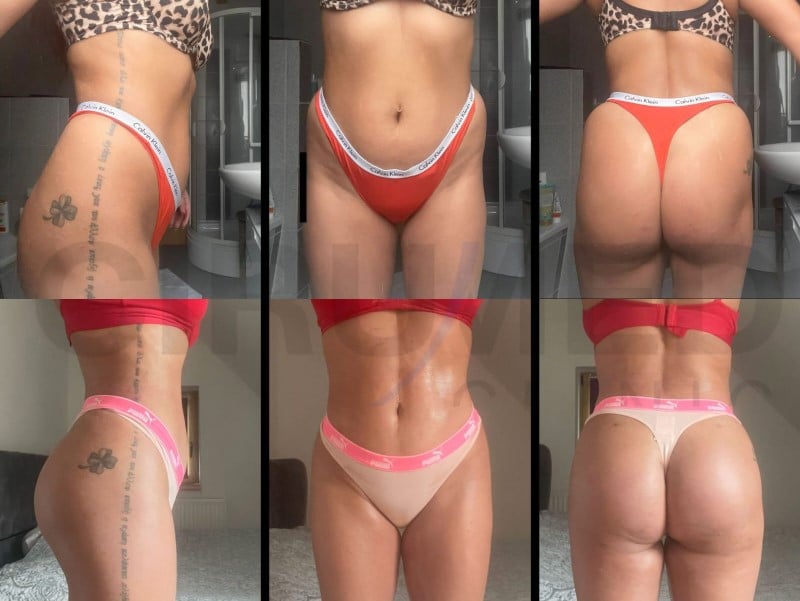
Surgical result at two weeks — BBL without implants with aggressive liposuction of the lumbar area
The result after two weeks: already visible
Two weeks post-surgery, the structural effect of the strategy was already clearly visible. At two weeks, inflammation is still present and the fat graft has not yet fully settled, so the final result will be more refined. However, the architectural decision—the secondary projection created by the lumbar sculpting—is clearly evident even at this early stage.
Signs of a properly executed non-implant strategy at two weeks
- Deeply sculpted lumbar region creating powerful secondary projection
- Gluteal projection amplified by the recession of the surrounding area
- Natural contour without the firmness associated with implants or the visible step at the upper pole
- Clean healing because the surgical plan was designed taking into account tissue perfusion
This is what anatomically tailored surgical planning looks like. Not the most popular technique applied to each patient—but the most appropriate technique identified for that specific anatomy.
When not to get buttock implants and when they are the right choice
This case is not an argument against buttock implants. They are the right choice in many situations, especially for patients with insufficient donor fat for a transfer with real volume, or for those seeking a structural projection that fat alone cannot reliably achieve. Supercharged BBLThe procedure, which combines implants with fat transfer, remains one of the most powerful tools in body contouring for the right patient profile.
The argument in this case is more specific: implants and aggressive liposuction are not always compatible in the same session, and patient selection must take this interaction into account. A patient who is a volume candidate for implants may also be an anatomical candidate for implant-free surgery—and in that scenario, choosing the simpler, lower-risk approach is not a compromise. It's precision.
See also: BBL with or without implants, which is better?
BBL without implants is usually superior when:
- There is enough donor fat for a transfer with a realistic result.
- The lumbar anatomy allows for powerful secondary projection
- Aggressive liposuction is planned for the same session.
- The patient prioritizes a natural result and an easier recovery.
- The risk of scarring from the combined procedure is high
Supercharged BBL implants are usually superior when:
- Insufficient donor fat for bulking goals
- The aim is to achieve a stable structural projection that is independent of weight.
- The potential for secondary projection in the lumbar region is limited.
- The liposuction plan is conservative and the risk of scarring is low.
- Very thin patient where fat transfer alone is not enough
Experience in surgical planning tailored to anatomy
Dr. Alexander Aslani Cirumed Clinic Marbella
- More than 16 years of experience in gluteal surgery and Brazilian Body Contouring
- 7.000+ BBLs performed without implants, hybrid procedures, and with implants
- Co-developer of the double plane gluteal augmentation technique (PRS, 2023)
- Contributing member of ASERF Task Force on Gluteal Fat Grafting Safety
- Publications in PRS, Aesthetic Surgery Journal, PRS Global Open and Clinics in Plastic Surgery
Deciding which technique is right for a given anatomy requires as much experience as performing it—perhaps even more. The willingness to recommend a simpler, lower-risk approach when it produces the best result is a sign of surgical judgment, not limitation.
The conclusion: more is not always better.
This case illustrates a principle that applies to all body contouring surgery: the best result doesn't come from using the most powerful technique available. It comes from identifying the technique most precisely suited to the anatomy in front of you.
Buttock implants would have added risk to this patient's surgical plan without improving her outcome. Aggressive liposuction of the lower back created secondary projection that implants could not have corrected. Fat transfer completed the shape that the liposuction began.
Two weeks after surgery, the strategy is already visible. The result will only improve as the healing process progresses, built on a foundation properly planned from the beginning.
Not sure if you need implants, fat transfer, or a combination approach?
The answer depends on a structural assessment, not a list of procedures. We'll tell you honestly which approach will give you the best results for your anatomy. At Cirumed Clinic Marbella, we offer initial video consultations for national and international patients, including an honest evaluation of whether implants, fat transfer, or a combination of both is truly the right option for you.
Request an assessment →No commitment required. Also available for international patients.
FAQ
When not to get buttock implants: frequently asked questions
When should buttock implants not be used?
Buttock implants are not recommended when aggressive liposuction of the lower back and flanks is planned in the same session. Extensive liposuction in this area disrupts the blood vessels that nourish the tissue around the implant incision, significantly increasing the risk of wound dehiscence, slow healing, and implant complications. Furthermore, patients with sufficient donor fat and favorable lumbar anatomy for strong secondary projection often achieve better results with a BBL without implants — with less surgical risk and a more natural result.
What is secondary screening at the BBL?
Secondary projection is the visual enhancement of the buttocks created by removing volume from the structures surrounding the buttocks, especially the lumbar region, rather than adding volume to the buttocks themselves. When the lumbar region and posterior flanks are aggressively sculpted, the buttocks appear to project more because the surrounding framework has receded. In the right anatomy, secondary projection from lumbar liposuction can match or surpass the visual effect of a buttock implant, without the associated risks of scarring.
Can a BBL without implants give as much projection as with implants?
In the correct anatomy, yes. When a patient has sufficient donor fat and strong secondary projection potential in the lumbar region, a BBL without implants When performed precisely, this technique can produce a projection that equals or surpasses what implants would have provided, with a more natural result and an easier recovery. This is not the case for all patients; those with insufficient fat or limited secondary projection potential benefit most from this approach. Supercharged BBL.
Regarding the procedure and recovery
What is the risk of scarring when combining liposuction with buttock implants?
Buttock implants are placed in the central crease between the buttocks—an area under constant tension and with a relatively poor blood supply. When extensive liposuction is performed on the lumbar and lateral gluteal areas in the same session, the blood vessels that nourish this tissue are disrupted, increasing the risk of wound dehiscence, slow healing, seroma, and, in severe cases, implant exposure. Careful patient selection and honest surgical planning are the primary safeguards against this pattern of complications.
What is the EVL technique used in this case?
EVL stands for Expansion Vibration Lipofilling, a fat transfer technique that optimizes fat cell viability during transfer by combining vibration-assisted extraction with controlled injection speed and pressure. It uses 4mm blunt cannulas and multiple low-volume passes instead of bolus injections, improving blood flow to the graft and increasing survival rates. Dr. Aslani's EVL technique is published in the journal Plastic and Reconstructive Surgery.
How do I know if I need implants or just fat transfer for my BBL?
The decision depends on your specific anatomy, primarily the volume of donor fat available, the possibility of sculpting your lower back, and the scarring implications of the planned liposuction. It cannot be accurately determined through a list of procedures or internet research. A structural evaluation with an experienced surgeon will identify which approach produces the best result for your anatomy, including whether a combined approach such as liposuction is indicated. Supercharged BBL.




