

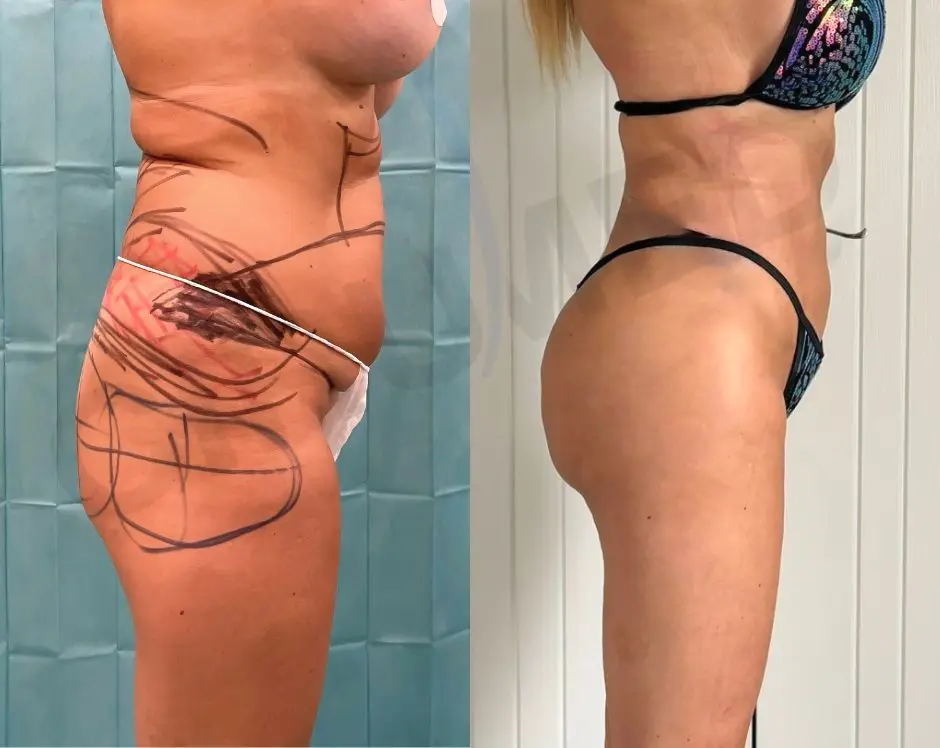
Transforming V-shaped buttocks into an open A-shape is not simply about adding more volume. In this clinical case, the starting point combined a relatively wide rib cage, inward-sloping hips, V-shaped buttocks, and prominent flank fat. The goal was to change the overall visual architecture of the lower body.
The planning was done in two surgical stagesThe first surgery reconstructed the waist base, torso and first gluteal expansion and, once the result was stabilized, a second BBL session allowed for a more marked expansion of the lateral and lower gluteal area.
This article is not a general guide on inverted triangle nor about a second BBL. The focus is specific: How a two-stage transformation of the buttocks from V-shape to A-shape was planned.
Quick facts about the case
Point of departure
Objective
First stage
Second stage
V-shape and A-shape: why geometry matters
The literature on gluteal contouring typically classifies posterior shapes into patterns such as A, V, round and squareThis classification is not just descriptive: it helps to plan which areas should be reduced and which need to gain volume.
In a V-shape, the visual width is concentrated higher up, and the contour narrows towards the bottom. In an A-shape, the opposite occurs: the hip and lower buttock area opens laterally. Reviews of buttock contouring also indicate that V-shaped and square shapes are often more difficult to reshape because the result depends on the relationship between the waist, hip, lateral thigh, and buttocks, not solely on the volume transferred.
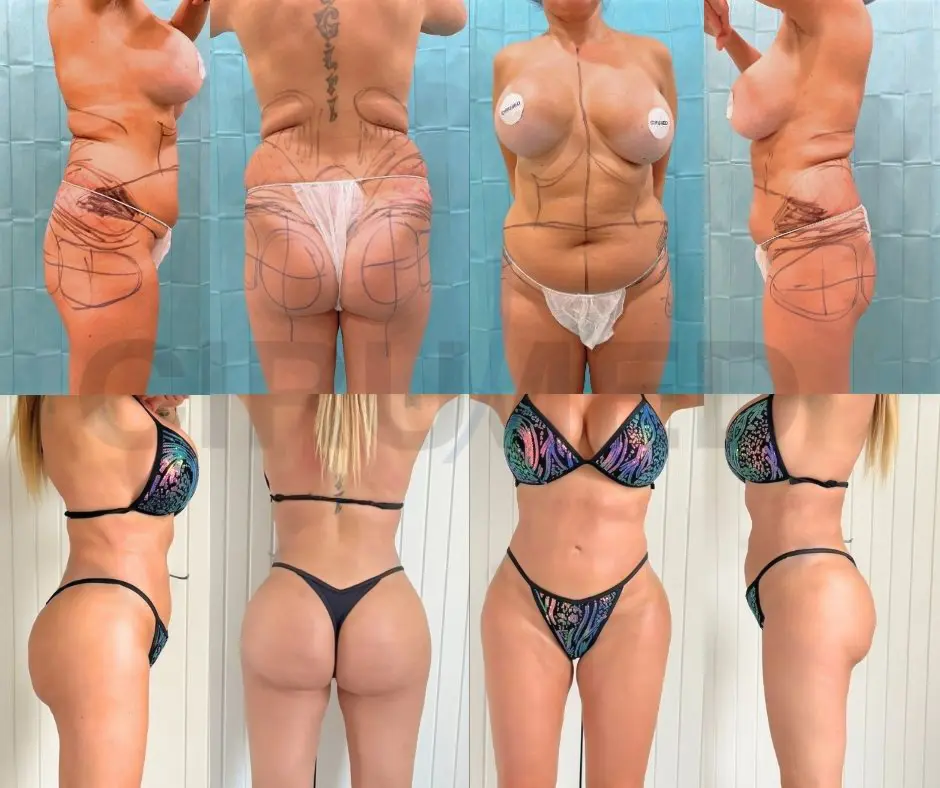
Why this starting point was especially difficult
Three elements were at work simultaneously. First, a relatively wide ribcage visually increased the weight of the upper body. Second, the V-shaped buttocks featured inwardly sloping hips, so the silhouette narrowed precisely where greater openness was desired. Third, the love handles They erased the waistline and further reinforced that V-shaped reading.
Individually, each of these factors can be addressed. Together, they force us to think of the body as a system of proportions: reducing the waist and torso, slimming the flanks, and adding volume precisely where the shape needs to open up.
Therefore, in this case, adding fat without first modifying the body frame would not have been enough to achieve a true V→A transformation.
Before, first stage and final result
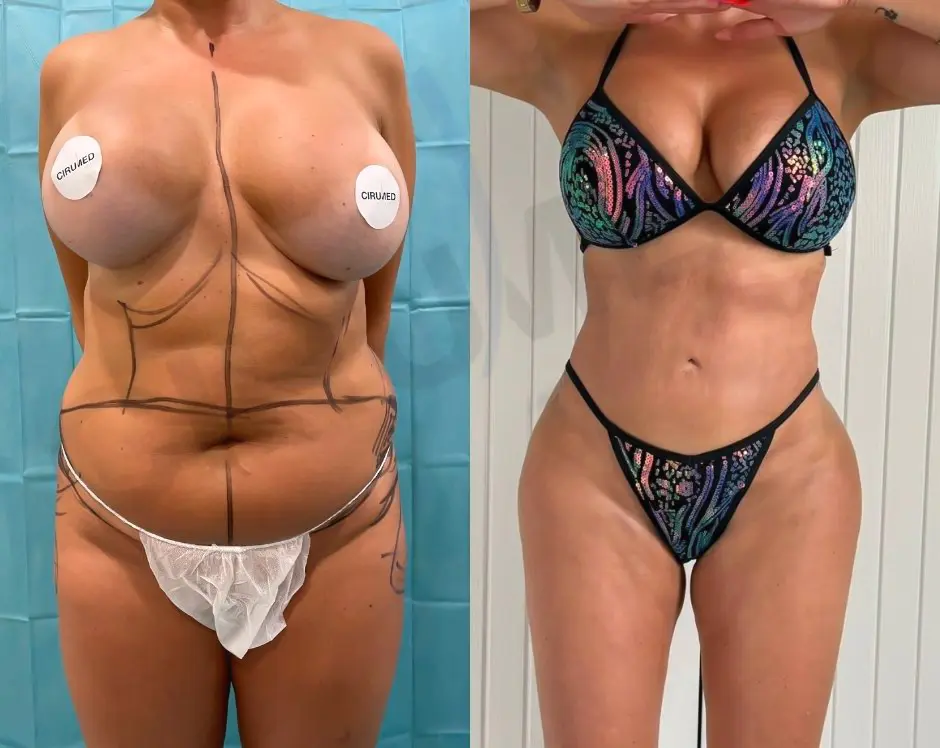
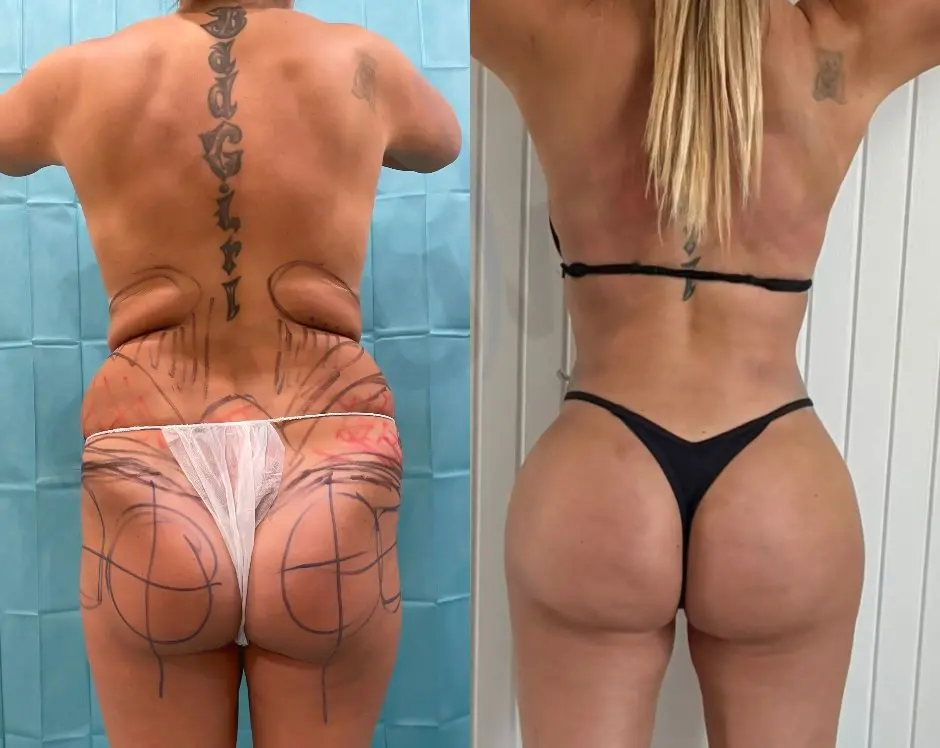
The images are central to the case because they allow us to understand that the change did not happen all at once. The visual sequence must show how each stage modified a different part of the body's architecture.
Why the transformation was planned in two stages
Transforming from a closed V-shape to an open A-shape requires simultaneous work on the waist, flanks, torso structure, and gluteal volume distribution. In this case, Dr. Aslani considered that attempting to achieve all these changes in a single session was unrealistic.
The first surgery created a new base. After healing, that base could be reassessed and used as a starting point for a second fat transfer. The second stage wasn't simply "doing another BBL": it had a specific function, to further augment the lateral and lower areas to complete the A-line shape the patient desired.
Stage 1: Rebuild the base
The first operation did not aim to finalize the result, but rather to modify the conditions that hindered the transformation. In this phase, several tools were combined because each one addressed a different component of the initial pattern.
Abdominal corset
Rib remodeling
Lipo 360
First BBL
The result after this first stage was already clearly better: the waist was more defined and the V shape had been significantly softened.
Step 2: Open the shape into an A
Once the initial transformation had healed and stabilized, the patient wanted to take the change further. The second stage focused on adding additional volume to the lateral and lower areas of the buttocks to enhance the contour and further open up the silhouette.
The advantage of working from a pre-remodeled base is that the second planning phase can begin with a torso and waist that have already changed. The goal shifts from "correcting everything" to... refine the volume distribution to approach the desired final geometry.
The key to a V→A transformation
The result depends on changing the relationship between waist, hips and buttocks, not on chasing a volume number. The literature on body contouring also insists that the buttocks should be planned in harmony with the surrounding structures and with the individual anatomy of each patient.
It's not just about volume.
Waistline matters
The direction of the graft matters
What does this mean for a patient with V-shaped buttocks?
If your anatomy starts with a pronounced V-shape, the surgical goal must be defined realistically. Not all patients need two operations, and not all can achieve the same A-shape. The amount of available fat, tissue expansion capacity, hip structure, torso width, and scarring all influence the plan.
In some cases, a single surgery can produce a very significant improvement. In others, when the desired change is particularly large, a phased approach allows for an assessment of the initial result before deciding how much further modification is necessary.
The assessment should focus on your anatomy and the result you are looking for, not on copying the volume or number of sessions of another patient.
Security and individual planning
Buttock fat transfer requires specific surgical planning. In recent years, plastic surgery societies have strengthened safety recommendations for BBL, including monitoring the injection plane and using real-time ultrasound to ensure the fat is transferred to the correct plane.
At Cirumed, the number of stages, the volume that can be transferred, and the combination with other procedures are decided on an individual basis after assessing anatomy, general condition, and expected recovery.
Related reading
These pages expand on related concepts without changing the main intention of this case: the transformation of buttocks from V-shaped to A-shaped through a two-stage planning process.
FAQ
Clinical experience and personalized planning
This case is part of Dr. Alexander Aslani's clinical experience in body contouring and buttock augmentation surgery. The photographs show an individual result and do not guarantee that another patient will achieve the same degree of transformation.
To determine whether a V-shaped figure can be improved in a single surgery or if a staged strategy would make sense, it is necessary to assess the complete anatomy: torso, waist, hips, buttocks, available fat, and tissue quality.