


Safety in body feminization surgery
Body feminization surgery should not be evaluated solely on the aesthetic outcome. In complex procedures, the most important question is how safety is planned before, during, and after the intervention.
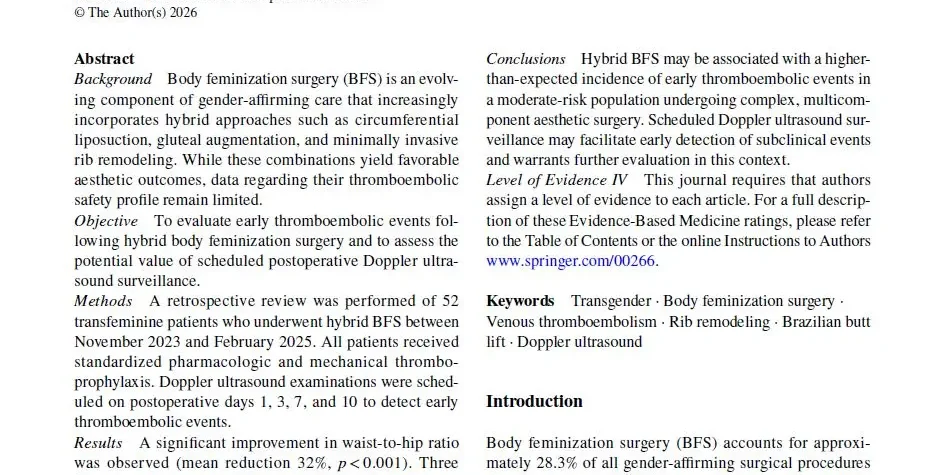
This article summarizes, in clear language, a peer-reviewed scientific publication by Dr. Aslani and his team on hybrid body feminization surgery, thrombosis prevention, and scheduled Doppler monitoring. The aim is not to cause alarm, but to explain why safety is studied, published, and incorporated into clinical protocol at Cirumed Clinic Marbella.
Based on a peer-reviewed scientific publication
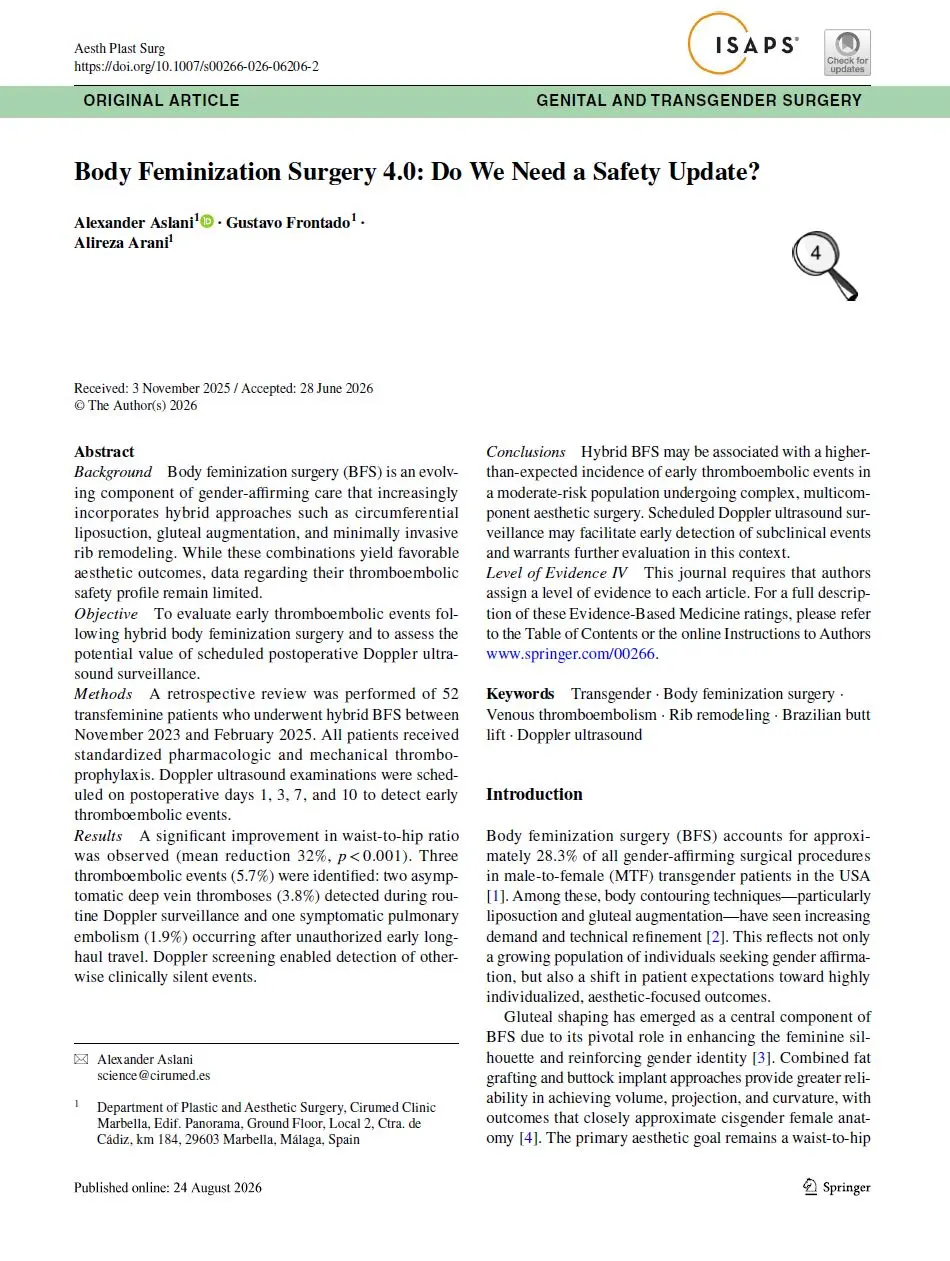
The content is based on the study “Body Feminization Surgery 4.0: Do We Need a Safety Update?”, published in Aesthetic Plastic SurgeryThis is an Open Access article on the initial safety profile of hybrid body feminization surgery and the role of scheduled Doppler ultrasound in detecting problems early.
Quick facts from the article
Main topic
Procedure studied
Medical focus
Cirumed Differential
What does a hybrid body feminization surgery include?
Modern body feminization rarely relies on a single technique. In the approach studied by Dr. Aslani, it can combine body feminization360 liposuction, fat transfer to the buttocks type BBLIn some cases, buttock implants and minimally invasive rib remodeling are used to slim the waist.
The aesthetic goal can be very compelling, but this combination also increases complexity: longer surgery times, greater demands on the body, strict postoperative care, specific positioning, and the use of compression garments. Therefore, safety cannot be treated as a secondary concern.
Why do we study the risk of thrombosis?
The study's focus on safety was venous thromboembolism: clots that can form in the legs, known as deep vein thrombosis or DVT, and which in the worst scenario can travel to the lungs and cause a pulmonary embolism.
This risk is not exclusive to body feminization. It can occur in lengthy or complex body contouring surgeries. The difference lies in how it is assessed, prevented, and monitored after the procedure.
Prevention and surveillance: how security is approached
Preventive medication
Mechanical compression
Doppler ultrasound
Strict instructions
What the study found
The publication found a reduced number of early clotting events. The important point is not just how many were detected, but how they were detectedSeveral appeared in scheduled Doppler ultrasounds in patients who were well and had no symptoms.
This is clinically relevant because these silent events might not have been identified with standard surveillance based solely on symptoms. By detecting them earlier, they could be treated promptly. In the follow-up described in the study, the treated patients did not develop any subsequent complications.
A case of pulmonary embolism was also documented in a patient who took a long-haul flight during the first week after surgery, against medical advice. This reinforces a fundamental point: postoperative instructions are not optional.
The main teaching
Detect earlier
Publish data
Monitor more
What does this mean for a patient?
For a patient, the message shouldn't be fear. The message should be sound judgment. A clinic that studies its own data, publishes it in a peer-reviewed journal, and adapts its protocols when it finds signs of safety is treating safety with the same level of seriousness as the aesthetic outcome.
At Cirumed, this translates into careful surgical planning, thrombosis prevention, postoperative follow-up, Doppler monitoring when indicated, and clear guidelines regarding mobility, compression, positioning, and travel. The goal is to protect the patient throughout the entire process, not just during surgery.
Read the full study
The study is published in open access and can be accessed directly from Springer. Including this link is important because it reinforces the medical authority of the article and connects the page to the original scientific publication.
See peer-reviewed publication: DOI 10.1007/s00266-026-06206-2
These pages expand on the procedures mentioned in the article, such as body feminization, BBL, and rib remodeling, without diverting the main focus of this publication: safety, thrombosis prevention, and Doppler monitoring in complex body surgery.
The goal is not to explain each technique in isolation, but to show how Cirumed integrates surgical planning, prevention protocols, and postoperative controls to reduce risks in combined procedures.
Body feminization
BBL Buttock Augmentation
Did you find this helpful? Share it!
FAQ
Is body feminization surgery dangerous?
Like any major surgery, it carries risks. When combining several procedures in a single intervention, planning must be especially rigorous. The study does not demonstrate that the surgery is inherently unsafe; it shows that complex cases benefit from prevention, monitoring, and structured follow-up.
What is done to prevent thrombosis in this surgery?
Pharmacological measures, mechanical compression, postoperative monitoring, and, in the protocol described by Dr. Aslani, scheduled Doppler ultrasounds to detect clots even in asymptomatic patients are used.
What is scheduled Doppler monitoring?
It is a series of ultrasound scans performed on specific days after surgery to check the veins in the legs. Its purpose is to detect early or silent thrombosis before it causes symptoms or complications.
Why shouldn't you fly right after surgery?
Long flights in the early postoperative period increase the risk of thrombosis. In the study, the most serious event was associated with a long-haul flight during the first week, taken against medical advice.
Where can I read the full study?
The article is published in Open Access at Aesthetic Plastic Surgery. You can check it here: DOI 10.1007/s00266-026-06206-2.
Personalized assessment at Cirumed Clinic Marbella
Safety in complex surgery begins before the operating room: medical evaluation, proper patient selection, technical planning, risk prevention, and postoperative follow-up. If you are considering body feminization surgery, the first step is an individual consultation with the medical team.