




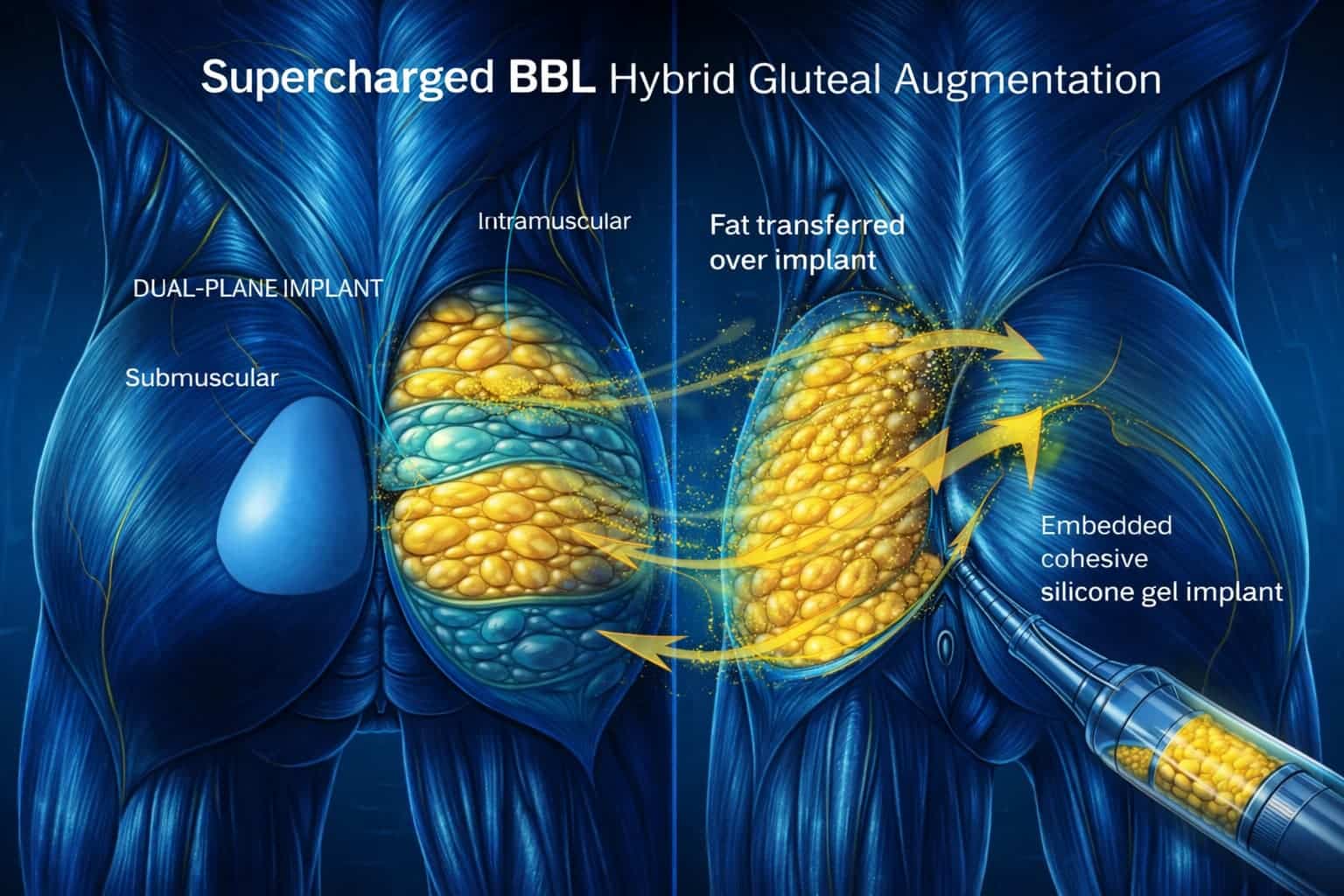
El Supercharged BBL in thin patients It's the surgical solution when there isn't enough donor fat to achieve gluteal projection with a traditional BBL. It combines cohesive gluteal implants that provide the central structure and projection with own fat transferThis procedure shapes the hips, smooths transitions, and provides a natural-looking result. At Cirumed Clinic Marbella, Dr. Alexander Aslani designs each case according to the patient's BMI, available fat distribution, and goals, without forcing the body's natural processes or oversizing the implant.
Informative content. The indication (fat grafting, implants, or hybrid technique) is decided after medical evaluation and anatomical study.
The supercharged technique that redefines projection in thin patients
If you want to know the basic procedure, visit Buttock augmentation (BBL)For hybrid cases, this strategy is tailored according to muscle, pelvis, and available fat.
The anatomical challenge in patients with low BMI
A patient may be in shape, with a proportionate figure, but not have enough fat to create the desired projection. In these cases, a BBL using only fat may look "nice," but not necessarily meet expectations for impact.
Why fat alone may not be enough
- Donor fat is limited (and cannot be "invented").
- Extracting too much can worsen the harmony of the contour.
- Fat retention is less predictable when there is little reserve.
- There are safety limits in injection molding.
- There is less "leverage" in the lower back to create a strong S-curve.
The logic of the Supercharged BBL: structure on one hand, form on the other
Implant = stable projection
- It is not reabsorbed.
- It provides measurable and constant volume.
- It allows for powerful results with little donor fat.
Fat = naturalness and transitions
- It softens edges and avoids steps.
- Rounds the sides and the top pole.
- Improves the waist-to-hip transition.
- It gives a more natural feel and movement.
Overall, the result is more predictable: projection with structural basis y organic finish through grafting.
Why the “dual-plane” technique makes a difference
In gluteal implants, the plane is crucial. A "dual-plane" design (combining intramuscular and submuscular placement) aims to:
- better implant coverage,
- less visibility or palpability of edges,
- greater stability and lower risk of displacement,
- and a more natural integration with fat grafting.
Translation into simple language: The implant is better protected by the muscle, and the fat is used to "sculpt" on top, gently.
Young patient with low BMI and high projection goal
In the case of the video, the patient had a BMI below 22 and wanted a more expressive result than fat alone could safely achieve. Her anatomy included:
- very little overall fat,
- little fat in the lower back (less room to create an S-curve with liposuction alone),
- A clean waistline (but with little "leverage" to narrow it further),
- strong gluteal muscles (favorable for implant placement),
- High expectations for projection and form.
In this profile, the implant creates the "base" projection and fat is used to round and feminize the contour around it.
Optional: Rib Remodeling to increase waist-hip contrast
In thin patients, when maximum waist definition and contrast are desired, an additional approach (as medically indicated) may be considered, such as the Rib RemodelingThe idea is to enhance the "optical illusion" of wider hips by improving the waistline.
It's not for everyone. The decision is based on anatomy, goals, and safety.
Security: why specialization matters
The reputation of buttock implants has historically been affected by outdated techniques, unstable pocket designs, and surgeons with limited experience in these types of cases. In surgery, the volume of cases and the standardization of the team reduce complications and make the procedure more predictable.
- specific postoperative protocols,
- reproducible pocket design,
- surgical time control,
- and a highly standardized workflow.
When waist, projection and smoothness are aligned
The key advantage of the Supercharged BBL in thin patients is this: the implant provides projection that fat alone cannot match, and the fat makes everything look smooth, round, and in harmony with the body. When the waist is also defined, the result can be very feminine without looking "artificial."
FAQ
Am I "too thin" for a BBL?
The decision isn't based on a single phrase, but rather on anatomy: available donor fat, skin quality, hip structure, and projection goal. In some slender bodies, the hybrid technique may be an alternative.
Is the implant noticeable or does it look artificial?
The hybrid technique aims for the exact opposite: using the implant as a structure and fat to smooth transitions. The goal is a natural contour, not sharp edges.
Why not just make fat even if there's little of it?
Because with too little volume, the result may fall short of the desired projection. Furthermore, extracting too much to "force" the graft can worsen the harmony of other areas.
What does the “dual-plane” offer compared to other planes?
Better implant coverage with muscle, greater stability, and less visibility. This facilitates a smoother result when combined with fat grafting.
Want to know if a Supercharged BBL is your best option?
A personalized assessment allows us to determine if a BBL with fat, a hybrid technique, or an alternative approach is right for you, based on your anatomy and goals.
Request an assessment



