



Inverted triangle or “sad triangle”: why it costs so much and why the correction changes so much
What is the sad triangle? It is a V-shaped silhouette or inverted triangle, in which the The waist appears wider than the hips..
It's not uncommon, but it is one of the patterns that generates the most emotional impact because it breaks the natural transition between waist and hip and makes the body look heavier in the upper part.
To understand the overall approach: a BBL It's not just about fat grafting. In many cases, the main change begins with the torso contour. 360° liposuction.
The case: when the waist is the widest point
In the preoperative period, the dominant feature is clear: the waist represents the widest point of the torso and, below, the contour narrows towards the hip.
This pattern usually comes from a combination of factors:
- accumulation of fat in the central area and flanks,
- narrow hips due to bone structure,
- and buttocks with limited or tighter volume.
In tight clothing, this imbalance is even more noticeable, because the body loses the visual continuity that many patients associate with a more feminine silhouette.
Why the inverted triangle is so surgically challenging
This pattern is demanding for two main reasons:
- The waist rules: If it is not visually reduced, the buttocks never come across as dominant.
- Gluteal capacity is usually lower: Often there is less safe space to graft large volumes without increasing the pressure too much.
Technical key: In these cases, you don't win by adding more volume. You win by... change the ratio: first waist, then volume dosed and well placed.
Why is waist reduction valued more than volume here?
Body contour is always relationalThe perceived size of the buttocks depends a lot on how narrow the waist looks.
Therefore, in an inverted triangle:
- If the waistline drops, the hips appear larger.
- The buttocks appear more projected even if the graft is moderate.
- And the visual change can be very large without taking the volume to extremes.
When skin quality allows, retraction technologies such as J-Plasma can help to better define the waistline after liposuction and reinforce that transition.
From case to concept: body types and prognosis in BBL
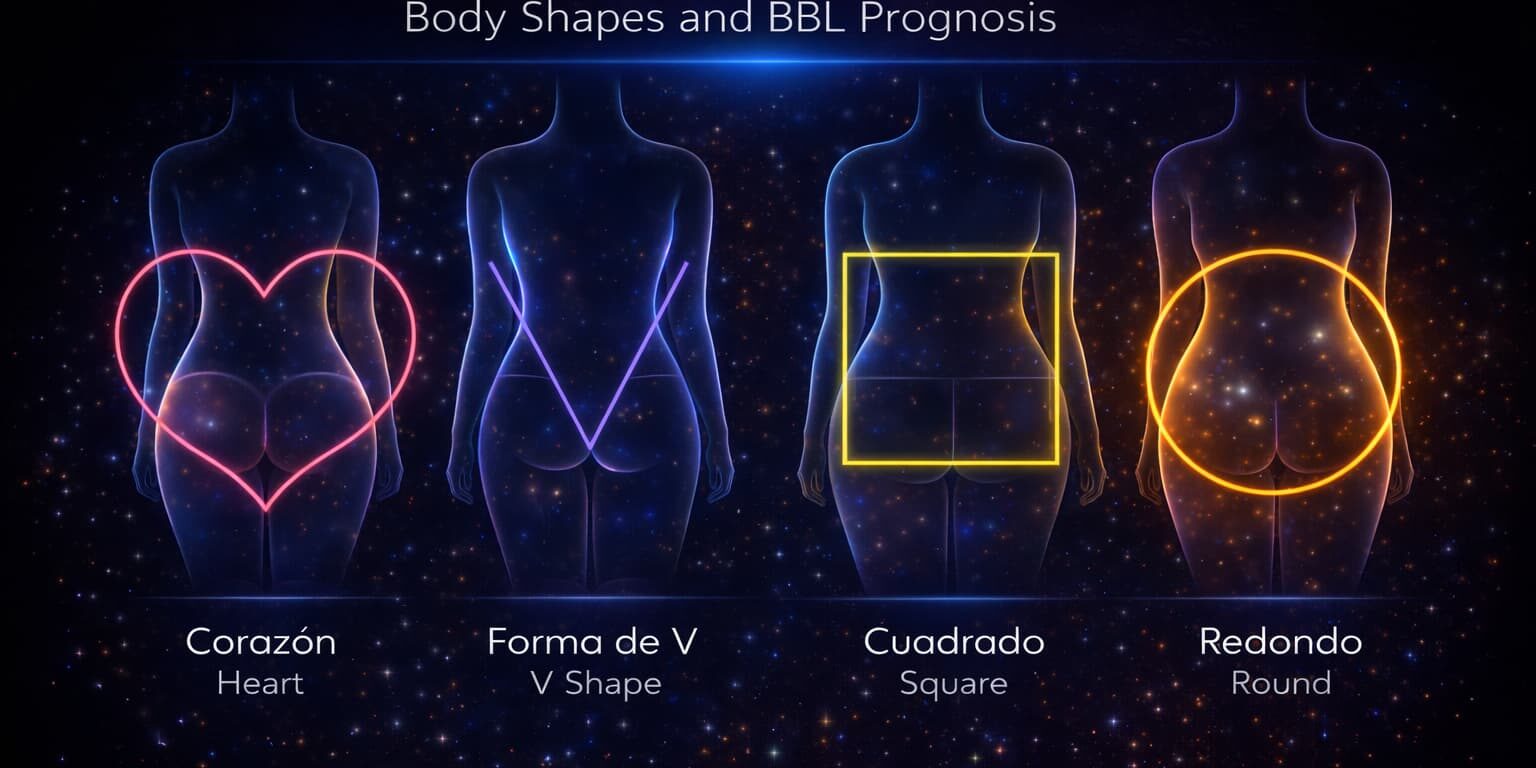
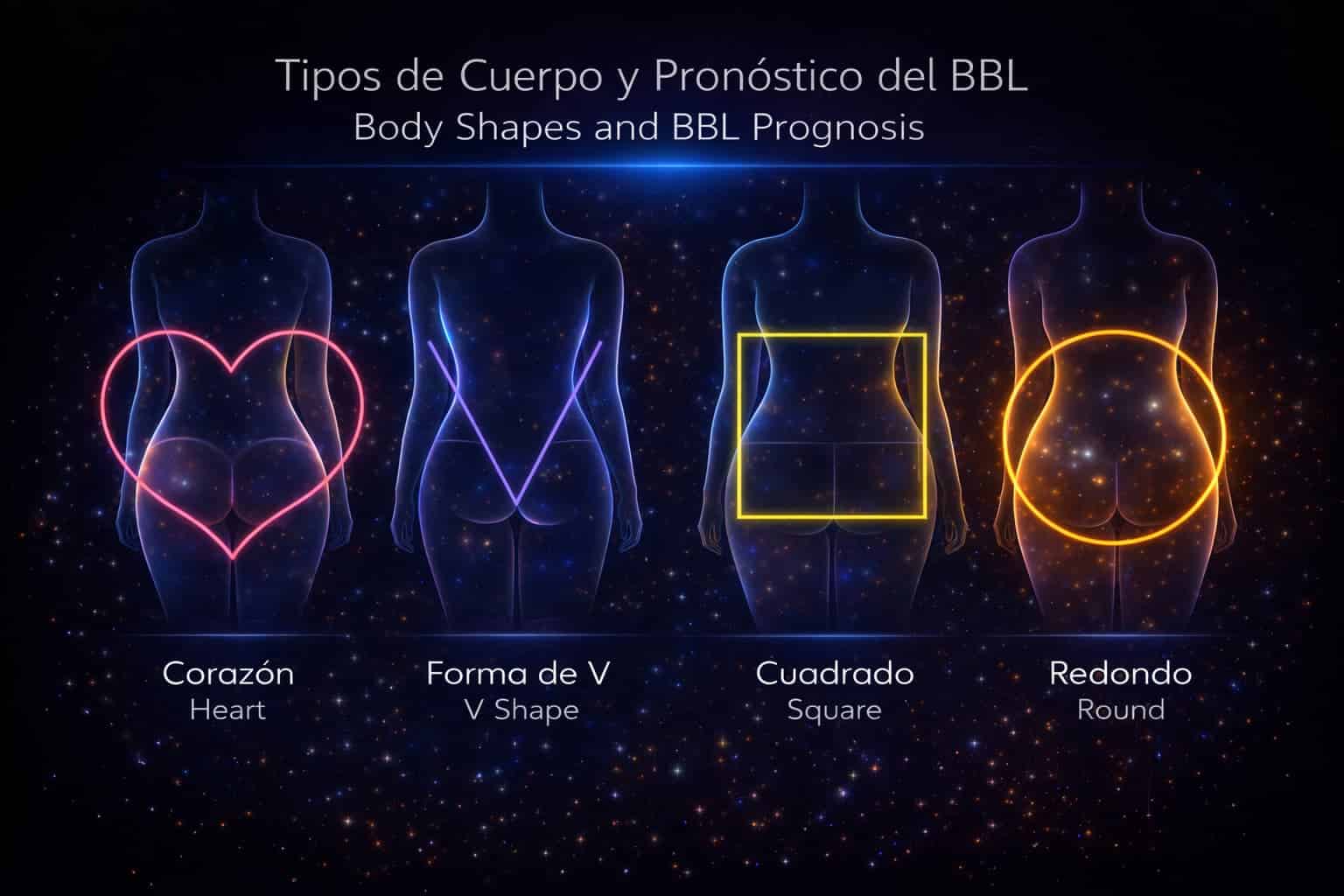
Although each patient is unique, classifying body pattern helps predict the type of outcome and adjust expectations.
As a simple rule, when the waist is narrower than the hips, the basis for a feminine result is usually more favorable.
| Your body type | What usually happens | Typical approach |
|---|---|---|
| Hourglass / A | The waist is already dominant and the hips follow suit. | Small changes often produce a big visual impact. |
| Rectangular | Waist and hips are similar in width. | BBL plus torso contouring usually makes a big difference. |
| Apple | The abdomen visually weighs more, although the hips may also be heavier. | Abdominal work and waist training are usually a priority. |
| Inverted triangle / V | The waist is wider than the hips and the buttocks are usually firmer. | Waist first, then dosed graft. |
On mobile: swipe the table to the side to see all columns.
To see an example where less is more and the projection depends on the contour: BBL without implants.
Why is gluteal capacity usually lower in a V-shaped body?
In the inverted triangle, the gluteus maximus is usually more compact and offers less room for large grafts.
If you try to force extreme volume:
- increases the pressure on the recipient tissue,
- It can lower fat survival,
- and the risk of irregularities or poor adaptation increases.
Responsible planning prioritizes three things: waist first, measured volume y smart location, especially in the hips, hip dips and lower pole to generate roundness.
Why these patients often end up especially satisfied
Although these are complex cases, many patients with inverted triangle breast deformities describe very high satisfaction after surgery.
The reason is simple: they are usually very aware of the imbalance between their waist and hips. When that ratio changes, the visual and emotional impact is very noticeable.
The most noticeable change: When the waistline drops and the hips become more defined, clothing choices change completely. Dresses, pants, and fitted garments become much more flattering.
Who is a good candidate and who is not
This approach is often particularly suitable for patients with:
- waist clearly dominant over hip,
- good skin quality or reasonable possibility of retraction,
- realistic expectations regarding volume limits,
- The goal is proportion and harmony, not extreme size.
On the other hand, it is not usually the best option for those seeking extreme volume at any price or for anatomies with very damaged skin lacking retraction capacity and without another complementary strategy.
Message for patients
The inverted triangle is a challenging pattern, but it doesn't mean the case has a bad prognosis.
In fact, when well planned, it can produce very powerful transformations.
The key is to accept three ideas:
- The waist creates much of the illusion of hips,
- Fat cannot be forced without limits,
- And strategy is worth more than surgical aggressiveness.
Do you think you have this body type?
An anatomical assessment allows us to calculate how much you can gain by reducing your waistline, how much real capacity there is for grafting, and what level of change is reasonable in your case.
FAQ
Is it possible to correct an inverted triangle shape without getting a huge butt implant?
Yes.
In many cases, the real driving force behind the transformation is reducing the waist and flanks, and then adding measured volume to the hips and lower pole. The proportions can change dramatically even if the grafting isn't extreme.
Why can't I graft as much as possible into the buttocks?
Because the recipient tissue has biological limits.
In V-shaped anatomies, the buttocks tend to be more compact, and forcing too much volume increases pressure, reduces fat survival, and raises the risk of irregularities.
What role does J-Plasma play in these cases?
When the skin is a good candidate, it can help improve definition after liposuction and reinforce the waistline.
It does not replace a facelift when there is a severe excess of skin.
How do I know if I belong to this V-shape group?
If your waist is the widest point of your torso and your hips look narrow, you may fit this pattern.
An anatomical assessment confirms the diagnosis and allows for the definition of a realistic plan.




