




BBL without implants: when a prosthesis is not appropriate
In buttock surgery, More volume doesn't always mean better results.Sometimes the anatomy already has a good base, but fat from the waist, flanks or lower back hides the natural projection of the buttocks.
In those cases, a BBL without implants, combined with a Lipo 360 When well planned, it can achieve a more natural result than a prosthesis.
This entry explains when implants can limit the outcome, what secondary projection is, and when it may make sense to use implants or a hybrid technique.
Not sure if you need implants or just fat transfer?
The decision depends on your anatomy, the amount of fat available, the shape of your pelvis, and the desired result. At Cirumed, we analyze each case to determine whether a BBL with fat transfer, implants, or a hybrid technique is the best option.
Quick facts
Process: BBL without implants with Lipo 360 and fat transfer.
Indicated when: There is a good gluteal base, fat that hides the back-buttock transition, and sufficient donor fat.
Key to the result: Define waist, flanks and lower back so that the buttocks look more projected.
Possible technology: J-Plasma to help with skin retraction when performing intensive liposuction.
It does not always replace implants: When fat or structure is lacking, a hybrid technique or a prosthesis may be better.
⚡ The essentials — what you need to know
- A BBL without implants may be better when the buttocks are not small, but are "covered" by fat in the lower back or flanks.
- 360° liposuction can create visual projection by cleaning up the transition between waist, back, and buttocks.
- Implants are not bad, but in some anatomies they can limit the sculpting of the area that most needs definition.
- J-Plasma can help the skin adapt better after aggressive liposuction.
- The correct technique does not depend on adding more procedures, but on choosing what your anatomy really needs.
- When there is a lack of fat or gluteal structure, implants or the Supercharged BBL They can still be the best option.
When is a non-implant BBL the best option?
A BBL without implants can be better when the patient already has a good gluteal base and sufficient donor fat, but the projection is hidden by fat in the waist, flanks, or lower back. In these cases, defining the torso with 360 Liposuction and strategically transferring fat can yield a more natural result than implants.
What the patient asked for vs. what her anatomy needed
Many patients come to the consultation thinking they need implants because they want more profile projection. But the problem isn't always a lack of volume.
In this case, the patient had a good gluteal base. What reduced the visual projection was an accumulation of dense fat in the lower back and flanks, just above the buttocks.
In other words, the buttocks weren't small. They were partially hidden by the surrounding fat distribution. Therefore, the priority wasn't adding implants, but rather smoothing the transition between the waist, back, and buttocks.
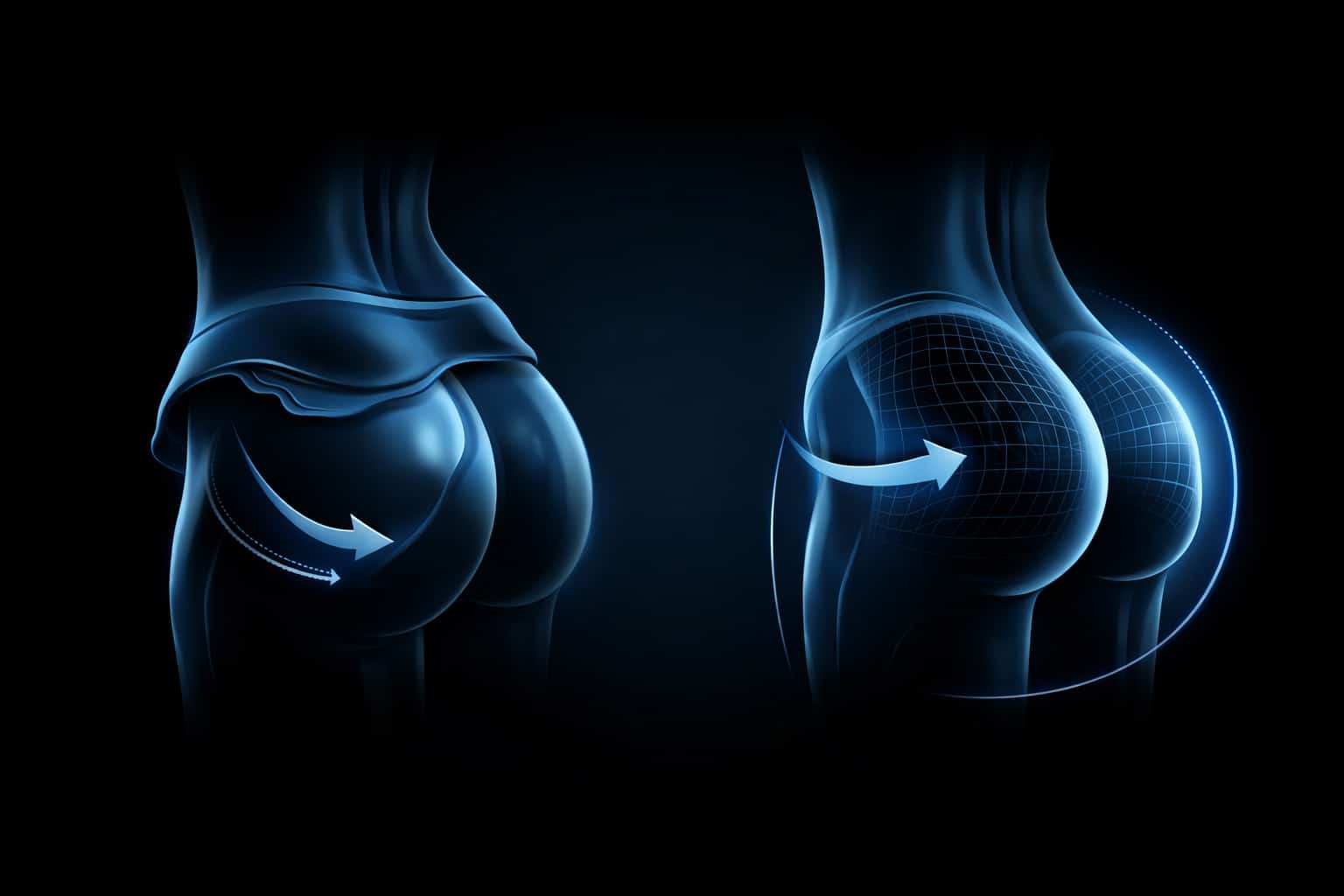
The best technique depends on your anatomy
A good result isn't always achieved by adding more volume. Sometimes it's achieved by removing what hides the natural shape of the buttocks.
Why implants aren't always the best option
Buttock implants are a useful tool when there is a lack of structure, fat, or stable projection. But they are not the automatic answer for every case.
In some anatomies, placing a prosthesis requires being more conservative precisely in the area that most needs sculpting: lower back, flanks and upper edge of the buttocks.
If the desired outcome depends on very precise and intensive liposuction in that area, the implant may limit the procedure. In that scenario, the prosthesis can add volume, but reduce the ability to create a clean and natural transition.
Strategy: more visibility by removing what was hiding it
The strategy was to perform a BBL without implants, focused on sculpting the torso and improving the back-buttock transition.
- 360° liposuction focused on lower back, waist and flanks.
- Defining the upper edge of the buttocks to increase visual projection.
- Targeted fat transfer to round and balance, without overloading.
- J-Plasma when indicated to help with skin retraction.
- Rib modeling only if the anatomy allows it and it provides a real benefit.
The key was understanding that the main change didn't come from adding more volume, but from revealing the form that already existed.
The role of J-Plasma in advanced contouring
When dense fat is removed from the lower back, the skin needs to adapt to the new contour. In some cases, J-Plasma can help improve skin retraction from within.
Its aim is not to add volume, but to improve the finish: cleaner transitions, less risk of irregularities and a smoother line between back, waist and buttocks.
Like any technology, it should only be used when indicated. It is not a substitute for good planning or precise liposuction.
Are you looking for buttock surgery and don't know which technique to choose?
At Cirumed we analyze your available fat, waist, lower back, pelvis, muscle and goals to decide if your best option is a BBL with fat, implants or a hybrid technique.
The correct indication is not the most complex, but the one that best fits your anatomy and safety.
When does it make sense to use implants or hybrid techniques?
This case doesn't mean that implants are a bad option. It means they aren't always the best solution.
Implants or a hybrid technique may make sense when there is not enough donor fat, when the pelvic structure is narrower, when a high and stable projection is desired, or when the aesthetic goal needs a structural foundation.
The decision should be made after evaluating the entire anatomy. Sometimes the best result is achieved by adding volume. Other times, by removing what obscures the natural shape.
Cirumed Principle: The correct technique is the one that improves the result without compromising safety.
Cirumed Experience
El Dr. Alexander Aslani He is the founder and Medical Director of Cirumed Clinic MarbellaHer practice focuses on body contouring surgery, buttock augmentation with own fat, Supercharged BBL, Lipo 360 and advanced waist and buttock reshaping.
The key in these cases is not to automatically choose between fat or implants, but to carefully read the anatomy: available fat, pelvic shape, back-buttock transition, skin quality and aesthetic goal.
Therefore, each case is planned individually, prioritizing safety, proportion, and a natural result.
FAQ
It depends on your available fat, the shape of your pelvis, the gluteal base, and the type of projection you're looking for. During the consultation, we'll analyze whether the result can be achieved with fat alone or if you need a structural base with an implant.
It's the visual projection that appears when fat that was concealing the buttocks is removed, especially from the lower back and flanks. Without adding much volume, the buttocks can appear more projected because the transition is cleaner.
J-Plasma can help the skin retract better after extensive liposuction. It is used to improve the visual appearance and reduce irregularities in areas where a large amount of fat has been removed.
The transferred fat that survives the first few months integrates permanently. The sculpted waist and back can also be maintained long-term, provided the weight remains stable.
No. Implants can be an excellent option when fat or structure is lacking. The important point is that not all patients need them. In some anatomies, a well-executed 360 liposuction and strategic fat transfer can yield a more natural result.
The non-implant BBL uses the patient's own fat to enhance the shape. The Supercharged BBL combines implants and fat for patients who need additional structural support and more projection. The choice depends on the patient's anatomy and goals.
Do you want to know which buttock augmentation technique is best for you?
At Cirumed Clinic Marbella we analyze your anatomy, available fat, waist, pelvis and goals to decide if your best option is a BBL with fat, implants or a hybrid technique.




