




Why the surgical environment matters as much as technique
When patients research surgery Mummy Makeover the combination of procedures that usually includes tummy tuck, liposuctionoften also Brazilian Butt Lift y breast surgery In a single session, most people focus on the results. Before-and-after photos, recovery times, and price comparisons dominate the conversation. What receives far less attention is the factor that most consistently separates good results from bad: the safety architecture surrounding the surgery itself.
Safety in advanced body contouring is not determined by any single innovation. It is the result of an integrated system in which the surgical environment, team expertise, operative efficiency, anesthetic protocol, and perioperative physiological management interact. Each component amplifies the others. When one fails, the entire system is compromised.
The 6 pillars of safety in body contouring
Prevention of hypothermia
The most underestimated risk in prolonged surgery. It affects coagulation, immunity, and thromboembolic risk.
Fluid equilibrium
Managing volumes in large-volume liposuction is one of the most demanding aspects of perioperative safety.
Tranexamic acid
It reduces intraoperative bleeding and transfusion rates from 6% to less than 1% in body contour.
Combined anesthesia
The combination of general and regional anesthesia reduces opioid requirements and speeds up recovery.
Operating time
Total surgical time is one of the strongest predictors of risk. The safe threshold: approximately 5 hours.
DVT prophylaxis
Deep vein thrombosis is the most serious postoperative complication. It requires active, multimodal prophylactic management.
The specialized outpatient setting: advantages and trade-offs
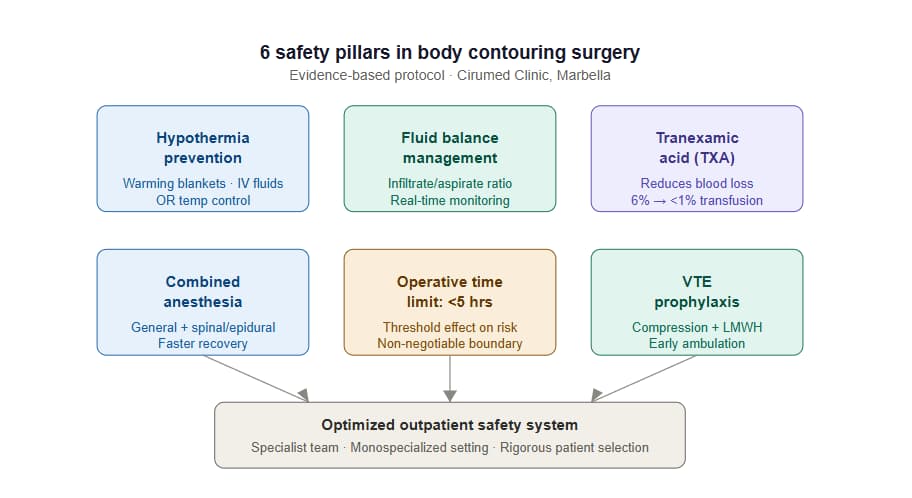
Safety protocol structured in 6 pillars for large volume body contouring procedures.
A single-specialty surgical facility dedicated exclusively to Aesthetic body contouring It offers measurable operational advantages over multi-specialty hospital settings. These are not marketing claims: they reflect the well-documented relationship between procedure volume, team familiarity, and quality of outcomes.
In a dedicated environment, surgical assistants anticipate every step. Anesthesia teams understand the exact physiological demands of the large volume liposuction and combined procedures. The instruments are standardized. Intraoperative communication is efficient and fluid. This composite effect is difficult to replicate in environments where the same team alternates between very different types of procedures throughout the day.
The absence of an on-site ICU is not a significant clinical limitation for properly selected patients undergoing elective body contouring surgery. However, it makes rigorous patient selection non-negotiable. The outpatient model works precisely because the patient population is carefully filtered.
Patient selection: the first and most important safety decision
No intraoperative protocol can compensate for poor patient selection. This principle is consistent throughout the body contouring literature and is reinforced by every analysis of serious complications in elective cosmetic surgery.
The candidates for combined body contour In an outpatient setting, patients must meet clear physiological criteria: BMI within an acceptable range, no significant cardiopulmonary comorbidity, non-smoker or with documented cessation, and realistic operative time requirements within safety thresholds. Patients with poorly controlled diabetes, active coagulation disorders, or significant obesity require prior medical optimization or an inpatient surgical plan.
The relationship between BMI and the risk of complications in tummy tuck y large volume liposuction This is well established in the literature. Likewise, the combination of smoking and large-volume procedures carries a substantially elevated risk of scarring that cannot be mitigated by technique alone.
What is your BMI?
Body mass index (BMI) is the primary criterion for eligibility for combined body contouring. Calculate yours before your appointment.
Pillar 1: Hypothermia prevention, the most underestimated risk
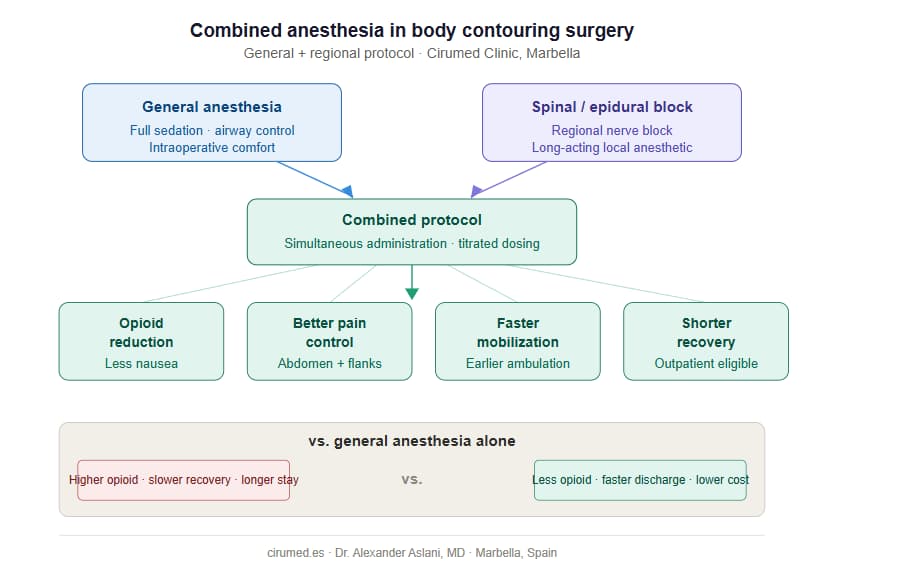
Combined anesthesia (general + regional) is key to reducing the risk of hypothermia and opioid requirements in long procedures.
In prolonged cosmetic surgery, intraoperative hypothermia is one of the most clinically significant triggers of complications and one of the most consistently underestimated. General anesthesia suppresses the body's thermoregulatory system. Without active countermeasures, core body temperature progressively drops during lengthy procedures.
The consequences are not subtle. Hypothermia impairs the function of clotting factors, increasing intraoperative bleeding. It raises the risk of infection by reducing tissue perfusion and impairing the immune response. It delays recovery and increases postoperative pain. And it is an independent risk factor for thromboembolic events, a potentially fatal complication in the postoperative period.
All intravenous fluids are warmed before administration. Active patient warming systems, such as heated blankets and mattresses, are used throughout the procedure. The operating room temperature is controlled and monitored. And, crucially, the duration of the operation is treated as a primary safety variable: every minute saved in the operating room directly reduces the risk of hypothermia.
Pillar 2: Fluid balance in large-volume liposuction
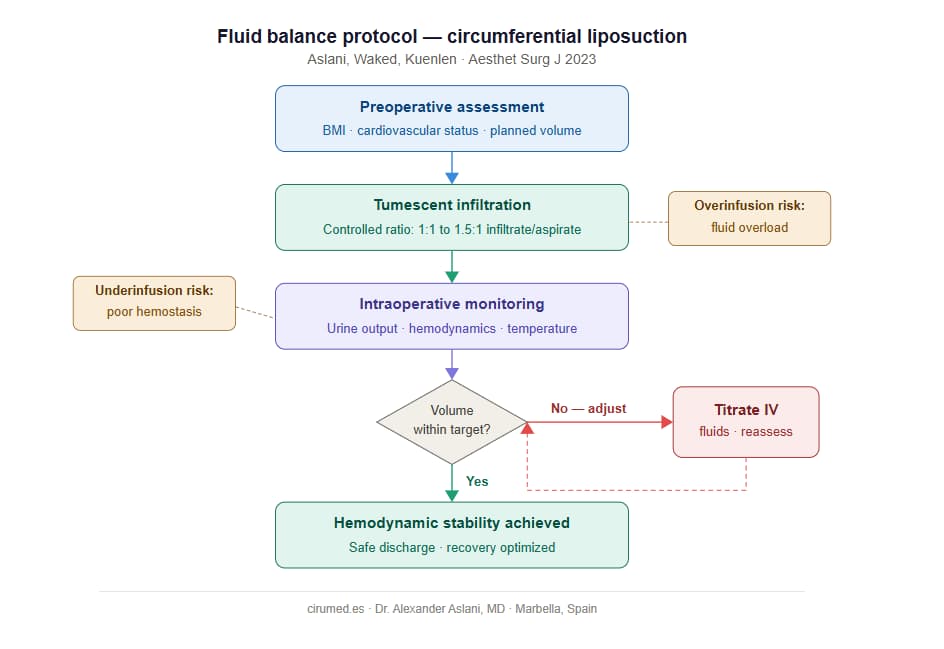
Controlling the infiltration/aspiration ratio is a critical safety parameter in procedures of circumferential liposuction.
Fluid handling in circumferential liposuction Tumescent infiltration and large-volume body contouring procedures are among the most technically demanding aspects of perioperative safety and one of the least visible to patients. Tumescent infiltration introduces large volumes of fluid into the body. The relationship between infiltration volume, aspiration volume, and systemic fluid shifts determines whether the patient remains hemodynamically stable throughout the procedure and during recovery.
The data published by our group analyzing fluid equilibrium parameters in circumferential liposuction These studies demonstrate that strict volume management protocols are associated with significantly improved perioperative safety profiles. The infiltration-to-aspiration ratio should be carefully controlled, intravenous fluid supplementation should be titrated to real-time monitoring data, and urine output should be maintained within physiological targets throughout the case.
Large volume liposuction procedure at Cirumed Clinic — real-time fluid monitoring.
Practices that cannot articulate a specific, evidence-based approach to infiltrate/aspirate ratios and intraoperative fluid monitoring are operating without a critical safety system.
Pillar 3: Tranexamic acid from body contouring trauma surgery
Tranexamic acid (TXA) is an antifibrinolytic agent that inhibits the breakdown of blood clots, reducing intraoperative and postoperative bleeding. Originally established in high-bleed surgical settings such as trauma, cardiac surgery, and orthopedics, TXA has now accumulated a solid evidence base in elective cosmetic procedures.
En large volume body contouring surgeryTXA reduces intraoperative bleeding, decreases the postoperative drop in hemoglobin, and drastically reduces transfusion rates. Published series report reductions in transfusion rates from approximately 6% to less than 1%. For outpatient surgical settings where transfusion capacity may be limited, this reduction is not a marginal benefit but a core safety outcome.
A common concern among patients is whether TXA increases the risk of clotting, given that patients of body contour They already carry a high risk of VTE. Current evidence does not support a significant increase in thromboembolic events with appropriately dosed TXA in elective procedures. The benefit-risk profile, when used within established protocols, is clearly favorable.
Pillar 4: Combined anesthesia faster recovery, less stress
The anesthetic protocol for combined procedures of body contour It directly influences the quality of recovery, opioid requirements, and mobilization time. A combination of general anesthesia with regional anesthesia (spinal or epidural) offers measurable advantages over general anesthesia alone for tummy tuck and combined lower body procedures.
The primary benefit is the reduction in opioid use. Regional anesthesia covers the lower abdomen and flanks with a long-acting local anesthetic, substantially reducing the postoperative pain burden. Lower opioid consumption translates to faster cognitive recovery, earlier mobilization, less nausea, and improved respiratory function in the immediate postoperative period. For outpatient procedures, these are not marginal improvements; they are the difference between a safe discharge and a patient requiring extended monitoring.
Combined anesthesia protocol in extensive body contouring procedures — Dr. Alexander Aslani, Cirumed Clinic.
Pillar 5: Operating time limits, a non-negotiable safety boundary
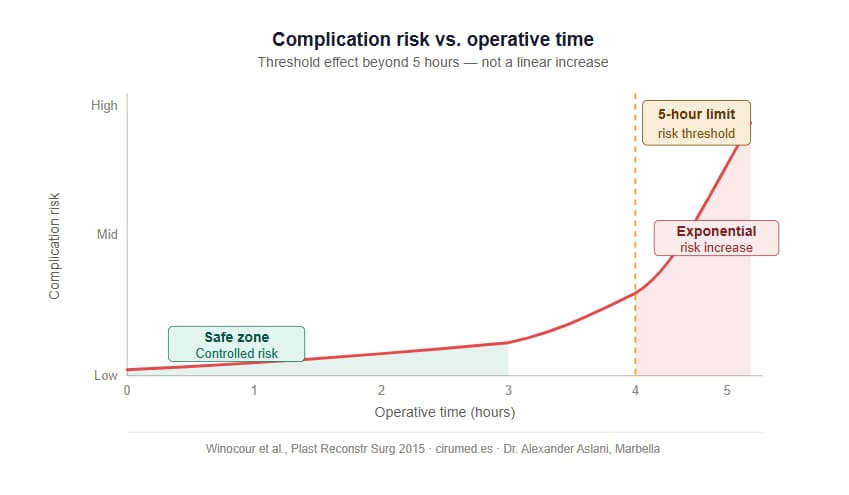
The relationship between operating time and risk of complications is not linear: there is a threshold effect around 5 hours in combined surgery.
Total operative time is one of the most powerful predictors of the risk of complications in combined cosmetic surgeryThe relationship is not linear; it is a threshold effect. Below approximately five hours of total operative time, complication rates in healthy patients remain within acceptable ranges. Beyond this threshold, the risk rises sharply and disproportionately.
The mechanisms are multiple and cumulative. Prolonged anesthesia increases exposure to hypothermia, cardiovascular stress, and impaired coagulation. Extended operating time correlates with greater fluid shifts, a higher inflammatory cytokine load, and a greater risk of venous thromboembolism (VTE) due to immobility. And the surgical team itself—however experienced—performs with less precision at the six-hour mark than at the three-hour mark.
Therefore, high-performance surgical systems are defined not by how many procedures they can group together, but by how precisely they adhere to time constraints. Mummy Makeover combining tummy tuck, liposuction y breast surgery (implants, without breast lift) is achievable within five hours in an optimized, specialized environment, thanks to technologies that reduce operating time: high-speed tumescent infiltration systems, liposculpture vibration-assisted, progressive tension sutures and continuous knotless closure techniques.
Pillar 6: DVT prophylaxis by managing the most serious postoperative risk

The latest developments in DVT prophylaxis, including immediate postoperative venous Doppler, are part of the standard protocol at Cirumed Clinic.
Deep vein thrombosis and pulmonary embolism represent the most serious, potentially life-threatening complications in elective cosmetic surgery. The combination of prolonged operative time, patient positioning, fluid shifts related to tumescent infiltration, and reduced postoperative mobility creates a high-risk environment that requires active prophylactic management. You can learn more about this topic in our dedicated article on DVT after body contouring surgery.
Current practice combines mechanical prophylaxis (sequential compression devices throughout the operative period) with pharmacological prophylaxis (low molecular weight heparin) initiated at an appropriate interval. Early ambulation—mobilizing the patient in the first few hours after surgery—is an independent risk-reduction measure facilitated by combined anesthetic techniques that allow for earlier motor recovery.
Given that the post-COVID community may have a slightly higher baseline thrombotic risk, we have implemented venous Doppler screening in immediate postoperative care. A deep vein thrombosis (DVT) can be completely asymptomatic. Actively searching for occult thrombi before they can cause a pulmonary embolism is an irreplaceable additional layer of safety.
Patient education about the risk of VTE and early mobilization is part of the safety protocol, not an add-on. Patients who understand why they are asked to walk in the first few hours after surgery, and who know the warning signs of DVT and PE, participate more effectively in managing their own safety during recovery.
Who is this approach for and who is it not for?
The optimized model of body contour The outpatient facility described here achieves its safety record through a careful match between patient, procedure, and facility capabilities. It is appropriate for:
- Healthy patients undergoing combined elective procedures within safe operating time limits
- Patients seeking efficient recovery with minimal hospitalization
- Individuals who meet physiological criteria and have been thoroughly evaluated preoperatively
It is not appropriate for patients with significant cardiopulmonary comorbidity, poorly controlled metabolic disease, or combinations of procedures that would require operative times beyond established safety thresholds. For these patients, a hospital surgical plan with ICU availability is the appropriate setting. The decision between settings is clinical, not commercial, and should be made conservatively.
Are you a candidate for a Mummy Makeover?
Patient selection is the first and most important safety decision. A proper preoperative assessment determines which procedures are safe for you, in what combination, and in what order.
FAQ
Is outpatient Mummy Makeover surgery as safe as in-hospital surgery?
For properly selected healthy patients, yes—and in some respects, the specialized outpatient setting offers safety advantages through team specialization that general hospital settings cannot replicate. The critical qualifier is patient selection: the outpatient model is safe precisely because the patient population is carefully filtered. Learn more on our page of Mummy Makeover.
How do I know if I'm a good candidate for combined body contouring?
Candidacy is determined through a formal preoperative evaluation that covers BMI, cardiovascular and pulmonary function, coagulation status, smoking history, and realistic scope of procedure. A surgeon who agrees to combine multiple major procedures without this evaluation is not following evidence-based practices. Use our BMI calculator as a first guiding step.
What is the maximum safe number of procedures in a single session?
The limiting factor is operating time, not the number of procedures per se. Most combinations tummy tuck with liposuction y breast surgery These procedures are achievable within five hours in a specialized setting. What matters is that the surgical plan is built around the time constraint as a non-negotiable boundary, not around the patient's wish list.
Why does my surgeon recommend tranexamic acid, and is it safe?
TXA reduces intraoperative bleeding and transfusion requirements in large-volume body contouring. Current evidence does not show a significant increase in the risk of clotting with appropriate dosing. It is now a standard component of safety protocols in high-volume specialist centers, having reduced transfusion rates from approximately 6% to less than 1%.
What is the risk of TVP after a Mummy Makeover and how is it managed?
The risk of VTE is elevated after combined body contouring procedures due to operative duration, patient positioning, and reduced postoperative mobility. Active management includes sequential compression devices during surgery, postoperative low-molecular-weight heparin, early ambulation, and, in our protocol, Venous Doppler screening to detect asymptomatic DVT. More information in our article on Deep vein thrombosis in body contour.
How important is the experience of the surgical team?
The experience and specialization of the team is a primary, not secondary, safety variable. In single-specialty centers, each member of the team—surgeon, anesthesiologist, scrub nurse, and recovery room nurse—is familiar with the specific procedure. This familiarity reduces errors, shortens operating time, and improves intraoperative communication. It is one of the strongest arguments for choosing a dedicated center over a generalist facility for complex body contour.
Clinical summary
Safety in surgery Mummy Makeover And body contouring is a systems problem, not a technical one. The procedures themselves tummy tuck, liposuction, breast surgery They are well established. What separates excellent results from preventable complications is the quality of the surrounding safety infrastructure.
- Multimodal hypothermia prevention
- Strict fluid balance protocol
- Tranexamic acid as a standard in body contouring
- Combined anesthesia: general + regional (spinal)
- Operating time discipline ≤ 5 hours
- DVT prophylaxis + postoperative venous Doppler
For patients evaluating surgical programs, the right questions aren't just about outcomes. They're about protocols. A surgical team that can articulate its approach to each of these pillars in a specific, not generic, way is a team that has carefully considered safety as a system.
Highlighted
- Aslani A. Outcome Analysis of Cohesive Gel Implants With Dual-Plane Technique in Primary Buttock Augmentation. Plastic Reconstruction Surgery Globe Open. 2025; 13 (12): e7350. DOI
- Aslani A. Combining Fat and Implants for Gluteal Augmentation. Clin Plast Surg. 2023;50(4). DOI
- Aslani A, Del Vecchio DA. Composite Buttock Augmentation: The Next Frontier in Gluteal Aesthetic Surgery. Plast Reconstr Surg. 2019;144(6):1312-1321. DOI
- Aslani A, del Vecchio DA, Bravo MG, Zholtikov V, Palhazi P. The Dual-Plane Gluteal Augmentation: An Anatomical Demonstration of a New Pocket Design. Plast Reconstr Surg. 2023;151(1):45-50. DOI
- Del Vecchio D, Bravo MG, Mandlik V, Aslani A. Body Feminization Combining Large-Volume Fat Grafting and Gluteal Implants. Plast Reconstr Surg. 2022;149(5):1197-1203. DOI
- Del Vecchio D, Kenkel JM. Practice Advisory on Gluteal Fat Grafting. Aesthet Surg J. 2022;42(9):1019-1029. DOI
- Oranges CM, Tremp M, di Summa PG, Kalbermatten DF. Gluteal Augmentation Techniques: A Comprehensive Literature Review. Aesthet Surg J. 2017;37(5):560-569. DOI
- Mofid MM, Teitelbaum S, Suissa D, et al. Report on Mortality from Gluteal Fat Grafting: Recommendations from the ASERF Task Force. Aesthet Surg J. 2017;37(7):796-806. DOI
- Richter DF, Stoff A. Gluteal Augmentation with Implants. Clin Plast Surg. 2018;45(2):217-227. DOI




