





Why risk has changed and how we manage it
When patients investigate Complications of the Brazilian Butt LiftThe conversation almost always revolves around fat embolism. However, in modern body contouring surgery, there is another risk that deserves a much more precise explanation: deep vein thrombosis (DVT or DVT) and its possible evolution to pulmonary embolism.
This point is crucial because many patients conflate different concepts under the word "embolism", when in reality fat embolism y venous thromboembolism They are not the same. The first is an intraoperative problem related to the injection technique. buttock augmentation with fatThe second is a postoperative risk of coagulation that can appear days after surgery, even when everything seems to be going well.
Key idea: Deep vein thrombosis (DVT) and fat embolism are completely different risks. Fat embolism is an intraoperative technical problem; DVT is a postoperative thrombotic risk that can be asymptomatic and still carry the potential for pulmonary embolism.
En Cirumed ClinicThis topic is especially relevant because many current procedures are no longer simple surgeries. Today we're talking about cases that combine BBL, high-precision liposuctionAbdominoplasty and, increasingly, rib reshaping or body feminization. This greater surgical aggressiveness has truly changed the landscape of thrombotic risk and demands equally sophisticated protocols.
What you should know
There are several points that should be understood from the beginning:
- DVT and fat embolism share neither the same mechanism, nor the same time of onset, nor any prevention strategy
- DVT can be completely asymptomatic, with no pain or swelling, and still carry the same risk of pulmonary embolism.
- In transgender patients undergoing estrogen therapy, the thrombotic risk may increase significantly.
- Prophylactic anticoagulation has a safety ceiling around surgery; it is not always possible to simply "give more medication".
- When a thrombus is detected, the treatment should change from prevention to therapeutic anticoagulation.
All of this has a very important practical consequence: in high-level body contouring surgery, thromboprevention cannot be based solely on telling the patient to report any leg swelling. This same safety principle already applies when we talk about BBL risksA serious protocol is always worth more than generic reassurance.
Why risk has changed
Deep vein thrombosis has always been a risk factor in elective surgery, but in modern body contouring, the situation has changed significantly over the last decade. Today, procedures are longer, more complex, and more invasive than before.
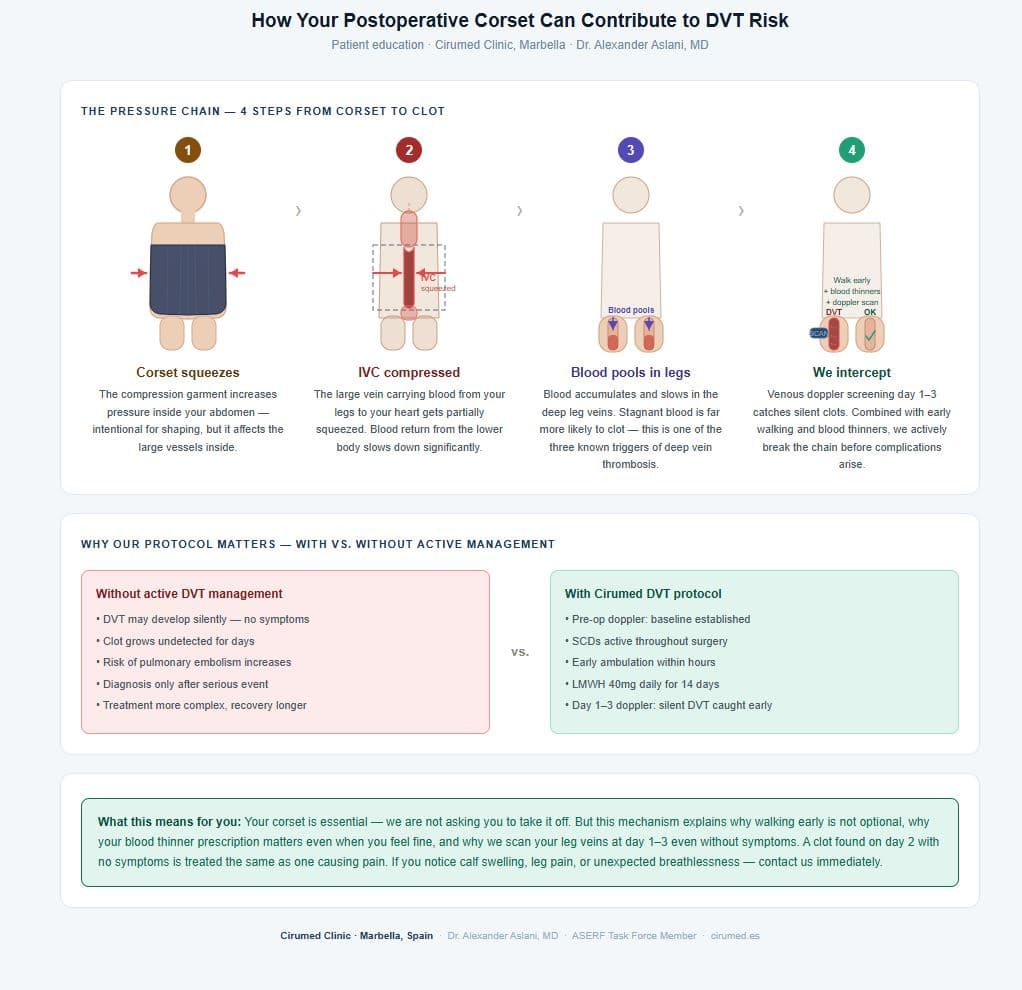
Many cases of Brazilian Butt Lift These procedures include 360-degree liposuction, abdominal wall surgery, and, in some contexts, rib remodeling. The latter also introduces a specific physiological factor: intra-abdominal pressure changes associated with postoperative corset use can alter venous hemodynamics in ways that classic DVT protocols were not designed to account for.
In addition, there is another relevant change: today we operate in a post-COVID population, with a consistent clinical signal of a moderately increased baseline prothrombotic risk compared to previous periods. The exact mechanism may vary, but the prudent clinical approach is to assume that the coagulation environment is no longer identical to what it was years ago. This is also why advanced procedures such as the Supercharged BBL They should always be evaluated in conjunction with their safety protocol.
DVT and fat embolism
Public awareness of the risks of Brazilian Butt Lift The narrative surrounding fat embolism has been dominated by the topic. This is understandable, because the perioperative deaths that prompted the ASERF investigation were related to intramuscular fat injection and fat embolism. But this media attention has created significant confusion in understanding the patient.
La fat embolism In BBL surgery, this is an intraoperative event caused by the inadvertent injection of fat into or beneath the muscle. It is prevented with proper technique, i.e., exclusively subcutaneous injection and confirmation via real-time ultrasound. In our practice, with modern technique, we consider this risk virtually avoidable. This point directly links to the logic of the main article on Brazilian Butt Lift complications.
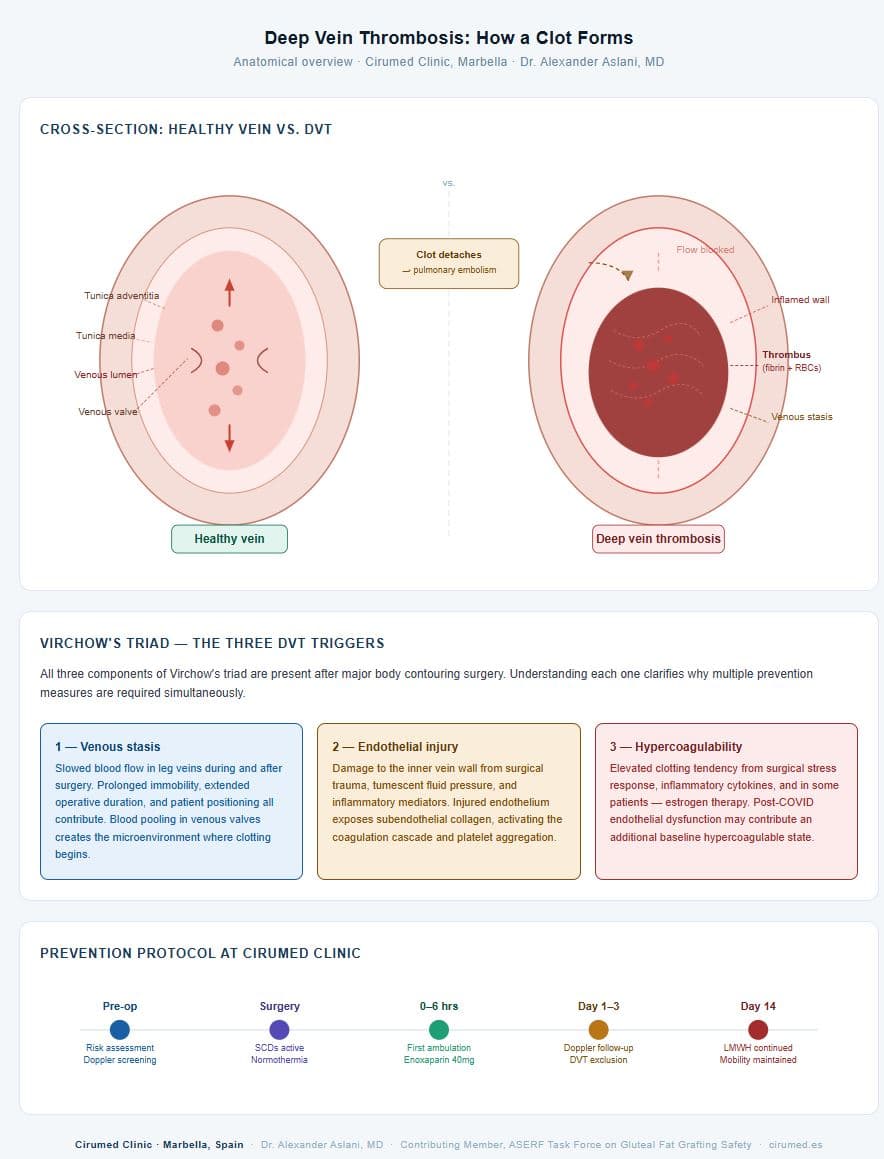
La Deep venous thrombosisIn contrast, it is a postoperative event based on Virchow's triad: venous stasis, endothelial injury, and hypercoagulability. All three elements are present after major body contouring surgery. Its risk window extends days or weeks after surgery, and it may be asymptomatic. That is why it should not be confused with the narrative of fat embolism.
Essential difference: Fat embolism is a technical complication of the operating room. DVT is a physiological complication of the postoperative period. They are not prevented in the same way, nor are they detected in the same way.
Asymptomatic DVT
One of the most important and least understood points is that a postoperative DVT may not present any obvious signs. Pain, warmth, or swelling in the leg is not always present. And yet, the risk of pulmonary embolism remains.
This completely changes the logic of postoperative follow-up. If diagnosis depends on the patient noticing symptoms and seeking medical attention, a significant proportion of cases will go undetected until a major thromboembolic event occurs. That is why active surveillance through Venous Doppler It makes real clinical sense.
In our practice, Doppler ultrasound does not replace pharmacological prophylaxis, but rather complements it. The goal is not to wait for something to happen, but to detect thrombi that might otherwise go unnoticed clinically. Just as in other BBL complicationsEarly detection completely changes the prognosis.
Our protocol
The prevention of deep vein thrombosis (DVT) in body contouring surgery must be multimodal. No single measure can resolve the entire problem on its own. Therefore, the protocol combines mechanical prophylaxis, thermal control, early mobilization, pharmacological prophylaxis, and, in higher-risk patients, venous Doppler monitoring.
During surgery, we use sequential pneumatic compression. In addition, we maintain active hypothermia prevention protocols, because intraoperative hypothermia not only affects bleeding and recovery, but can also worsen coagulation dynamics and venous flow.
Another essential pillar is the early mobilizationWhen the patient's physiology allows, we mobilize her a few hours after surgery. Early return to walking is not a secondary recommendation: it is one of the most effective interventions for reducing venous stasis. This is especially relevant in extensive surgeries of Body contouring and liposuction.
Anticoagulation and limits
In the perioperative setting, there is one issue that requires clear communication with the patient: prophylactic anticoagulation has a safety limit. The standard prophylactic dose of enoxaparin protects against thrombus formation, but it cannot be simply escalated in the first few postoperative days because the risk of bleeding from surgical wounds, liposuction, or drained areas imposes a very real clinical ceiling.
This means that an increased risk cannot always be addressed simply by adding more anticoagulant. Beyond a certain point, the cost in terms of bleeding becomes unacceptable. That is precisely where the Venous Doppler It becomes a strategic tool: when pharmacological prophylaxis has already reached its safe limit, the correct clinical response is to actively monitor, detect early and treat if a thrombus appears.
This distinction is crucial to understanding why effective DVT prevention depends not only on medication but also on a sound diagnostic strategy. Similarly, safe gluteal surgery depends not only on the aesthetic outcome but also on the comprehensive protocol that accompanies procedures like the Supercharged BBL.
Request a pre-operative risk assessment at Cirumed Clinic, Marbella
If you are researching Complications of the Brazilian Butt Lift or the risk of thrombosis after body contouring surgery, the correct answer is not a reassuring phrase, but a clear protocol. In Cirumed Clinic MarbellaEach patient receives an individual assessment of thrombotic risk before surgery.
Your surgery should be as safe as it is transformative. That standard begins before you sign the consent form.
Venous Doppler
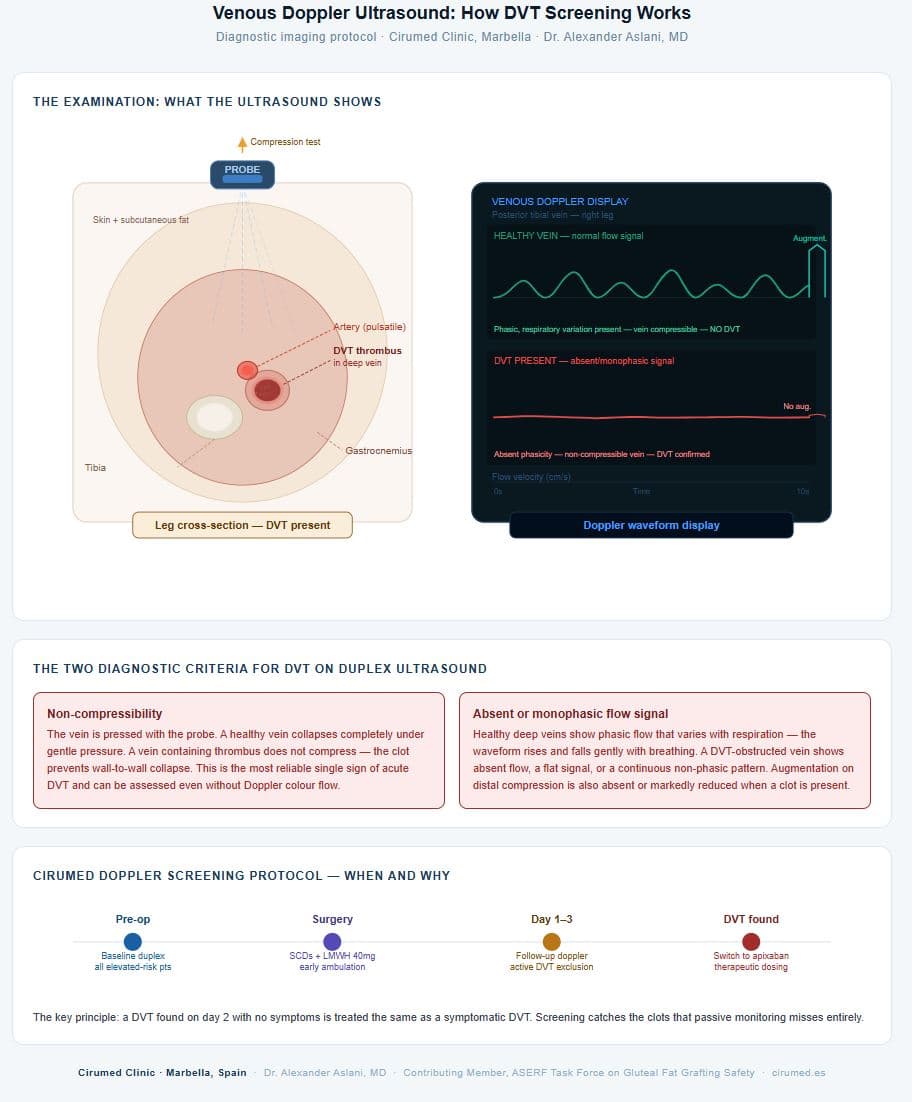
The logic behind our venous Doppler protocol is very simple: if we know that a DVT can be completely asymptomatic, it doesn't make sense to rely solely on the patient noticing symptoms. That's why we perform baseline venous Doppler ultrasound preoperatively and follow-up ultrasounds between days 1 and 3 postoperatively in high-risk patients.
The goal is not to replace pharmacological prophylaxis, but to add a layer of active surveillance. In other words, we don't wait for the body to alert us to a blood clot; we try to find it before it causes a major clinical event.
This approach makes even more sense in high-volume procedures, in transgender patients on hormone therapy, or in surgeries where rib remodeling and postoperative bracing add additional hemodynamic variables. It also aligns with the broader rationale of Advanced management of BBL complications.
Trans patients and hormones
Feminizing hormone therapy, especially estrogen-based therapy, is an independent risk factor for thromboembolic events. The degree of risk can vary depending on the formulation, dose, route of administration, and age, but in the context of major surgery, the impact is clinically relevant.
Therefore, in extensive body feminization procedures that include rib reshaping, large volumes of fat grafting, and gluteal augmentation, we recommend considering a pause in estrogen therapy for 2 to 4 weeks before surgery, always in coordination with the patient's hormone prescriber. This is not a rigid, universal rule, but it is a recommendation that carries significant weight as the scope of the surgery increases.
This is a clear example of why thrombotic assessment must be personalized. Not all patients start from the same baseline risk, and a good protocol must recognize this. In contexts of advanced body feminizationThat nuance is even more important.
What happens if a blood clot appears?
When venous Doppler identifies a DVT, symptomatic or not, management immediately changes from prophylaxis to therapeutic anticoagulationIn our current practice, we prefer Apixaban compared to rivaroxaban in this context, based on recent comparative data showing equivalent efficacy with a more favorable bleeding profile.
Here it is worth clarifying another common misconception: the value of direct oral anticoagulants is not in improving standard prophylaxis when there is no thrombus yet, but in treating the thrombus when it has already been diagnosed and real therapeutic anticoagulation is needed.
Early detection of DVT through active surveillance allows treatment to begin before the problem progresses to a pulmonary embolism. This is precisely one of the major clinical advantages of the Doppler-based protocol. It's the same rational approach we apply when we analyze Complications of the Brazilian Butt Lift: to clearly identify the risk, measure it accurately, and act beforehand.
What it means to you
If you are researching body contouring surgery, whether you Brazilian Butt LiftWhether it's a combined procedure or body feminization, deep vein thrombosis is a real risk that deserves a real response from the surgical team. The correct response is not simply to say that it is rare. The correct response is to explain what protocol is followed to prevent, detect, and treat it if it occurs.
Asking your surgeon if they use venous Doppler ultrasound, what pharmacological protocol they follow, how they manage hormone therapy in transgender patients, and what they do if a blood clot develops is not an exaggeration. It's a smart way to assess whether you're dealing with a team that truly understands the complexity of the surgery they're proposing. It's also worth reviewing the foundational article on... BBL complications to have a more complete view.
Strategic question: If you're considering extensive body surgery, don't just ask about before-and-after photos. Also ask about the DVT protocol, mobilization procedures, venous Doppler ultrasound, and the treatment plan if a clot is detected.
FAQ
Is DVT the same as fat embolism after a Brazilian Butt Lift?
No. Fat embolism is an intraoperative event related to the fat injection technique. DVT is a postoperative event: a blood clot in the veins of the leg that can appear days after surgery. These are distinct risks and require different prevention strategies. You can find more information in our guide on Complications of the Brazilian Butt Lift.
Will I always know if I have deep vein thrombosis?
No. A clinically significant proportion of postoperative DVTs can be completely asymptomatic. That's why venous Doppler monitoring is worthwhile in higher-risk patients.
What can I do to reduce the risk before surgery?
Quitting smoking, maintaining a stable weight, being well-hydrated on the day of surgery, managing chronic conditions, and discussing any hormonal treatments in advance if you belong to a specific risk group are all important. It also helps to fully understand the procedure, whether it's a BBL or more extensive body surgery.
I am a trans woman on hormone therapy, should I stop taking hormones before surgery?
It depends on the extent of the procedure. In extensive surgeries involving rib remodeling, large volumes of fat, and gluteal augmentation, we usually recommend an estrogen break of 2 to 4 weeks, always in coordination with the hormone prescriber.
What happens if a blood clot is detected after surgery?
We are moving from prophylaxis to therapeutic anticoagulation. Currently, we prefer apixaban as a treatment option due to its efficacy and a more favorable bleeding profile compared to rivaroxaban in this context.
Does rib remodeling increase the risk of DVT?
Yes, it can increase due to the longer surgical duration, added trauma, and hemodynamic changes resulting from postoperative corset use and increased intra-abdominal pressure. In patients undergoing procedures such as the Supercharged BBLThis is one of the nuances that should be carefully considered.
Conclusion
In modern body contouring surgery, deep vein thrombosis cannot be managed with protocols designed for smaller, less invasive procedures. The risk landscape has changed, and prophylaxis must change as well.
Clear differentiation between fat embolism and DVT, early mobilization, mechanical prophylaxis, prudent use of anticoagulation, adaptation in trans patients on hormone therapy, and above all, active surveillance through Venous Doppler They are now fundamental pieces of truly safe surgery.
When a blood clot is detected, treatment must be escalated rapidly and judiciously. And when it isn't detected, the credit doesn't lie in luck, but in having built a protocol robust enough to minimize risk from the outset. That's the same philosophy that should guide any serious reading on the subject. Complications of the Brazilian Butt Lift, buttock augmentation with fat or more advanced procedures such as Supercharged BBL.
Dr. Alexander Aslani is the Medical Director of Cirumed Clinic in Marbella, collaborating member of the ASERF Task Force on Gluteal Fat Grafting Safety and author of works focused on perioperative safety and advanced body contouring surgery.
Highlighted
- Aslani A. Outcome Analysis of Cohesive Gel Implants With Dual-Plane Technique in Primary Buttock Augmentation. Plastic Reconstruction Surgery Globe Open. 2025; 13 (12): e7350.DOI
- Aslani A. Combining Fat and Implants for Gluteal Augmentation. Clin Plast Surg. 2023;50(4).DOI
- Aslani A, Del Vecchio DA. Composite Buttock Augmentation: The Next Frontier in Gluteal Aesthetic Surgery. Plast Reconstr Surg. 2019;144(6):1312-1321.DOI
- Aslani A, del Vecchio DA, Bravo MG, Zholtikov V, Palhazi P. The Dual-Plane Gluteal Augmentation: An Anatomical Demonstration of a New Pocket Design. Plast Reconstr Surg. 2023;151(1):45-50.DOI
- Del Vecchio D, Bravo MG, Mandlik V, Aslani A. Body Feminization Combining Large-Volume Fat Grafting and Gluteal Implants. Plast Reconstr Surg. 2022;149(5):1197-1203.DOI
- Del Vecchio D, Kenkel JM. Practice Advisory on Gluteal Fat Grafting. Aesthet Surg J. 2022;42(9):1019-1029. DOI
- Oranges CM, Tremp M, di Summa PG, Kalbermatten DF. Gluteal Augmentation Techniques: A Comprehensive Literature Review. Aesthet Surg J. 2017;37(5):560-569.DOI
- Mofid MM, Teitelbaum S, Suissa D, et al. Report on Mortality from Gluteal Fat Grafting: Recommendations from the ASERF Task Force. Aesthet Surg J. 2017;37(7):796-806.DOI
- Richter DF, Stoff A. Gluteal Augmentation with Implants. Clin Plast Surg. 2018;45(2):217-227.DOI




