



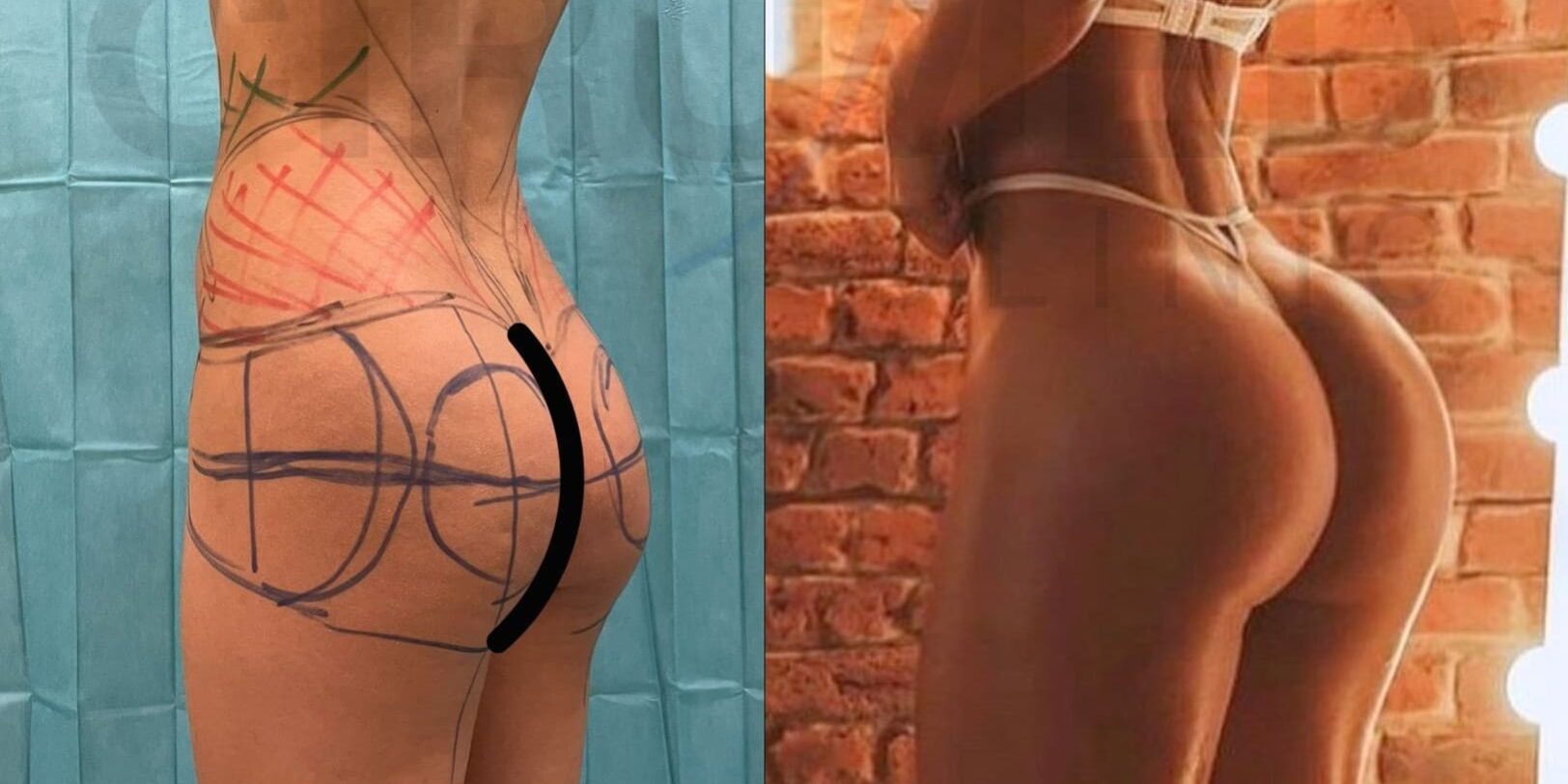
The term skinny BBL It has become one of the most frequent searches in buttock surgery. However, it is also one of the most misunderstood concepts. In a truly thin patient, with a low percentage of fat and little donor tissue, a fat-only BBL is usually not anatomically possible.
This case shows what can realistically be achieved in a low BMI patient: central gluteal projection using gluteal implantsA small amount of fat is used only to soften edges and improve transitions. The structure of the result does not come from the fat; it is provided by the implant.
Quick tips: the most important things you need to know
- The “skinny BBL” is not a surgical term, but a popular social media hashtag.
- Un BBL with own fat It requires sufficient donor fat; in very thin patients, this fat is often not available.
- In a patient with a low BMI, significant projection usually requires gluteal implants.
- The size of the implant depends on the soft tissue coverage, not on aesthetic desire.
- The conversation about expectations is essential to avoid unrealistic comparisons with Instagram or TikTok.
Clinical case: gluteal augmentation in a thin patient with low donor fat volume.
Why “skinny BBL” is a problematic term
“Skinny BBL” is a term that originated on social media, not in surgery. It suggests that a thin patient can achieve a large buttock augmentation using the same fat transfer technique employed for patients with abundant donor fat. The problem is that this promise cannot be fulfilled when the anatomy doesn't provide sufficient volume.
A fat-only BBL requires three conditions: readily available fat for extraction, sufficient fat after processing, and a stable final volume that will survive long-term. In a thin patient, 360° liposuction can only provide a very limited amount of fat. After processing and partial reabsorption, the final volume is often insufficient to create a visible projection.
Honest surgical translation
In a truly thin patient, "skinny BBL" doesn't usually mean a BBL with fat transfer alone. In practice, it typically means a buttock augmentation with implants, sometimes supplemented with a small amount of fat to refine the contour.
The case: buttock augmentation in a patient with very little donor fat
The patient had a slender build, with a low BMI, minimal subcutaneous fat in the trunk, and a flat or poorly projected gluteal contour. Her goal was to achieve significant posterior projection.
The assessment confirmed what the visual examination had already suggested: the available fat in the abdomen, flanks, and lower back was insufficient for a significant result using isolated fat transfer. Therefore, a BBL using only fat was not a viable strategy.
Initial Anatomy
- Thin patient with low BMI
- Minimal donor fat in trunk
- Flat or poorly projected buttocks
- Limited soft tissue coverage
- Desire for more later projection
Surgical strategy
- Implant as the main source of projection
- Double-plane pocket technique
- Limited fat for refining
- Size adjusted to tissue coverage
- Natural result within anatomical limits
The indication was a gluteal augmentation using implants and a dual-plane pocket technique. This approach is related to the approach of Supercharged BBLalthough in this case fat was not the main structural component.
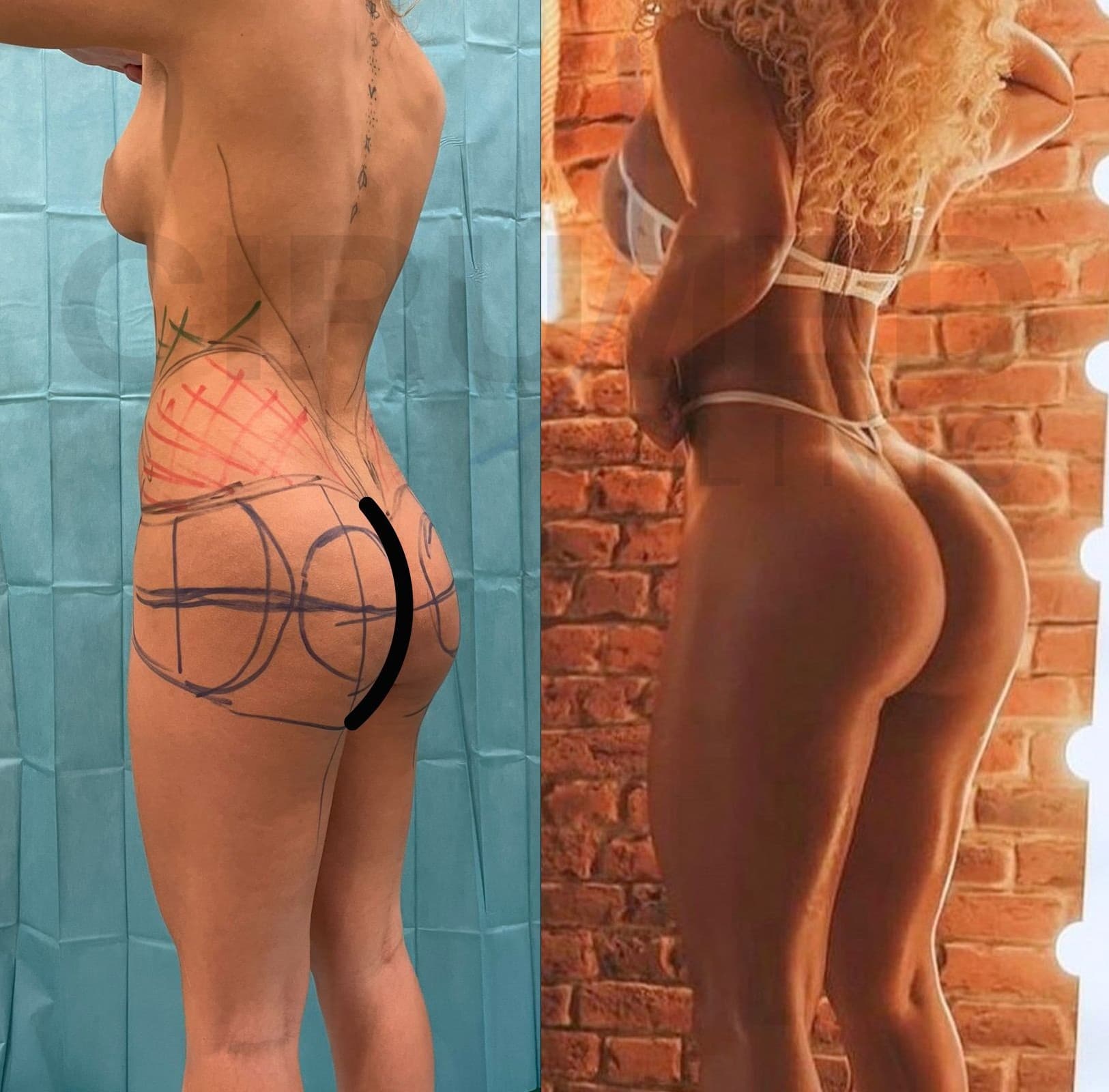
Buttock augmentation in a thin patient: when there is not enough fat, the implant provides the structural projection.
The main anatomical limitation: soft tissue coverage
In thin patients, the most important variable is not the size of the implant or the desired shape. It is the soft tissue coverage: the thickness of the muscle and subcutaneous fat covering the implant.
When there is good coverage, the implant is integrated under a sufficient layer of tissue. Its edges are not visible, and the contour appears smoother. Conversely, when the coverage is thin, the implant sits closer to the skin's surface. Choosing a size that is too large increases the risk of visible edges, rippling, or asymmetrical settling.
Visible edges
The lateral or lower margin of the implant can be felt or even seen under the skin in certain positions or lighting.
Rippling
The surface of the implant can transmit small irregularities to the skin contour if the coverage is too thin.
Asymmetric settlement
Thin tissues provide less stability to the implant, which can increase the risk of differences between both sides.
Anatomical boundary
The maximum safe size is determined by the tissue that can cover the implant, not the image the patient wishes to achieve.
Therefore, the implant size in a skinny BBL is not a free choice. It's an anatomical calculation. In some cases, it may be more prudent to use a moderate volume, as occurs in certain cases of buttock augmentation with small implant, who try to force an excessive size.
How is coverage assessed before planning the implant?
During the consultation, manual examination and visual analysis are essential. In a patient with a low BMI, the thickness of the lateral gluteal tissue, skin quality, coverage over the gluteus maximus, and overall elasticity of the area are evaluated.
A patient with very thin tissue can tolerate an implant of approximately 250 to 300 ml per side. Another patient, also thin but with slightly more tissue, can tolerate 350 to 400 ml. The number is not an aesthetic preference: it is a consequence of anatomy.
Common error in thin patients
Recommending an implant larger than the tissue can cover is one of the most frequent causes of implant visibility, marked edges, and the need for revision surgery.
Want to know if you have enough fat for a BBL?
In thin patients, the decision doesn't depend solely on weight or BMI. It depends on the actual donor fat, soft tissue coverage, and the type of result you hope to achieve.
The expectations gap: social media versus surgical reality
The most important conversation with thin patients doesn't begin with the technique. It begins with expectations. Many "skinny BBL" images on Instagram or TikTok don't represent what a truly thin patient can achieve using their own fat.
Some patients labeled as having a “skinny BBL” weren't actually thin before surgery: they had enough fat, underwent extensive liposuction, and afterward appeared much slimmer. Others did receive implants, but the result is presented as a conventional BBL, without explaining that the projection comes from the implants.
This confusion creates an impossible expectation: the patient believes she can achieve a great projection with her own fat, when her anatomy does not have enough fat to produce that result.
The key to a good consultation
Thin patients should not be compared with the results of patients who had abundant donor fat. The comparison should be made with cases of similar anatomy.
How we manage expectations at Cirumed
At Cirumed, the first part of a skinny BBL consultation isn't choosing the implant. It's establishing a baseline. We explain what a BBL using only fat can achieve, what augmentation with implants can achieve, and what role a small amount of fat can play in smoothing contours.
We also differentiate between cases where fat grafting may be sufficient and those where hybrid techniques or implants are necessary. To better understand these differences, you can consult our guide on How to choose between BBL, implants or hybrid technique.
When the decision is made after this conversation, the patient understands what outcome is realistic for her anatomy. This improves satisfaction and reduces the risk of later disappointment.
Skinny BBL, Supercharged BBL and hybrid augmentation: how they relate
El Supercharged BBL It combines implants and fat to achieve structural projection and contour refinement. In patients with sufficient fat, the fat component can play a significant role. In very thin patients, available fat may be minimal, making the implant the primary element.
Therefore, some skinny BBL cases resemble a buttock augmentation with implants more than a traditional BBL. In patients with more fat, a more comprehensive hybrid approach may be considered, as occurs in certain cases of Supercharged BBL with small implants or with implants of greater projection depending on the coverage available.
If the patient has a square or flat anatomy, it may be helpful to review cases where these are combined. high-projection buttock implants with fat transfer to improve overall shape.
When is a fat-only BBL possible in a thin patient?
Not all thin patients are in the same situation. There is an intermediate category: patients who appear underweight but have some available fat in their abdomen, flanks, or lower back. In these cases, a modest result using their own fat may be possible.
The key question isn't just the patient's weight, but how much fat can be safely harvested and how much projection she desires. A thin patient seeking a subtle change may be satisfied with using her own fat. In contrast, a thin patient seeking significant projection typically requires implants.
To delve deeper into this topic, we recommend reviewing the difference between BBL with or without implantsbecause the choice depends on the actual anatomy and not on the commercial name of the technique.
Specific risks of implants in thin patients
The general risks associated with buttock implants exist in all patients. However, in thin patients, two aspects require special attention: edge visibility and rippling. Both are directly related to soft tissue coverage.
Choosing an implant that is too large for the patient's anatomy can lead to a more artificial result and increase the risk of revision surgery. This is why honest planning is more important than promising the maximum volume.
In patients who already have problems with visible or poorly placed implants, it may be necessary to consider a revision surgery for failed buttock implantsTherefore, the first procedure must be carefully planned from the beginning.
Bigger isn't always better.
In thin patients, the best implant is not the one with the largest volume. It's the one that the tissue can cover safely and naturally.
Experience in gluteal surgery for low BMI patients
Buttock augmentation in thin patients requires a different anatomical approach. It's not just about adding volume, but about considering limitations: available fat, muscle coverage, skin, body proportions, and realistic expectations.
Dr. Alexander Aslani — Cirumed Clinic Marbella
- More than 16 years of specialized practice in gluteal surgery and body contouring.
- More than 7.000 buttock surgery procedures performed.
- Development of advanced buttock augmentation techniques with implants and double-plane pocket.
- Experience with thin patients, low BMI, and cases with minimal donor fat.
- Scientific publications and participation in the safety of gluteal fat grafting.
Are you thinking about a skinny BBL?
In thin patients, what can be achieved depends on the available fat, soft tissue coverage, and body proportions. An honest assessment will determine whether your case can be resolved with fat transfer, implants, or a combination of techniques.
Video consultations are available in Spanish, English, and German for international patients.
Frequently asked questions about skinny BBL
Can I get a BBL if I'm very thin and have no fat?
Not a BBL using only fat. The procedure requires sufficient donor fat, and many very thin patients don't have the necessary volume. In these cases, the most realistic option is usually a buttock augmentation with implants, sometimes supplemented with a small amount of fat to refine the contours.
What does skinny BBL really mean?
Skinny BBL is a popular term used on social media. In surgery, it can refer to thin patients who want a buttock augmentation, but the actual technique depends on the anatomy. If there isn't enough fat, the result cannot be achieved with isolated fat transfer.
What size implant can I get if I'm thin?
The size depends on the soft tissue coverage. In thin patients, the range can be approximately 250 to 400 ml per side, depending on muscle thickness, skin, and individual anatomy. Forcing a larger size can cause visible edges or rippling.
Will my result look like the skinny BBLs on Instagram?
It depends on whether those patients had a similar anatomy to yours. Many images on social media come from patients with more donor fat or from cases with implants that aren't clearly explained. That's why it's important to compare with similar cases, not with misleading reference images.
What is the difference between a BBL with fat transfer and buttock implants?
A fat transfer BBL uses fat harvested from another area of the body. Buttock implants provide structural projection using cohesive silicone. In patients without sufficient fat, implants are often the only way to achieve visible projection.
Can a thin patient achieve a natural-looking result with implants?
Yes, provided the implant size is appropriate for the soft tissue coverage. The goal is not to place the largest possible implant, but to choose a volume that the tissue can safely and naturally cover.
What BMI is considered skinny for a BBL?
There is no exact limit, although a BMI below 22 can guide the assessment. What's important is not only the BMI, but also the actual donor fat and soft tissue coverage in the gluteal region.
Can I combine a small amount of fat with implants?
Yes. In many cases of thin patients, the available fat is used to soften edges and improve transitions, while the implant provides the main projection.




