




How to correct a wide waist and narrow hips with a hybrid body contour
Not all body contour imbalances are related to weight. Some patients, often slim, athletic, and in good physical shape, present a specific anatomical pattern in which the waist projects more than the hips. The result is a silhouette that is perceived as disproportionate even when there is no excess fat. This is what we call Bullhorn anatomy. In these types of cases, the main goal is not weight loss, but correct waist and restore the natural waist-to-hip ratio.
Quick tips: the most important things you need to know
- Bullhorn anatomy is a problem of proportion, not weight.
- Correcting a wide waist requires two simultaneous steps: narrowing the waist and increasing the lateral projection of the hip.
- The EVL technique, within Cirumed's advanced gluteal augmentation approach, allows for more precise fat grafting in the lateral contour.
- Small changes in the waist-to-hip ratio can produce a very large visual difference.
- Not all patients are candidates: correct anatomical selection is crucial for safety and outcome.
When waist correction becomes the key to body transformation
Not all patients who appear disproportionate need to lose weight. In Bullhorn anatomy, the main issue is that the waist widens laterally and the hips lack sufficient convexity. Instead of the waist curving inward and flowing into fuller hips, the torso appears wider at the midsection and narrower at the bottom.
This makes the body appear unbalanced in tight clothing, bikinis, and in front of the mirror. The patient may exercise, take care of herself, and maintain a low body fat percentage, but still feel that her figure lacks harmony. The problem isn't the weight. The problem is the proportion. In these cases, correct the waist It is usually the step that most transforms the silhouette.
What is Bullhorn Anatomy
Bullhorn anatomy describes a structural mismatch between the waist and the lateral hip region. We typically observe several features:
- The iliac crest and lateral girdle open outwards.
- The hips have little lateral projection or little convexity.
- The waist-to-hip ratio approaches or even exceeds 1,0.
- The widest part of the torso is located at the waist, not at the hips.
Viewed from the front or at an angle, the silhouette widens at the waist before narrowing downwards. This disrupts the harmonious transition that many patients seek when consulting about a [contour/body shaper/etc.]. buttock augmentation (BBL) or by advanced body contouring surgery.
Important: Bullhorn anatomy is not the same as hip dips. Although they may look similar at first glance, the anatomical challenges and surgical strategies are different. If you'd like to better understand this difference, you can read this article about it. pencil cases vs hip dipsIn the Bullhorn style, it's necessary to reduce the waist projection and add shape to the hips; simply adding volume is not enough.
The real goal: to correct waistline and restore proportion
The correct surgical strategy is not about enlarging for the sake of enlarging. It's about recalibrating the silhouette. To correct this anatomy, three objectives must be achieved simultaneously:
- Reduce the lateral projection of the waist.
- Increase hip projection.
- Reconstruct a natural transition between waist and hip.
Therefore, in these cases, isolated treatment often falls short. The patient doesn't just need more volume: she needs a new body geometry. When the diagnosis is correct, correct waist It changes much more than simply adding size.
Step 1: Correct waist with precision liposuction
The first part of the procedure focuses on reducing the lateral waistline through strategic liposuction as part of a body contouring surgery. This isn't a generic liposuction; rather, it's a highly controlled procedure targeting the iliac crest and lateral fat compartments to eliminate the projection that creates the bullhorn appearance.
In many patients, this phase needs to be more precise than aggressive. Enough reduction is necessary to correct the lateral opening, but abrupt transitions, irregularities, or unnatural tissue thinning must be avoided. The goal is to create the correct geometric foundation for the second step. If you'd like to learn more about this concept, you can see how the waist circumference in BBL It contributes a large part of the visual result.
Step 2: Reconstruct hip projection with hybrid gluteal augmentation
Narrowing the waist alone can make the torso appear smaller, but it won't create an hourglass figure if the hips remain flat. Therefore, in this case, a different approach was taken. hybrid body contour combining two elements:
- gluteal implants to provide structural projection and depth.
- Assisted fat transfer with EVL technique to better define the lateral convexity and smooth the transitions.
The implant provides stable support and a projected base, especially important in patients with limited donor fat. The fat grafting allows for a more refined lateral contour and a more natural integration between the implant and the soft tissues. The result is not simply a larger buttocks: it's a corrected silhouette.
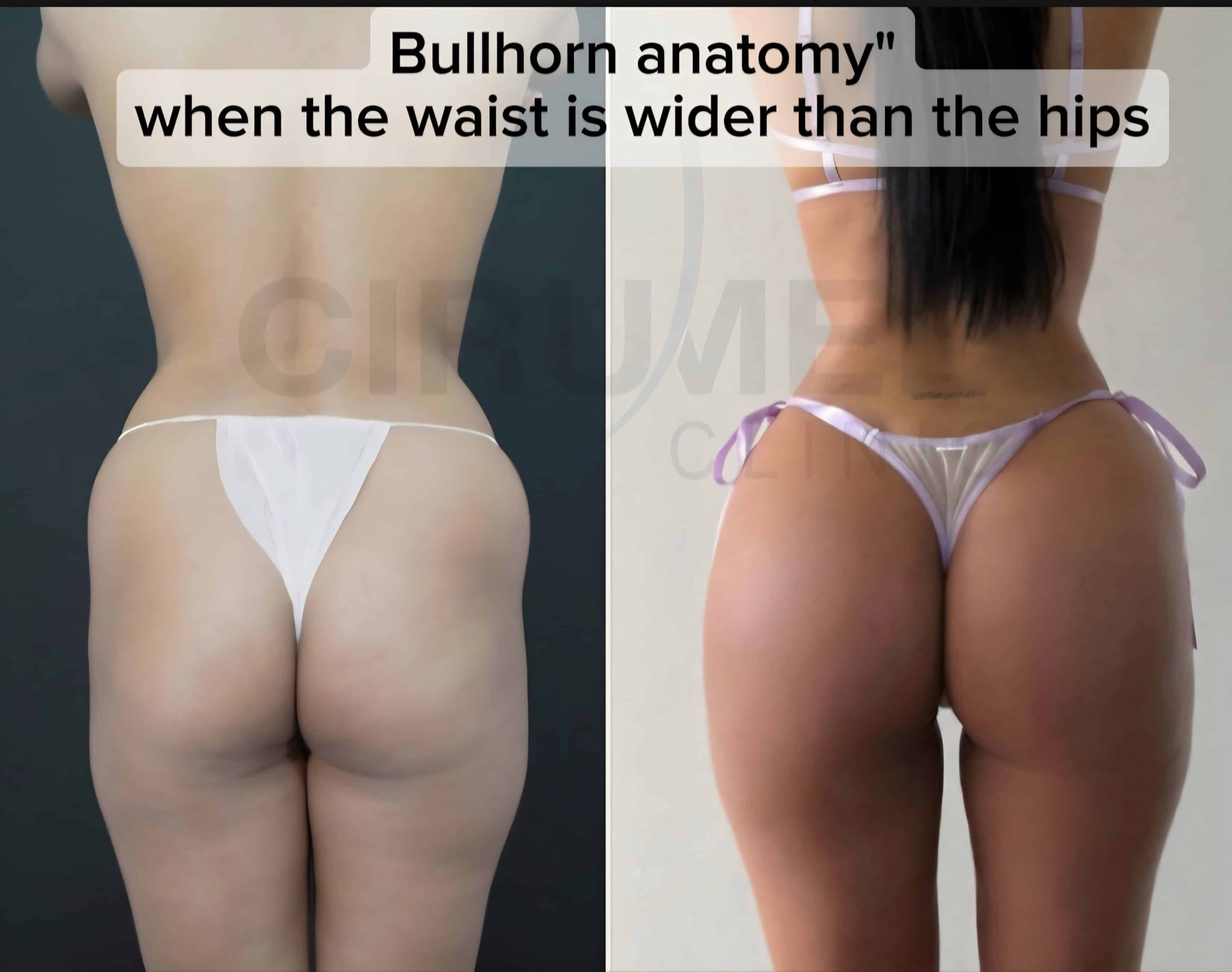
Bullhorn anatomy correction case using lateral waist reduction and hip expansion with hybrid technique.
Why hybrid techniques are often superior
Bullhorn anatomy frequently appears in thin patients with little available fat in the lower back and insufficient natural hip projection. In that context:
- Fat alone is usually insufficient to create structural expansion.
- Implants alone increase projection, but do not refine the lateral shape.
- The combination of both techniques creates a much more effective biomechanical synergy.
That's precisely why, when the goal is to correct proportions and not exaggerate volume, the hybrid approach often offers more sophisticated and stable long-term results. If you want to compare options, this article on BBL with or without implants It helps to understand which technique is appropriate according to the anatomy.
The effect of the waist-to-hip ratio
One of the most powerful visual cues in body contouring surgery is the waist-to-hip ratio. Small variations can completely change how the figure is perceived.
- A ratio close to 1,0: straight, square or slightly curved silhouette.
- Ratio below 0,8: more defined and harmonious silhouette.
- A reduction of only 0,1–0,15 can transform the perceived shape of the body.
This case demonstrates that, in many cases, proportional correction has a much greater aesthetic impact than a large increase in volume.
Why even thin patients can look disproportionate
One of the most common misconceptions is that body dissatisfaction is solely due to weight. In reality, many athletic and slim women feel disproportionate because their waist protrudes laterally, their hips lack curves, and the transition between these two areas is not seamless.
These patients aren't looking to look bigger. They're looking to look more balanced. That's the clinical difference. While in other cases body contouring focuses on treating excess fat, here the goal is to correct an anatomical and structural limitation. A good example is this. Clinical case of buttock augmentation in a thin patientwhere the strategy is not based on excessive volume, but on proportion.
Safety and patient selection
Not every patient with a wide waist is a candidate for Bullhorn correction. The correct indication requires careful evaluation of several factors:
- Skin elasticity and retraction capacity.
- Thickness of soft tissue at the waist.
- Bone morphology of the pelvis and iliac crest.
- Suitability for implants and surgical plan planning.
There's a fundamental principle: excessive liposuction without hip augmentation can worsen the imbalance. Similarly, excessive hip augmentation without waist control can look artificial. Balance isn't optional; it's the foundation of the result.
Who is a good candidate?
- Thin patients with lateral waist projection.
- Narrow hips in relation to the width of the torso.
- Persistent dissatisfaction despite good physical fitness.
- A desire for a more harmonious silhouette, not necessarily a larger one.
- Realistic expectations about the results.
When it is not indicated
- Seeking an extreme or artificial increase.
- Poor skin quality or insufficient elasticity.
- I reject combined procedures when they are necessary.
- General health condition not suitable for surgery.
Surgical experience in complex proportion corrections
This type of surgery is not about following a trend. It requires precise anatomical reading, careful tissue handling, and the ability to combine techniques efficiently. Dr. Alexander Aslani He has developed a highly specialized practice in gluteal surgery and advanced body contouring, with thousands of procedures performed and participation in international scientific publications.
When the main problem is proportion rather than volume, surgical experience makes a decisive difference in the approach and the final result.
Conclusion: Correcting your waistline can indeed transform your silhouette.
Bullhorn anatomy isn't corrected by training more or losing more weight. It's corrected by restoring the waist-to-hip ratio. This usually requires... correct waist, reduce its lateral projection and increase the hip in a structured way through a hybrid strategy.
This case illustrates something essential in advanced body surgery: often, the most powerful change comes not from adding a lot of volume, but from precisely redistributing proportions. In some cases, even a high projection can be achieved with small implants inside a Supercharged BBLprovided the anatomy is well analyzed.
Do you recognize this pattern in your body?
If you feel your waist looks wider than your hips despite being in shape, it could be due to anatomical factors rather than weight. At Cirumed Clinic Marbella, we conduct an individual assessment to determine what correction is possible in your case.
We will study your anatomy, your proportions, and the most appropriate surgical strategy before you travel.
Cirumed Clinic Marbella also offers initial assessments via video conference for international patients.
Frequently asked questions about how to correct the waistline in Bullhorn anatomy
Can bullhorn anatomy be corrected without surgery?
When the primary problem is structural, exercise can improve muscle tone, but it doesn't change bone geometry or the lateral projection of the waist. If there is a true anatomical disproportion between the waist and hips, effective correction usually requires body contouring surgery.
Does having a bullhorn anatomy mean I'm overweight?
No. In fact, many patients with this body type are slim, athletic, and maintain healthy habits. Bullhorn anatomy isn't about weight, but rather the proportions between the waist, pelvis, and hips.
Can it be corrected with liposuction alone?
In most cases, no. Reducing the waistline without increasing hip projection can leave the imbalance visible or even worsen it. That's why the most effective strategy often combines precise liposculpture with hybrid body contour.
What does hybrid gluteal augmentation offer in these cases?
The hybrid approach allows combining the structural stability of the gluteal implants with the ability to refine the fat graft. This is especially useful in thin patients with little donor fat and a need for greater lateral convexity.
Is Bullhorn anatomy the same as hip dips?
No. Although they can be visually confused, they are different anatomical problems. Hip dips usually involve a localized depression in the hip; in bullhorn anatomy, the main problem is that the waist protrudes more than the hips. Therefore, the treatment is also different. You can learn more about this difference in this article about pencil cases vs hip dips.
Who is usually a good candidate for this type of correction?
Good candidates are usually slim patients with a prominent waistline, narrow hips, good skin elasticity, and realistic expectations. The final indication always requires an individualized anatomical assessment.
Is the goal to achieve a larger buttocks or a more harmonious silhouette?
In these types of cases, the main goal is not to maximize volume, but to restore proportion. The most important change is usually in the transition between waist and hips, not in an exaggerated increase in buttock size.
Can I submit a rating if I live outside of Spain?
Yes. Cirumed Clinic Marbella allows an initial online assessment for international patients before their trip.




