


Gold case: why this anatomy favored a hybrid 330cc buttock augmentation
Main idea: This article does not attempt to explain in general terms what a hybrid gluteal augmentation is. The differentiating approach is to understand why this patient was a particularly favorable candidate for a 330cc hybrid gluteal augmentation: good muscle thickness, sufficient available fat and a very useful fat distribution in the waist and flanks.
At Cirumed Clinic Marbella, the result depends on more than just choosing a technique. In this case, the 330cc gluteal implant provided stable projection, the patient's own fat smoothed the transition around the implant, and the initial anatomy allowed both to work together to achieve the desired result.
That's why we talk about a “Gold Case”: a situation in which the technique can approach its maximum potential because the patient has particularly suitable anatomical conditions.
Main video of the case
Quick facts about the case
The 3 conditions that made this a Gold Case
This case stands out not only for the technique, but also because the patient had particularly favorable anatomical conditions for a hybrid gluteal augmentation with a 330 cc implant and her own fat.
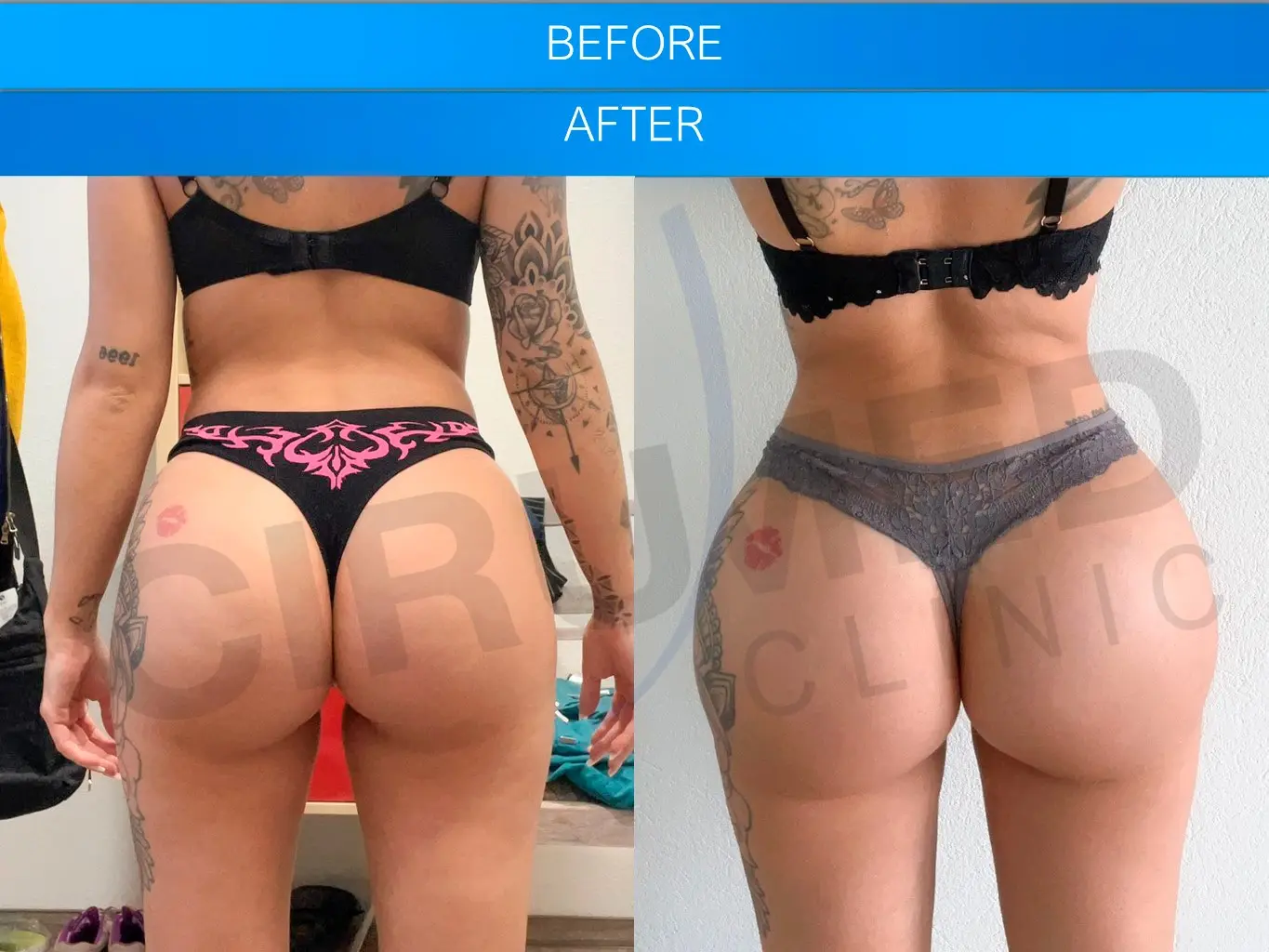
Why combine implants and fat?
A single gluteal implant can offer lasting projection, but if tissue coverage is limited, it may be more noticeable. Using the patient's own fat, on the other hand, provides a more natural texture, although this depends on the amount available and how much of the graft survives.
The hybrid approach allows each resource to be used for what it does best: the implant supports projection and the fat provides naturalness, transition and contour.
Why 330 cc was suitable for this anatomy
This article does not seek to debate whether a small or large implant is better. Its purpose is more precise: The correct size is the one that the anatomy can safely and naturally cover..
In this patient, a 330 cc implant was suitable given the available muscle thickness and tissue. Choosing a larger volume would not necessarily have resulted in a better outcome; it could have increased the risk of visible margins or a less integrated shape.
The fat grafted around the implant completed the silhouette. Therefore, the number “330 cc” should not be interpreted as a universal figure, but rather as an anatomical choice for this specific case.
How waist fat helped the result
One of the reasons this case was particularly favorable is that the fat wasn't distributed evenly. It accumulated in areas that are very useful for body contouring: the waist, flanks, and lower back.
Removing the fat visually refined the silhouette. Reusing it improved the transition around the implant. In other words, the same fat that widened the waist later helped to create a more natural-looking buttock augmentation.
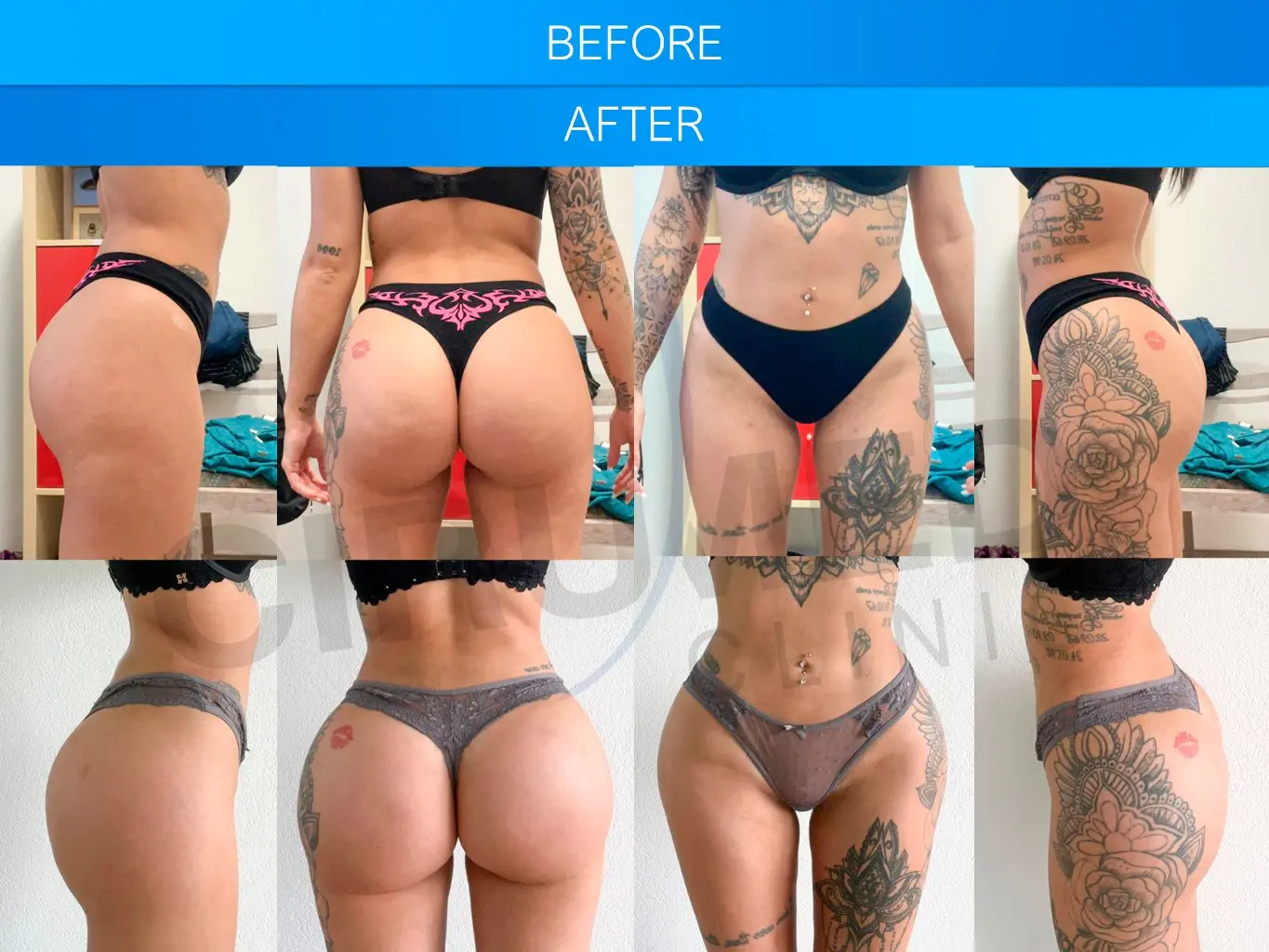
Photos of the case
What can we learn from this case?
The main takeaway is that a good hybrid result stems from the collaboration between anatomy and surgical planning. The implant provides stable projection, the fat creates a more natural transition, and liposuction of the appropriate areas improves the body contour.
When a patient has favorable conditions, the result can be more harmonious because each part of the technique works with fewer compensations. Therefore, a personalized assessment is essential before deciding on size, technique, or expected outcome.
Related reading
These pages expand on specific topics without shifting the focus away from this case: why this patient was a particularly favorable candidate for a 330cc hybrid gluteal augmentation.
Did you find this helpful? Share it!
FAQ
A good candidate typically has sufficient muscle thickness to accommodate the implant, available body fat for transfer, and a fat distribution that allows for contour improvement upon removal. In this case, all three conditions were present.
Yes, autologous fat is important for smoothing the implant's perimeter and creating a natural transition. If very little fat is available, the hybrid component is more limited, and it may be necessary to adjust expectations or the strategy.
The muscle helps create a stable pocket and adequate coverage for the implant. When the muscle is too thin or the coverage is limited, the risk of the implant being more noticeable increases.
Yes. In this case, the fat was accumulated in the waist and flanks, an especially useful area because removing it defined the waist and, at the same time, provided fat to graft around the implant.
Because that volume was compatible with the patient's muscle and tissues. The choice wasn't made to maximize size, but to achieve a stable projection that could integrate naturally with the grafted fat.
No. Technique is important, but the initial anatomy has a significant influence. Muscle thickness, the amount of fat, and its distribution determine the potential results in each individual case.
Personalized assessment with Dr. Aslani
This case illustrates why a hybrid buttock augmentation should not be chosen solely based on the implant's cubic centimeter size. The key is to assess the patient's actual anatomy: muscle mass, available fat, body distribution, tissue quality, and aesthetic goals.
At Cirumed Clinic Marbella, the indication is presented in a personalized way to decide if the most appropriate approach is fat, implant, hybrid technique or a broader body contouring strategy.