




One of the most frequent points of confusion in buttock contouring surgery is the difference between pencil cases and hip dipsMany patients believe they need aggressive liposuction of the outer thigh when, in reality, the problem is not excess fat but a lateral structural depression. Operating on them as if they were the same is a surgical error with consequences. This case explains why the correct diagnosis changes everything.
The essential things you need to know
- pencil cases vs hip dips They are not the same, and treating them the same way produces results opposite to those sought.
- This patient came in requesting liposuction of her saddlebags. The actual diagnosis was a trochanteric depression, a structural hip dip. Liposuction of that area would have worsened her contour.
- The solution was a BBL with own fat which redistributed the volume towards the deficient area without removing anything from the lateral hip.
- The visible result in the operating room demonstrates that precision matters more than the total volume removed.
- Approximately 70% of the complex gluteal revision cases we treat at Cirumed are a consequence of excessive liposuction of the hip area in a previous surgery.
Intraoperative clinical case: correct diagnosis of hip dips vs saddlebags Dr. Alexander Aslani, Cirumed Clinic Marbella
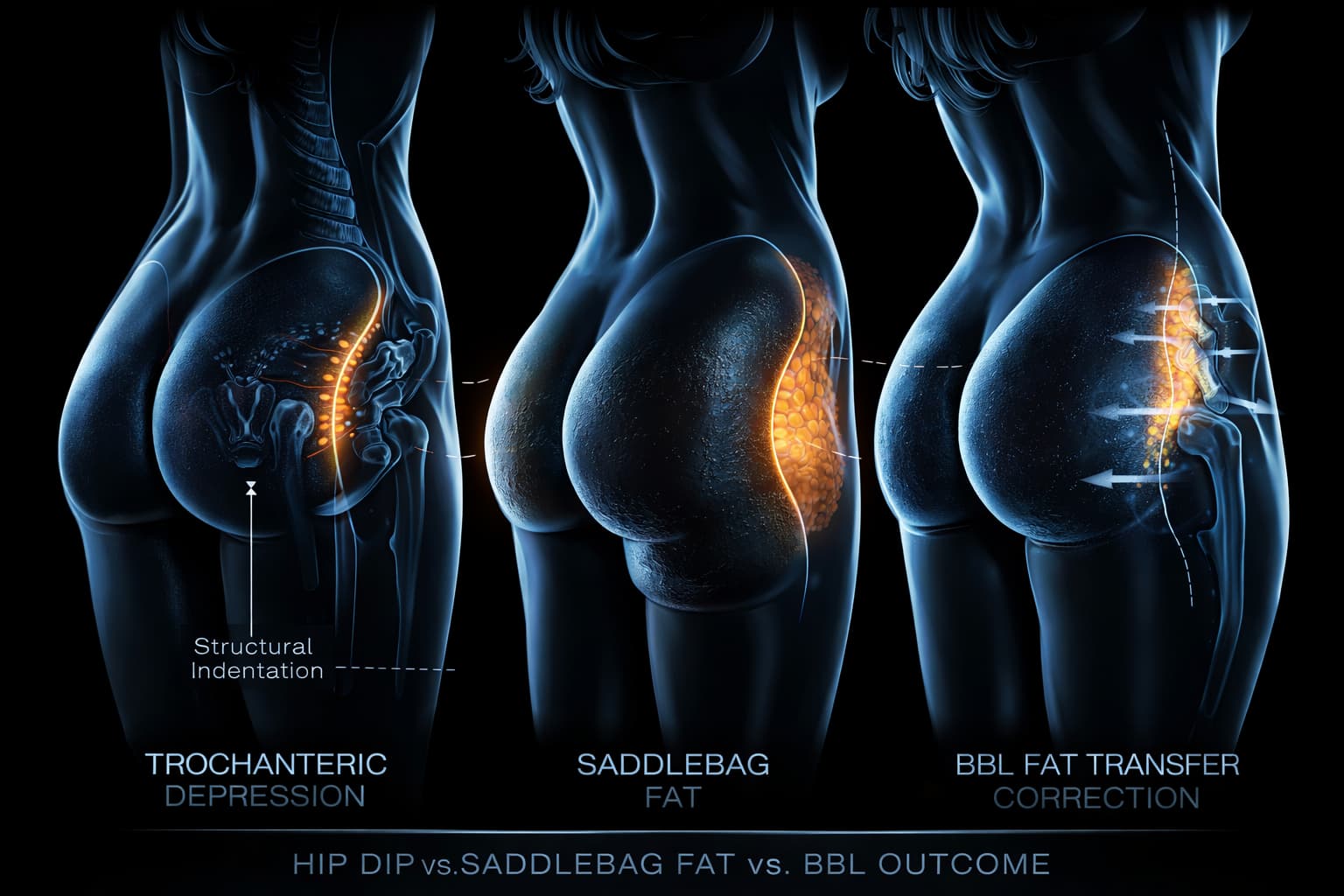
Saddlebags vs hip dips: the anatomical difference that changes everything
Before planning any lateral hip surgery, it is essential to answer one question: Is the problem excess volume or a volume deficit? The answer determines whether the solution is to remove fat or add it.
← Swipe to see →
| Feature | Cartridges | Hip Dips |
|---|---|---|
| What is a biosimilar | Excess subcutaneous fat on the lateral aspect of the thigh | Structural depression at the level of the greater trochanter |
| Cause | Fat accumulation often with skin laxity | Skeletal morphology and genetic volume deficit |
| What you see | Protuberance below the iliac crest | Lateral sagging that interrupts the hip curve |
| Correct treatment | Moderate and controlled liposuction | Fat transfer adds volume where it's lacking |
| Frequent mistake | Excessive liposuction that creates irregularities | Liposuction of the area worsens the depression |
Treating a hip dip as a saddlebag is a surgical mistake
When fat is removed from an area that already has a volume deficit, the lateral buttock support structure is weakened. This compromises the structural support of the buttocks and can create secondary depressions, fat migration, and long-term instability. Correcting these types of complications is significantly more complex than preventing them.
The case: a "cartridge" that was actually a hip dip
The patient arrived requesting liposuction of what she described as prominent saddlebags. However, the clinical examination revealed that the problem was not excessive fat in the trochanteric region, but quite the opposite:
- Marked trochanteric depression, structural hip dip
- Insufficient projection of the lateral gluteal pillar
- Volume deficit in the superolateral quadrant of the gluteus
- Hip contour visually segmented by sagging, not by excess
In patients like this, aggressive liposuction of the so-called "cartridge" would have created secondary depressions, tissue irregularities, increased risk of fat migration, and chronic instability of the lateral contour.
The surgical strategy: add where it was missing, respect what was holding it together
The surgical plan was designed around one principle: volume redistribution is superior to volume subtraction when the problem is structural.
High-definition 360° liposuction
Conservative fat removal was performed on the lateral hip area, respecting the lateral gluteal pillar. Fat was extracted from the abdomen, flanks, and lumbar region to define the waist and obtain donor fat.
Preservation of the lateral pillar
The lateral gluteal pillar is not a cosmetic addition; it's structural support. Its preservation is as important as fat transfer to areas of deficiency.
Fat transfer to depression
Grafting directed to the trochanteric depression and the superolateral quadrant of the buttock to fill the depression and create a continuous waist-to-hip transition.
Single BBL session using own fat
All in a single procedure in a certified hospital operating room under general anesthesia. Without implants, the available fat was sufficient for the planned structural correction.
The key concept: the lateral pillar of the gluteus
The lateral pillar is the structural zone that connects the waist to the hip, supports the projection, and prevents lateral collapse. If it is removed or weakened, no amount of central projection can compensate for the defect. In patients with hip dipsThe integrity of this area determines whether the final result looks athletic and harmonious or artificial and irregular.
The intraoperative outcome: precision before volume
Intraoperative images taken at the end of the surgery show complete rounding of the hip line using fat transfer alone, without over-resection of the lateral thigh. The result, visible even on the operating table before edema appears, demonstrates:
- Seamless and smooth transition from hip to waist
- Elimination of lateral sag
- Stable rounding of the lateral contour
- Harmonized lower silhouette without irregularities
Taking into account the expected fat reabsorption and resolution of the edema, the grafted volume was sufficient to permanently correct the hip dip. To see more cases, visit our website. before and after gallery.
Why excessive liposuction creates secondary deformities
At Cirumed, approximately 70% of complex gluteal surgery cases are revision procedures. Many of these patients had previously undergone a BBL at another center. One of the most frequent technical errors: over-liposuction of the supposed saddlebag area.
What usually happens is that the lower lateral quadrant of the buttocks becomes excessively thin, the gluteal pillar weakens, fat migrates or redistributes over time, visible irregular depressions appear, and revision surgery becomes significantly more complex. Therefore, avoiding this mistake is much easier than correcting it.
⚠ Patients who should NOT undergo aggressive lateral liposuction
- In patients with visible hip dips, the sinking would worsen.
- Sparse lateral soft tissue with no safety margin
- Previous gluteal surgery means the tissue is already compromised
- Laxity of connective tissue increases the risk of irregularities
- History of previous aggressive liposuction in the area
Is this approach for you? Pouches vs. hip dips: how to know which one you have
✓ This approach is for you if…
- You have a visible depression on the side of your hip, not a bulge.
- You've been told you need liposuction of your saddlebags, but you're not sure.
- You're looking for a smooth hip transition without artificial shapes
- You prefer structural correction to maximum projection
- You are a candidate for BBL with own fat with sufficient donor fat
This approach is not for you if…
- You seek extreme lateral projection beyond your anatomical limits
- You have significant skin laxity that requires excision procedures.
- You cannot accept the 3-6 month fat reabsorption phase
- Your problem is actually excess fat on the side of your thigh.
Three questions to ask before planning any lateral hip surgery
Is the problem excess volume or a volume deficit? Is the depression structural or related to fat? Will removing tissue worsen the contour? Without answering these questions, surgical planning is guesswork. With them, the results become predictable.
Do you have hip dips and have you been told you need liposuction of your saddlebags?
The correct diagnosis completely changes the surgical plan and the outcome. An evaluation with the Dr. Aslani Determine if your problem is excess or insufficient volume, and which technique produces a lasting result without creating secondary deformities. You can also consult the ISAPS guidelines.
No commitment required. Also available for international patients.
Frequently asked questions: pencil cases vs hip dips
Regarding diagnosis and difference
What is the difference between pencil cases and hip dips?
cartridge belts They are an excess of subcutaneous fat on the lateral aspect of the thigh, below the iliac crest. hip dipsIn contrast, hip dips are a structural depression at the level of the greater trochanter, a lateral indentation that interrupts the natural curve of the hip. The problem with hip dips is not excess volume but a deficiency. Therefore, the correct surgery is the complete opposite: liposuction for saddlebags, fat transfer for hip dips.
How do I know if I have saddlebags or hip dips?
The most reliable way to diagnose hip problems is through a clinical examination by a surgeon experienced in body contouring. As a general guideline: if you have a bulge or bump on the side of your hip, it's likely saddlebags. If you see a depression or "bump" between the iliac crest and the greater trochanter that interrupts the natural curve of the hip, it's probably hip dips. In many cases, both are present simultaneously, making differential diagnosis even more crucial before surgery.
Why is it a mistake to operate hip dips like saddlebags?
Because with hip dips, the problem is a lack of volume, not an excess. If liposuction is performed in an area that is already sunken, the tissue that still supports the lateral structure of the buttocks—the lateral pillar—is removed. This weakens the contour, creates more visible secondary depressions, can cause fat migration, and leaves the tissue in worse condition for any future revision. Therefore, it's a mistake that is much easier to avoid than to correct.
Regarding treatment and recovery
How are hip dips surgically corrected?
The correction of the hip dips The most effective method is fat transfer directed to the trochanteric depression, the sunken area, using a BBL with own fatFat is extracted from donor areas such as the abdomen, flanks, or lower back and precisely redistributed to the area of deficiency. In cases with very little available fat, it may be necessary to combine this with other approaches. The key is to preserve the lateral buttock pillar throughout the procedure.
How long does recovery take after hip dip correction with BBL?
Recovery is similar to that of a standard BBL. For the first 2-3 weeks, relative rest is recommended, and sitting directly on the buttocks should be avoided. A compression garment is worn for 4-6 weeks. Strenuous exercise should be avoided for at least 6 weeks. Final results are visible after 3-6 months, once the swelling has subsided and the transferred fat has integrated.
Can saddlebags and hip dips be corrected in the same surgery?
Yes, and it's quite common. Many patients present with both conditions simultaneously: excess fat in one area of the lateral thigh and a trochanteric depression in another. In these cases, surgery combines controlled liposuction in the areas of excess fat with targeted fat transfer to the areas of deficiency. The key is for the surgeon to correctly diagnose which part of the lateral hip requires which intervention—before making any incisions.




