



La male liposuction It follows a different anatomical logic than female body contouring surgery. In men, the goal is not usually to create curves or increase volume, but to define structures: a flatter abdomen, a cleaner waist, a firmer chest, and an athletic silhouette that doesn't look artificial.
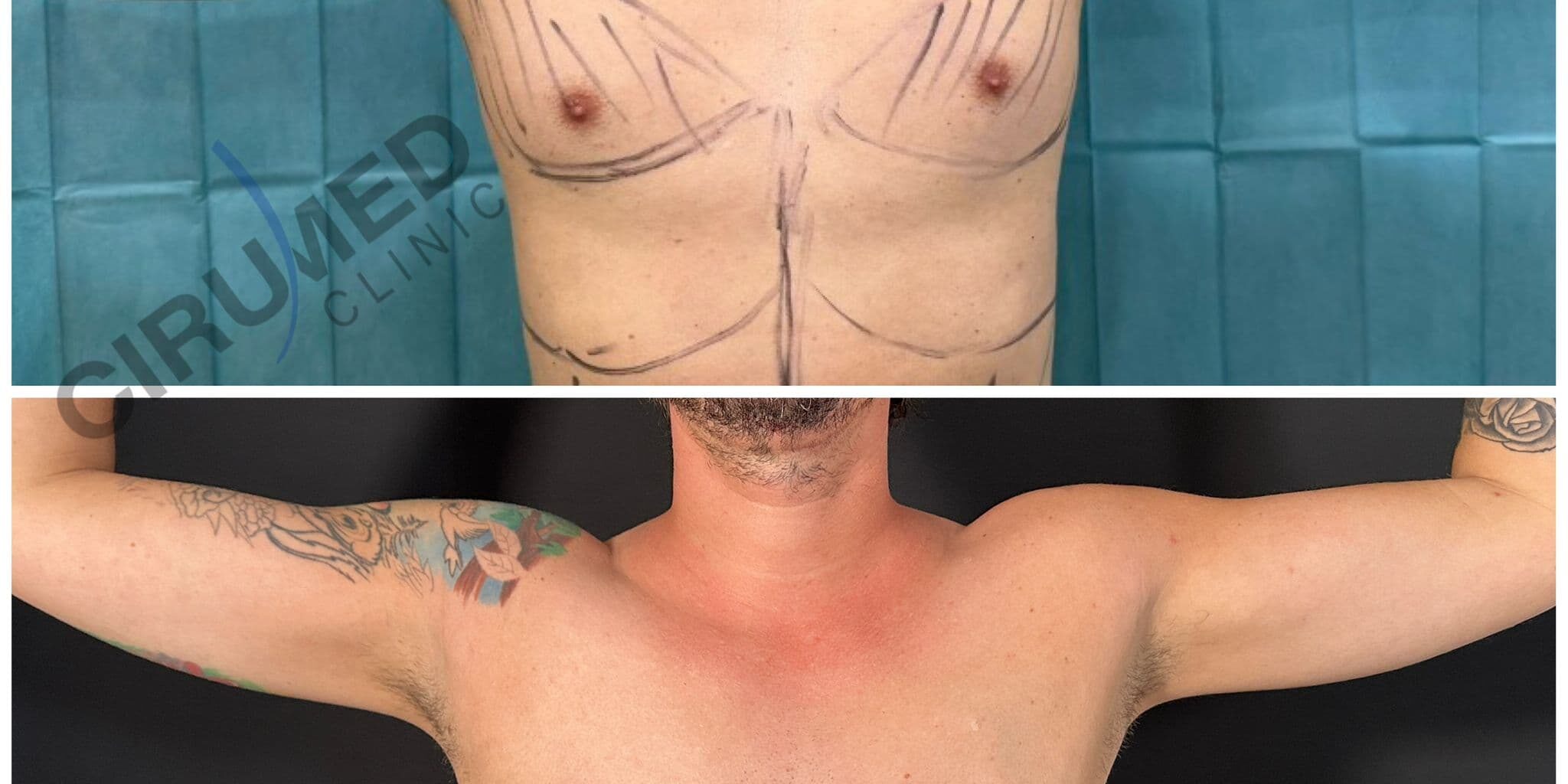
This case shows how a male liposuction high precision, combined with minimally invasive correction of male gynecomastia and smooth abdominal definition, can transform stubborn fat into a masculine, natural, and proportionate result.
The essential things you need to know
- Stubborn fat in the lower abdomen and flanks is very common in men, even with regular training.
- True gynecomastia is not just fat: it can also include denser glandular tissue.
- Male liposuction should define lines, not create a feminine waist or an artificial abdomen.
- In patients with thick subcutaneous fat, soft abdominal definition is usually more natural than extreme abdominal etching.
- The combination of liposuction, gynecomastia treatment, and assisted skin retraction allows for a more complete result.
Clinical case: male liposuction, smooth abdominal definition and gynecomastia correction
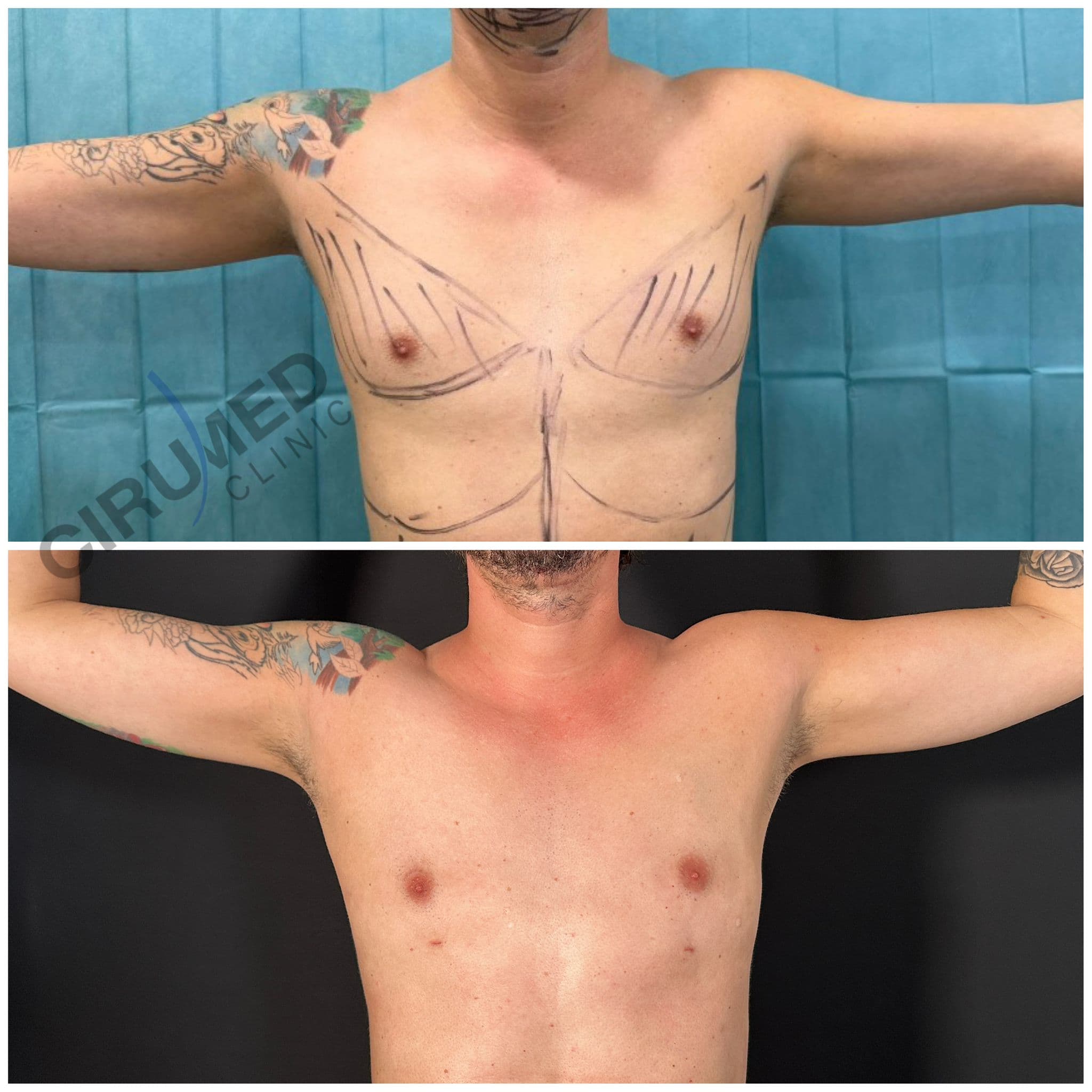
Correction of male gynecomastia and torso reshaping using a minimally invasive technique.
The case: stubborn fat in the abdomen, flanks, and male chest
The patient presented with a significant accumulation of subcutaneous fat in the lower abdomen and flanks. This area, commonly known as the "swim ring" or "love handles," can be resistant to exercise and weight changes. Furthermore, it is a common pattern in men due to hormonal distribution and the regional density of fat cells.
Along with this localized fat, the patient also presented with true gynecomastia. This means that there was not only fat in the chest, but also fibrous glandular tissue that created projection and an appearance of "enlarged male breasts." In these cases, a liposuction The standard is usually insufficient, as the gland is denser and responds differently.
Initial Anatomy
- Stubborn fat in lower abdomen
- Prominent “float” type flanks
- Undefined waist
- Glandular gynecomastia
- Breasts with excessive volume
Surgical objective
- Flatter abdomen
- A cleaner male waistline
- Reduced flanks
- Firmer and more defined breasts
- Natural abdominal definition
Surgical strategy: radical liposuction with controlled definition
The surgical plan did not consist solely of fat removal. To achieve a masculine and balanced result, it was necessary to combine volume reduction, structural definition, breast correction, and improved skin retraction. This type of approach is related to the male liposculpturebut adapted to the specific anatomy of the patient.
Abdominal and flank liposuction
Stubborn fat was removed from the lower abdomen and side area to create a cleaner transition between rib cage, waist, and pelvis.
Gynecomastia correction
The glandular tissue was fragmented and aspirated using vibratory instrumentation, avoiding visible scarring and open techniques in this selected case.
Smooth abdominal definition
Subtle anatomical shadows were marked following the rectus abdominis, without creating excessive furrows or a "sculpted" appearance.
Assisted skin retraction
Energy technology was used in selected areas to promote skin contraction after fat reduction.
Why the result had to be natural, not extreme
In male liposuction, the goal is not to create an artificial "six-pack." The result should enhance the patient's natural anatomy: a flatter abdomen, a cleaner chest, and more athletic lines, but without exaggerated lines or a surgical appearance.
Do you have stubborn fat or enlarged male breasts?
The right strategy depends on whether the problem is fat, glandular tissue, sagging skin, or a combination of factors. A medical evaluation will determine if you need liposuction for men, gynecomastia correction, or a combined approach.
High-precision liposuction of the abdomen and flanks
The first step was to treat the abdomen and flanks using vibration-assisted liposuction. This technology facilitates the fragmentation of dense fat, improves contour control, and can reduce trauma compared to more aggressive manual techniques. You can find more information about the different types of liposuction. advanced liposuction technologies and its instructions.
In men with thicker subcutaneous fat layers, the amount of fat removed must be carefully planned. Removing too much volume superficially can result in depressions, irregularities, or an overly pronounced appearance. Therefore, the goal is to reduce the "love handles" without compromising a natural look.
Minimally invasive gynecomastia correction
True gynecomastia requires a specific approach. When glandular tissue is present, conventional liposuction may not be sufficient because glandular tissue is firmer and more resistant than fat. In this case, the tissue was fragmented and aspirated using vibratory instrumentation, avoiding additional open excision incisions.
This approach can offer advantages in selected patients: less visible scarring, faster recovery, and preservation of the natural chest contour. The goal is not to empty the chest, but to flatten it while maintaining a proportionate masculine projection. For cases where the primary problem is enlarged male breast tissue, please refer to the page on [website/section name]. Gynecomastia in men.
The key idea
Correcting gynecomastia doesn't mean leaving the chest sunken. The goal is to eliminate excess glandular and fatty volume while preserving a masculine and natural pectoral shape.
Soft abdominal definition: better than an artificial six-pack
One of the most important aspects in this case was abdominal definition. There are two approaches: aggressive, high-definition etching and subtle anatomical enhancement. In patients with thicker subcutaneous fat, extreme etching can produce an artificial or overly sculpted appearance.
For this reason, a subtle abdominal definition was performed. The vertical markings were aligned with the rectus abdominis to create natural shadows, enhance muscle perception, and maintain a result that ages better over time. This approach also differs from a Lipo 360 conventional, because it not only reduces volume: it seeks a controlled masculine definition.
When to avoid overly aggressive marking
- When the subcutaneous fat layer is thick.
- When the skin has a limited capacity to retract.
- When the patient seeks an athletic but natural result.
- When there is a risk of irregularities due to over-definition.
Energy-assisted skin retraction
After significant fat reduction, the skin needs to adapt to the new contours. In this case, energy technology was used in selected areas to promote skin retraction and improve the final definition.
This step is especially relevant in men, as skin quality can vary greatly. If too much volume is reduced without proper retraction, sagging may occur. Conversely, adequate retraction helps achieve a firmer abdomen without excision surgery. In selected cases, a similar approach to that of the 360 liposuction with Renuvionalways according to the skin quality and the patient's objective.
The aesthetic philosophy: masculinity through structure, not volume
Male liposuction should not follow the same logic as female body contouring. In women, the goal is often to redistribute volume and enhance curves. In men, the objective is usually different: to flatten bulges, define lines, and improve transitions without feminizing the waist.
The waist should be narrowed, but not transformed into an hourglass figure. The abdomen should be defined, but not sculpted. The chest should be flattened, but not left empty. This balance requires experience with male fat patterns and a different approach than liposuction for women.
Who is a good candidate for male liposuction?
Surgery may be appropriate for patients with localized fat deposits resistant to diet and exercise, relatively stable weight, and realistic expectations. It may also be indicated for men with mild to moderate gynecomastia who desire a flatter chest without extensive visible scarring.
In patients with more than 3,5 cm of abdominal subcutaneous fat, soft definition is usually preferable to extreme etching. This results in a more natural appearance and reduces the risk of irregularities. In cases with clear localized fat, a [optional technique] may also be considered. liposuction for men adapted to abdomen, flanks, back or chest.
Good candidate
- Stubborn localized fat
- Stable weight
- Mild or moderate gynecomastia
- Desire for a natural result
- Good quality leather
It's not ideal when there are
- Severe obesity without prior weight loss
- Extensive sagging requiring excision
- Expectations of an immediate “fitness body”
- Desire for extreme definition with thick fat
- Uncontrolled medical problems
Safety, limits, and realistic results
Liposuction is a powerful tool, but it must respect vascularization, skin perfusion, fat thickness, and the body's natural healing processes. Excessive removal can lead to irregularities, while overly aggressive fat etching can result in an artificial-looking abdomen.
Furthermore, if gynecomastia is not fully treated, breast volume may persist or asymmetry may develop. Therefore, the key is to correctly diagnose what part of the problem is due to fat, what part to glandular tissue, and what part to skin quality.
Why experience matters in the male contour
Male cosmetic surgery requires a specific anatomical understanding. Symmetry, moderation, and subtle transitions are more important than exaggerated transformations. In this case, the combination of flank reduction, controlled abdominal enhancement, gynecomastia correction, and assisted retraction resulted in a masculine transformation that looked natural.
The results demonstrate that technical precision can avoid more invasive surgeries in well-selected patients. Furthermore, it allows for the restoration of proportion without creating an overly surgical appearance. To learn more about the surgeon's medical profile, you can visit the website of [website/link missing]. Dr. Alexander Aslani.
Dr. Alexander Aslani — Cirumed Clinic Marbella
- Advanced specialization in body contouring surgery.
- Experience in high-definition liposuction and male body contouring.
- Anatomical approach geared towards natural and proportionate results.
- Ratings available for international patients.
- Individualized surgical plan according to fat, gland and skin quality.
Do you want to know which technique fits your case?
If you have stubborn fat in your abdomen or flanks, enlarged male breasts, or a lack of abdominal definition, a personalized assessment can determine if you need male liposuction, gynecomastia correction, assisted skin retraction, or a combination of techniques.
Also available for international patients.
Frequently asked questions about male liposuction and gynecomastia
Does liposuction for men help define abdominal muscles?
It can help improve abdominal definition, but it shouldn't be considered an artificial way to create abs. In many patients, especially if there's a thick layer of fat, subtle definition offers a more natural result than extreme definition.
Can gynecomastia be corrected with liposuction alone?
It depends on the case. If the problem is primarily fat, liposuction may be sufficient. However, when glandular tissue is present, a technique capable of fragmenting and removing that denser tissue is needed.
Are there visible scars after gynecomastia surgery?
In selected patients, the correction can be performed using small incisions and minimally invasive techniques. This reduces the visibility of scars compared to more extensive open approaches.
What is the difference between liposuction for men and women?
In men, the goal is usually to define structure, reduce protrusions, and enhance athletic lines. In women, the aim is often to accentuate curves and redistribute volume. Therefore, the surgical approach differs.
When is J-Plasma or assisted skin retraction recommended?
It may be recommended when the skin is expected to need help adapting to the new contour after fat removal. It is especially useful if there is a significant reduction in volume or variable skin quality.
Who is not a good candidate for this procedure?
It is not usually ideal in cases of severe obesity, massive sagging, unrealistic expectations, or a desire for extreme abdominal definition when the fat layer is too thick.




