




Tuberous breasts are a congenital breast development disorder in which the glandular tissue does not grow normally, resulting in breasts with a narrow base, a tubular or elongated shape, and, in many cases, enlarged or bulging areolas. They are also known as tubular breasts, tubular chest, or constricted breasts. The condition usually becomes visible during puberty and has a surgical solution: the correction of tuberous breasts in Marbella, performed by Dr. Alexander Aslani at Cirumed Clinic, is tailored to each individual case to release the constriction, reshape the gland, and improve the breast shape naturally.
This guide explains what tuberous breasts are, their causes, the different grades, how they are diagnosed, and the surgical treatments available to correct them. We also cover recovery, expected results, and frequently asked questions about tuberous breast correction.
The essentials about tuberous breasts
Tuberous breasts, also called tubular breasts or constricted breasts, are a breast developmental abnormality that typically becomes visible during puberty. They can result in a narrow base, enlarged areolas, a lack of volume in the lower part of the breast, and asymmetry. Correction usually requires customized surgery to release the constriction, reshape the glandular tissue, and improve breast form.
Anesthesia: general
Duration: 1,5–3 h approx.
Initial recovery: 7–10 days
Final result: 3–6 months
Key: reshape the form, not just increase volume
What are tuberous breasts?
Tuberous breasts are a breast developmental disorder in which the glandular tissue does not expand normally. As a result, the breast takes on a narrow, tubular, or constricted shape, with a reduced breast base and incomplete development of certain areas of the breast.
This is a congenital condition that usually becomes apparent during puberty, when breast development begins. Many patients seek help for cosmetic reasons, although the impact can also be emotional, affecting self-esteem, body confidence, and the choice of clothing, bras, or bikinis.

How to know if you have tuberous breasts
Not all tuberous breasts look the same. In some cases, the abnormality is very obvious, while in others it can be mistaken for small, asymmetrical, or underdeveloped breasts. Medical evaluation is important because correction depends not only on breast size, but also on shape, base, inframammary fold, and the distribution of glandular tissue.
You may suspect you have tuberous breasts if your breasts are elongated or tubular in shape, the areola appears large or bulging, there is little volume in the lower part of the breast, or there is a marked difference between both breasts.
Main features of the tubular chest protector
Narrow breast base
The breast does not develop evenly over the chest wall, which makes the base narrower than usual.
Areolar herniation
The areola often appears larger, more prominent, or bulging due to the pressure of the breast tissue on this area.
Lack of volume at the bottom
The lower quadrants of the breast are often underdeveloped, which contributes to the tubular appearance.
Raised submammary fold
The fold under the breast is located higher than normal, altering the overall shape of the breast.
Frequent asymmetry
It is common for one breast to be more affected than the other, and even for only one breast to have a tuberous deformity.
Causes of tuberous breasts
Although there is no single, clearly defined cause, several factors have been identified as being related to the development of tuberous breasts. One of the most widely accepted is the presence of an alteration in the mammary fascia, a fibrous band that hinders the normal expansion of glandular tissue.
A genetic predisposition, alterations in the embryonic development of the breast, or certain hormonal factors during puberty, when this malformation usually becomes visible, can also play a role.
Grades or types of tuberous breast
The most commonly used classification for tuberous breasts is that of Grolleau, which distinguishes three grades according to the severity of the alteration.
Grade I
It is the mildest form. There is a deficiency in the inferomedial quadrant, but the overall shape of the chest is relatively preserved.
Grade II
This is considered a moderate degree. Lack of development is observed in the lower quadrants, a protruding areola, and a raised inframammary fold.
Grade III
This is the most severe form. The constriction affects the entire breast base, the areola is usually very dilated, and the asymmetry can be very pronounced.
Symptoms and visible signs
In addition to the physical characteristics already described, many patients with tuberous breasts experience discomfort with the appearance of their breasts, difficulty finding bras or clothes that fit well, and a significant impact on self-esteem or confidence in their body image.
In some cases, the problem isn't perceived as a malformation, but rather as a "strange," "pointy," "separated," or disproportionate breast. That's why many patients discover they have tuberous breasts during a breast surgery consultation.
Tuberous breasts and breast asymmetry
Asymmetry is very common in this malformation. In some cases, one breast has a tuberous shape while the other has a more normal development. This makes a completely personalized surgical approach essential, aimed not only at correcting the shape but also at balancing the symmetry between both breasts.
How is the diagnosis made?
The diagnosis of tuberous breasts is clinical and must be made by a specialist surgeon. During the evaluation, the shape of the breast, its volume, the breast base, the position of the inframammary fold, and the size and shape of the areolas are analyzed.
The patient's medical history is also reviewed, and her breast development during puberty is studied. In some cases, photographs, measurements, and additional tests are performed to properly plan the surgery.
Consequences of tuberous breasts
Tuberous breasts can have a significant impact on a patient's life. Beyond the shape of the breasts, they can cause anxiety, embarrassment, difficulty showing one's body in certain situations, and problems choosing clothes, bras, or bikinis.
In some cases, functional difficulties may also exist, such as alterations in breastfeeding, depending on the degree of glandular development and the type of correction that is performed.
Treatment of tuberous breasts
The treatment for tuberous breasts must be tailored to the degree of deformity, the patient's anatomy, and the desired outcome. The goal is not only to increase breast size, but also to correct the constriction, expand the breast base, reshape the glandular tissue, and improve symmetry.
Why it's not a conventional breast augmentation
Correction of tuberous breasts should not be approached as a standard breast augmentation. In tubular breasts, the main problem is not just the lack of volume, but the way the breast has developed: a narrow base, a poorly expanded lower pole, a high inframammary fold, and, in many cases, a dilated or protruding areola.
Therefore, placing an implant without first correcting the constriction can worsen the tubular shape or create an unnatural result. The treatment should release the internal tissues, reshape the mammary gland, reposition the inframammary fold when necessary, and select the appropriate volume to achieve a more rounded, symmetrical, and harmonious breast.
Correction with implants
In many cases, correcting tuberous breasts requires releasing the tissue constriction, reshaping the mammary gland, and placing implants to restore volume and improve shape. This option is usually indicated, especially in moderate or severe cases.
The choice of implant should be personalized. The goal is not only to add volume, but also to help expand the breast base and achieve a more natural transition between the upper pole, the lower pole, and the areola.
Correction without implants
In certain cases, existing breast tissue can be remodeled without the need for implants, especially when the patient has sufficient natural volume and the main objective is to correct the shape, areola, or asymmetry.
Correction with own fat
The body's own fat, through lipofilling techniques or fat transferIt can be used to enhance contour, smooth transitions, and selectively add volume. In some cases, it can be combined with implants for a more natural result.
It may interest you: types of breast implants.
Correction of dilated areolas
When areolar herniation or an excessively large areola is present, it may be necessary to reduce or reshape the areola during the same procedure. This step is important to improve the overall shape of the breast and prevent it from retaining a tubular appearance after surgery.
Before and after correction of tubular breasts
Before surgery, patients often present with a tubular breast shape, a narrow base, and more prominent or enlarged areolas. This can cause significant insecurity when wearing certain clothes or showing their torso.
After surgical correction, the goal is to achieve a more rounded, harmonious and natural breast shape, significantly improving the proportion, symmetry and the patient's confidence in her own image.
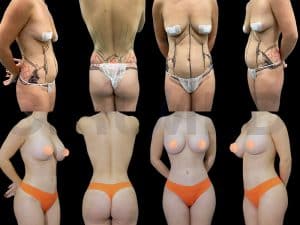
We recommend you see our cases of: breast augmentation before and after.
Recovery and postoperative care
Recovery after tuberous breast correction depends on the technique used, whether implants were placed, whether glandular remodeling was performed, and whether the areola was corrected. Generally, initial recovery is gradual and allows for a return to gentle activities within a few days.
First 48 hours
During the first few days, relative rest is usually recommended, along with the use of the bra or post-surgical garment indicated by the surgeon to help maintain the shape of the breast and promote proper healing.
First week
The patient can gradually resume gentle activities, avoiding any significant physical exertion.
First month
At this stage it is usually possible to gradually return to your normal routine, although intense or impact sports should be avoided unless authorized by your surgeon.
Scar care
Scar care is an important part of postoperative recovery. Depending on the case, creams, massages, or specific guidelines may be recommended to improve its healing.
Expected results
The goal of tuberous breast correction is to achieve a more rounded, proportionate, and natural-looking breast. In most cases, the change is not limited to volume: it also improves shape, the position of the inframammary fold, symmetry, and the relationship between the areola and the rest of the breast.
The final result is usually assessed between 3 and 6 months, when the inflammation has decreased, the tissues have adapted and the breast shape has stabilized.
Do you think you might have tuberous breasts?
If your breasts are narrow, tubular, have enlarged areolas, lack volume in the lower part, or exhibit marked asymmetry, a medical evaluation can help determine if you have tuberous breasts and what type of correction would be most suitable for you.
FAQ
Can tuberous breasts be corrected without surgery?
No. Definitive correction of tuberous breasts requires surgical treatment, as it is a structural alteration of breast development.
Are tuberous breasts a malformation?
Yes. Tuberous breasts are considered a congenital disorder of breast development. It's not simply having small breasts, but a specific developmental pattern in which the breast does not expand properly.
Do tuberous breasts worsen over time?
They do not usually worsen progressively, but they can become more evident with weight changes, pregnancy, breastfeeding, or natural aging of the breasts.
Can tuberous breasts be corrected with implants alone?
It depends on the case. In some patients, the implant is part of the treatment, but it is usually also necessary to release the constriction, reshape the gland, and correct the shape of the areola or the inframammary fold.
Does surgery for tuberous breasts leave scars?
Yes, like any surgery. The location of the scars depends on the technique used. In many cases, the procedure involves working around the areola to reshape it and correct areolar herniation.
Is the result permanent?
The correction is long-lasting, although as with any breast, the passage of time, hormonal changes, pregnancy, breastfeeding or weight variations can influence its appearance over the years.
Can you breastfeed after surgery?
In many cases, yes, although it will depend on the type of malformation, the technique used, and the glandular anatomy of each patient. This is something that must be assessed individually with the surgeon.

What if I only have one tuberous breast?
In these cases, a personalized surgery is designed to correct the affected breast and, if necessary, balance the symmetry with the other breast.
How long does it take to see the final result?
Although the change in shape is noticeable from the beginning, the final result is usually assessed between 3 and 6 months, when the inflammation subsides and the tissues stabilize.
Does correction of tuberous breasts change the size of the areola?
Yes, when there is a dilated or protruding areola, it can be reduced and reshaped during the same surgery to achieve a more proportionate shape.
Correct tuberous breasts with natural results at Cirumed Clinic
Tuberous breasts are a congenital malformation that can affect both the shape and symmetry of the breasts, causing aesthetic and emotional discomfort. At Cirumed, Plastic Surgery Clinic in MarbellaWe understand the sensitivity of these types of cases and offer advanced surgical solutions to restore breast harmony precisely and naturally.
Our specialists analyze the severity of the malformation and design a fully personalized surgical plan, which may include glandular remodeling, breast base correction, areola reshaping, and, when indicated, implants or fat transfer. Thanks to our team's experience and the use of advanced medical technology, we strive for balanced, natural-looking results tailored to each patient.
If you are considering breast augmentation, you can learn more about our treatment. breast augmentation in Marbella, consult the types of breast implants or review our case studies breast augmentation before and after.
Conclusion
Tuberous breasts are a condition that can significantly affect body image and emotional well-being, but today there are surgical treatments capable of correcting it with excellent results.
If this malformation is affecting your quality of life, the most important thing is to consult with an experienced specialist, assess your case individually, and study the available options to achieve a harmonious, natural correction adapted to your needs.




