BBL should not be treated as a simple surgery. It's a body contouring procedure that combines liposuction, fat processing, and fat transfer to the buttocks. Like any surgery, it carries risks; the difference lies in how the patient is selected, how the technique is planned, and what safety protocols are implemented.
At Cirumed Clinic Marbella, Dr. Alexander Aslani approaches BBL from a clear position: the goal is not to operate on everyone, but to operate only when the risk is proportionate, the anatomy allows it and the procedure can be done with safety criteria.
Quick facts
- BBL can be safe when performed with strict selection, proper technique, and medical supervision.
- The most common risks are infection, bruising, irregularities, asymmetry, scarring, and partial fat loss.
- The most serious risk in gluteal fat transfer is fat embolism, which is why the technique and injection plane are critical.
- Not all patients are candidates: high BMI, diabetes, advanced age or a history of non-resorbable fillers may change the indication.
- Post-operative care is also part of safety: compression, mobility, medical monitoring and avoiding direct pressure are key.
Quick answer: Is BBL dangerous?
The BBL It is not dangerous by definition.However, it is a surgery that demands great rigor. The risk increases when the procedure is trivialized, unsuitable patients are operated on, excessive volume is sought in a single surgery, or technical safety principles are not respected.
The correct question is not just “is BBL dangerous?”, but: Am I a safe candidate for a BBL and who will perform it?
Therefore, before discussing results, volume, or price, the first step should be an individual medical assessment.
Risks and possible complications of a BBL
A BBL combines two surgeries in one: liposuction and fat transfer. Therefore, its risks can arise from both the fat removal and the fat grafting into the buttocks.
Infection
As with any surgery, infection can occur at the incision sites or in the treated tissues. The risk is reduced with sterile technique, a suitable surgical environment, close monitoring, and strict adherence to postoperative instructions.
Bruising, swelling and discomfort
Liposuction can cause bruising, swelling, and pain during recovery. These effects are usually expected, but they should be monitored to distinguish a normal recovery from a complication.
Fat necrosis or irregularities
Not all transferred fat survives. Some may be reabsorbed, and in some cases, hard areas, irregularities, or partial volume loss may appear. The technique, the amount transferred, and postoperative care all influence the outcome.
Visible scars
Liposuction incisions are small, but they can leave scars if the skin heals poorly or if they are not cared for properly. Planning the entry points helps to make them as discreet as possible.
Asymmetry or unsatisfactory result
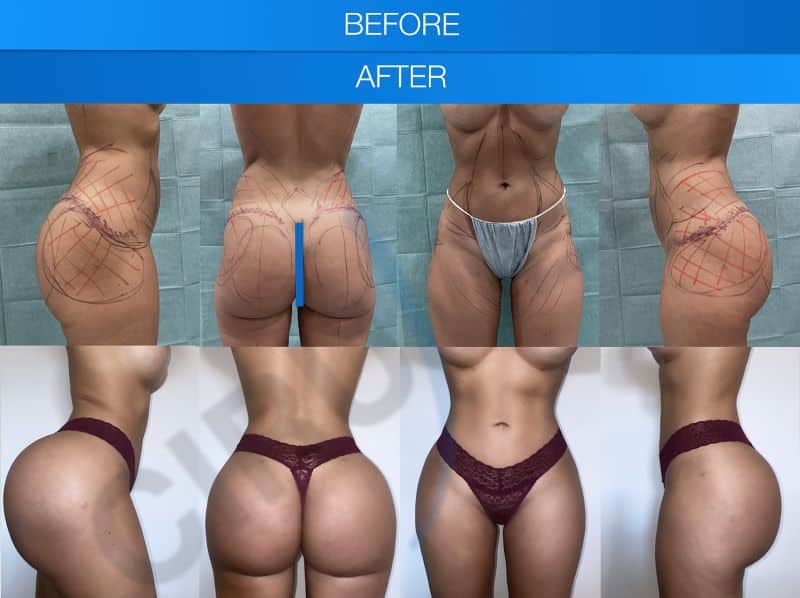
Asymmetry can stem from the initial anatomy, fat survival, or unrealistic expectations. That's why it's crucial that the preoperative consultation clearly defines what can and cannot be achieved.
The risk that really changed BBL surgery
The most serious risk historically associated with BBL is the fat embolismThis can occur if the fat enters deep blood vessels and travels to the pulmonary circulation. That's why modern safety recommendations for gluteal fat grafting emphasize avoiding deep injection and carefully controlling the injection site.
In practical terms: a safe BBL doesn't just depend on "adding fat," but on where it is placed, how it is placed, and in which patient it is placed.
This is one of the reasons why at Cirumed safety begins before the operating room: assessment of health, anatomy, BMI, history, expectations and real volume limits.
When a BBL may not be advisable
An essential part of safety is knowing when to say no. At Cirumed, certain situations may make a patient an unsuitable candidate for a high-volume BBL or extensive body contouring surgery.
- High BMI: It can increase the complexity of anesthesia, surgery, and postoperative care. Read more about it. BMI for BBL.
- Age and general condition: It's not solely determined by age, but the risk changes with age. See the guide on the age limit for BBL.
- Diabetes: Even when well controlled, it can influence the protocol and management of complications. See BBL and diabetes.
- Previous gluteal fillers: especially if they were non-resorbable. See BBL after fillers.
For a complete overview, see our page on BBL contraindications.
How we reduce risks at Cirumed
1. Strict patient selection
Not all patients who want a BBL need surgery. The medical evaluation reviews general health, medical history, medications, BMI, tissue quality, available fat, and expectations.
2. Realistic surgical plan
Safety is compromised when attempting to achieve a result that anatomy doesn't allow. The amount of fat, waist circumference, hip shape, and gluteal projection must be planned proportionally.
3. Specialized surgical technique
BBL requires specific expertise in body contouring. Dr. Aslani has developed a specialized practice in this field, with over 7.000 specialized body contouring cases in the last 16 years.
4. Postoperative protocol
Recovery is not a formality. Compression, drainage, mobility, inflammation control, nutrition, and medical follow-up all influence the safety and quality of the outcome.
You can expand on this section in our guide. BBL postoperative care.
Questions you should ask before surgery
A well-informed patient makes better decisions. Before a BBL, it's advisable to ask:
- Am I really a candidate for this surgery?
- What specific risks are there in my case?
- How much fat can realistically be transferred?
- What happens if I don't have enough donor fat?
- What post-operative protocol will I have to follow?
- What warning signs should I be aware of after surgery?
- When will I be able to sit up, sleep on my back, or return to exercise?
It's also reasonable to discuss budget from the outset. You can check our page on [topic missing]. How much does a BBL cost?.
What if a BBL isn't safe for me?
Just because a BBL isn't recommended in a particular case doesn't mean there aren't any alternatives. Depending on the anatomy and the goal, a different strategy can be considered: more conservative liposculpture, body contouring, phased surgery, skin tightening treatments, or, in some cases, combined techniques.
The important thing is not to force an indication. Cosmetic surgery only makes sense when the expected benefit justifies the risk and the plan can be carried out safely.
To learn about the main procedure, you can check the page of BBL in Marbella.
What does this mean for you as a patient?
A Brazilian Butt Lift (BBL) can transform your figure, but it shouldn't be sold as a quick or risk-free procedure. Making the right decision starts with an honest assessment: what can be done, what shouldn't be done, and what results are realistic for your body.
At Cirumed, a good candidate is not simply a patient who wants more buttocks. It's a patient whose health, tissue, available fat, and expectations allow us to plan the surgery safely.
FAQ
Is BBL surgery dangerous?
BBL is not inherently dangerous, but it is a demanding surgery. The risk depends on patient selection, the technique, the surgical environment, the surgeon's experience, and postoperative follow-up.
What is the most serious risk of a BBL?
The most serious risk described in gluteal fat transfer is fat embolism. That's why modern techniques emphasize avoiding deep tissue planes and adhering to strict safety protocols.
What complications can a BBL have?
There may be infection, bruising, inflammation, visible scarring, irregularities, partial fat loss, asymmetry, or the need for revision. Most risks are reduced with proper indication and an appropriate protocol.
How do I know if I'm a good candidate for a BBL?
You need an individual medical evaluation. This includes a review of your general health, BMI, medical history, skin quality, donor fat, expectations, and any potential contraindications.
Does recovery affect safety?
Yes. Wearing the compression garment correctly, avoiding direct pressure, walking as instructed, keeping up with checkups, and following the post-operative protocol helps reduce problems and improve the outcome.
What if I'm not a BBL candidate?
There may be safer alternatives, such as a more conservative plan, phased surgery, liposculpture, or specific treatments depending on the case. The important thing is not to force surgery that doesn't fit your risk profile.
Cirumed Experience
Dr. Alexander Aslani He is the Medical Director of Cirumed Clinic Marbella and one of Europe's most experienced plastic surgeons specializing in body contouring surgery. He has performed over 14.000 procedures since 1995 and more than 7.000 specialized body contouring cases in 16 years of single-specialty practice.
Their approach to BBL combines anatomical planning, strict patient selection, advanced surgical technique, and postoperative follow-up to reduce risks and seek proportionate results.
Request your personalized assessment
Every patient is different. At Cirumed Clinic Marbella, Dr. Aslani's team will study your case individually to explain whether a BBL is safe for you, what risks your case would involve, and what results can be realistically expected.