



Advanced abdominoplasty with a single scar: the anatomical limit of the bikini scar
Central idea: In an abdominoplasty, a scar is unavoidable.
Surgical quality is not about promising zero scarring, but about choosing the right scar for the anatomical problem and, when possible, achieving a powerful result while maintaining only a single bikini scar.
Related: Abdominoplasty · 360° Liposuction · BBL
The case: severe laxity and advanced diastasis
The patient presented with a very advanced degree of abdominal wall deformity: massive apron-like skin excess, marked diastasis recti, and global abdominal deformity.
In such scenarios, many teams recommend extended scars or a Fleur-de-Lis pattern, adding a vertical scar.
What's interesting about this case is that it represents the upper limit in which a pure horizontal correction can still be attempted, with advanced technique and with realistic expectations about the tension and behavior of the closing.
Psillakis classification: why it exists and what it contributes
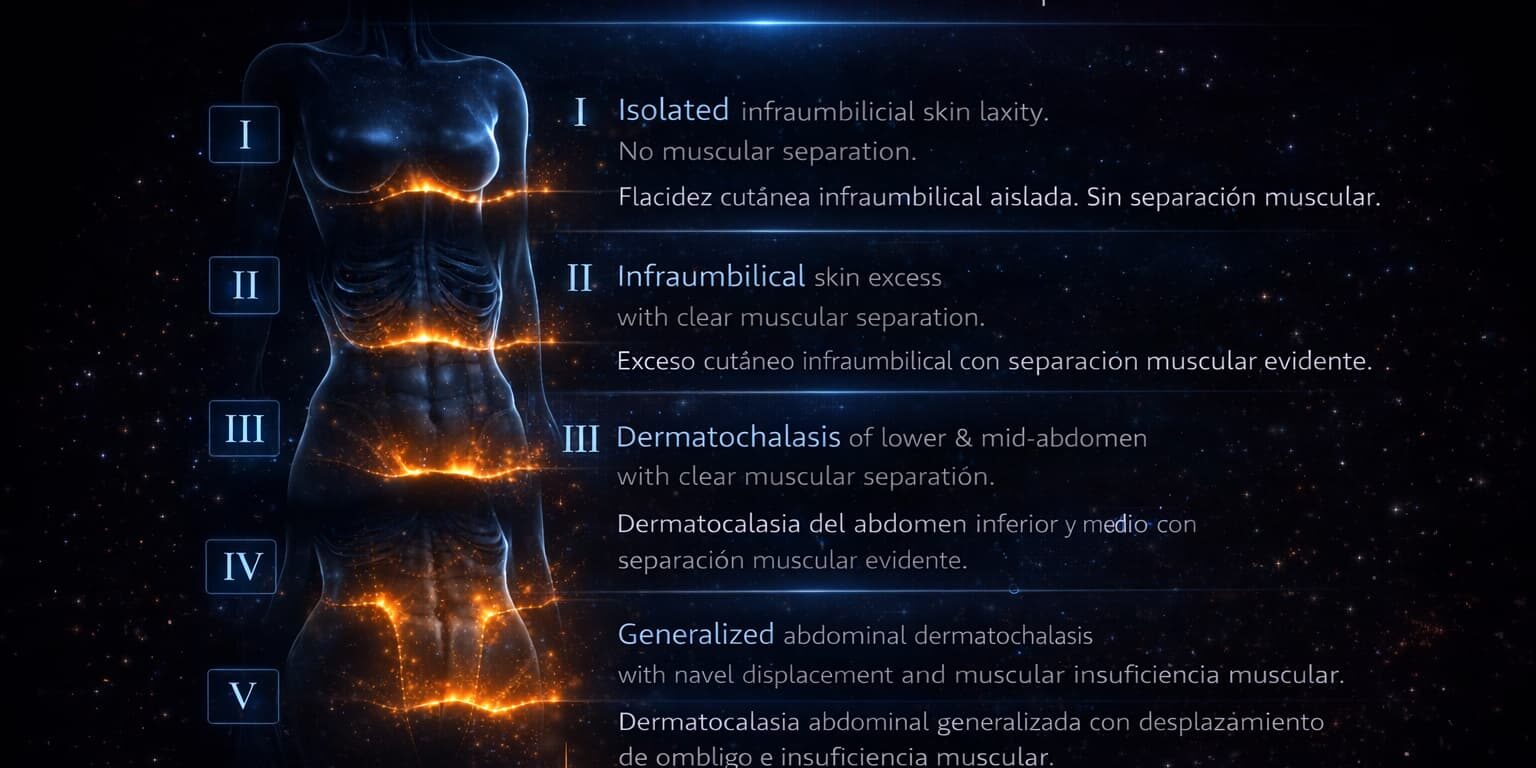
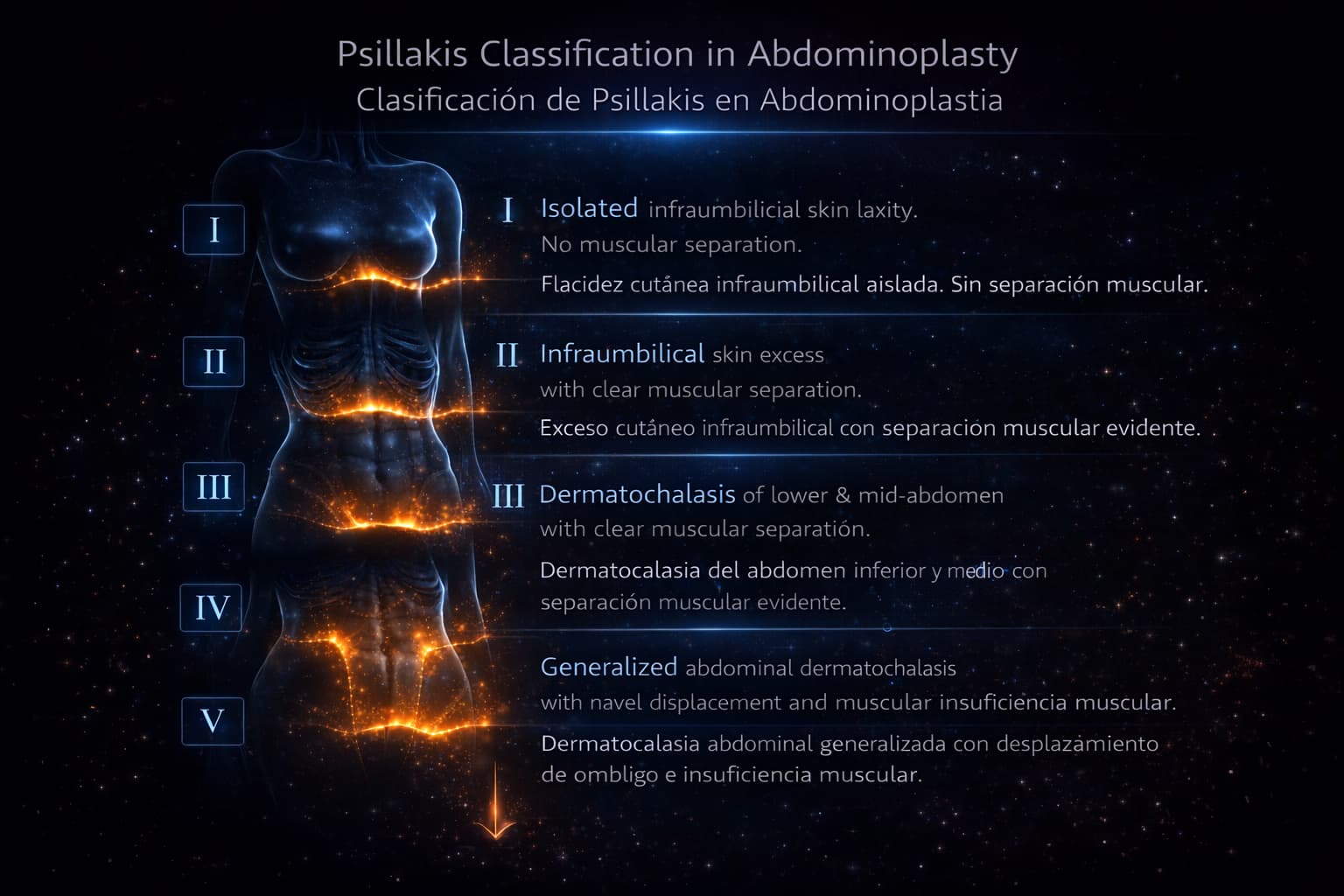
The Psillakis classification helps to order the severity of abdominal dermatochalasis and muscle insufficiency, and guides the scar strategy.
- Type I: mild infraumbilical laxity, without relevant diastasis.
- Type II: Infraumbilical excess with diastasis; a standard abdominoplasty with plication is usually sufficient.
- Type III: excess in lower and middle abdomen with clear diastasis and acceptable navel.
- Type IV: More generalized dermatochalasis, marked insufficiency, and umbilical displacement.
- Type V: massive excess, often following significant weight loss, with either a vertical or circumferential component.
This case: functionally close to a high Type IV or borderline Type V. That's why it's considered a borderline case for trying to maintain a single bikini scar.
Strategy: corset-type plication and maximum skin resection
The basis of the correction is a corset muscle plication.
This maneuver restores the stability of the abdominal wall and helps to create a more defined waistline. In severe cases of diastasis recti, it already represents a significant reconstructive component.
Next, a large excess of skin and tissue is removed. At this point, it is generally accepted that a vertical scar will likely be necessary.
However, this is where technique comes in, pushing the limits of what is possible.
Technique: compress length without adding vertical scarring
In extreme cases, the problem is geometric: the upper line of the flap is longer than the lower bikini incision.
To resolve this discrepancy without adding a vertical scar, a suture type can be used accordion or controlled folding.
- It allows for the distribution of excess flap length.
- It helps distribute tension and minimize dog ears.
- Reduces strong contour distortions.
Important: This technique has anatomical limitations. This case is shown precisely because it is at the upper end where it can still work without compromising the outcome.
Why this represents the limit of a single bikini scar
There are anatomies in which the vertical excess is so large that no suture can safely resolve it without adding a vertical scar.
When excess skin extends well beyond the inguinal folds or vertical redundancy is extreme, vertical scarring or even circumferential patterns become the safest and most predictable option.
The lesson here is clear: The scar is dictated by anatomy.The technique can widen the margin, but it cannot eliminate it.
Synergy with rib remodeling: a stronger waist
In this patient, the following was also performed: rib modeling.
In the context of an advanced abdominoplasty, it has a synergistic effect: by reducing the lower thoracic frame, it amplifies the waist created by the corset-type plication.
The result is a cleaner transition between the upper and lower torso.
Complementary procedures: liposuction and BBL
The case was further complemented by liposuction of flanks and lower backalways respecting safety limits.
Fat removal is never unlimited: there is a physiological maximum to maintain hemodynamic stability and overall safety.
In addition, purified fat was transferred to the buttocks, approximately 1.000 cc per side, as part of a BBLseeking harmony between abdomen, waist and gluteal region.
In combined surgeries, safety depends on case selection, a specialized team, and efficient surgical times.
For whom might this approach be suitable, and for whom might it not?
It may be suitable in patients with severe laxity who are still within the anatomical margin of horizontal correction and who prioritize minimizing visible scarring.
It is not usually appropriate when there is extreme vertical excess or when a circumferential correction would be clearly safer and more predictable.
Conclusion
Even in advanced abdominal deformities, in carefully selected cases a very powerful transformation can be achieved with a single bikini scar.
But this type of case represents the edge of what is possible.
The right decision always stems from a rigorous anatomical evaluation and an honest conversation about benefit, safety, and scarring.
Do you want to know which scar is right for your abdomen?
During the consultation, your laxity, diastasis, skin distribution, and aesthetic priorities are assessed to define the safest and most effective plan.
FAQ
Is it really possible to have an extreme abdominoplasty with just one bikini scar?
In selected cases, yes.
But it represents the upper limit. If there is extreme vertical excess, a vertical scar or a distinct pattern may be safer and more predictable.
What is a corset-type plication and what is it used for?
It is a suture of the muscular wall, especially of the rectus muscles, which restores stability and narrows the abdomen.
It helps create a more defined waist, especially in severe diastasis recti.
What is accordion technique?
It is a form of suture that folds the length of the upper flap to fit the lower bikini incision.
Its aim is to distribute tension and prevent deformities, but always within certain anatomical limits.
When is a Fleur-de-Lis or a vertical scar recommended?
When there is a very large vertical excess or when the excess skin cannot be safely redistributed using only a horizontal scar.
Can abdominoplasty be combined with liposuction?
Yes, and it's often key to defining flanks and lower back.
It should always be done respecting safety limits and within an efficient surgical plan.
Can it be combined with BBL in the same act?
In specialized teams and with good patient selection, it can be considered.
The priority is always to control surgical times, hemodynamic safety, and recovery.
What does rib modeling contribute in this context?
In indicated cases, it can increase the contrast between waist and hip by narrowing the lower thoracic frame.
That enhances the visual effect of the abdominal corset.




