The most misunderstood part of a tummy tuck is not the scar
If you're looking for general information about the surgery, its indications, recovery, and results, you can consult our complete guide on Abdominoplasty at CirumedIn this article we focus specifically on the anatomy, fascia, diastasis and biomechanics of the abdominal wall.
Many patients come to the consultation worried about the length of the scar, the pain associated with abdominal wall repair, or the recovery time. All of that is part of the process, but It does not, by itself, explain the quality of the result..
The basis of the procedure runs deeper: in the anatomy, function, and biomechanics of the abdominal wallIn certain cases, abdominoplasty is not limited to removing excess skin, but may also include structural repair of the fascia and abdominal wall with the aim of improving form, support and function.
In this article we explain how the abdominal wall is organized, what can change after pregnancies or significant weight fluctuations, and why current techniques seek to correct these alterations in an anatomically coherent way.
The anatomy of the abdominal wall: more complex than it seems
The abdominal wall is not a "muscular fabric" that can be squeezed like a garment. It is a dynamic structure made up of several layers that work together:
- rectus abdominis muscles,
- external and internal obliques,
- transverse abdominis,
- white line,
- fascial wrappings,
- neurovascular pathways,
- planes of connective tissue that distribute tension.
Muscles generate force, while the fascial system It participates in the transmission of that force through the abdominal contour. Therefore, the abdominal wall functions as an integrated structure and not as an isolated flat surface.

What really happens after pregnancy and weight changes
Many patients believe that pregnancy only stretches the skin or that the "muscle separation" is simply a gap. In reality, the changes can also affect the fascia, the tension of the abdominal wall, and the distribution of pressure.
Diastasis is not a muscle tear
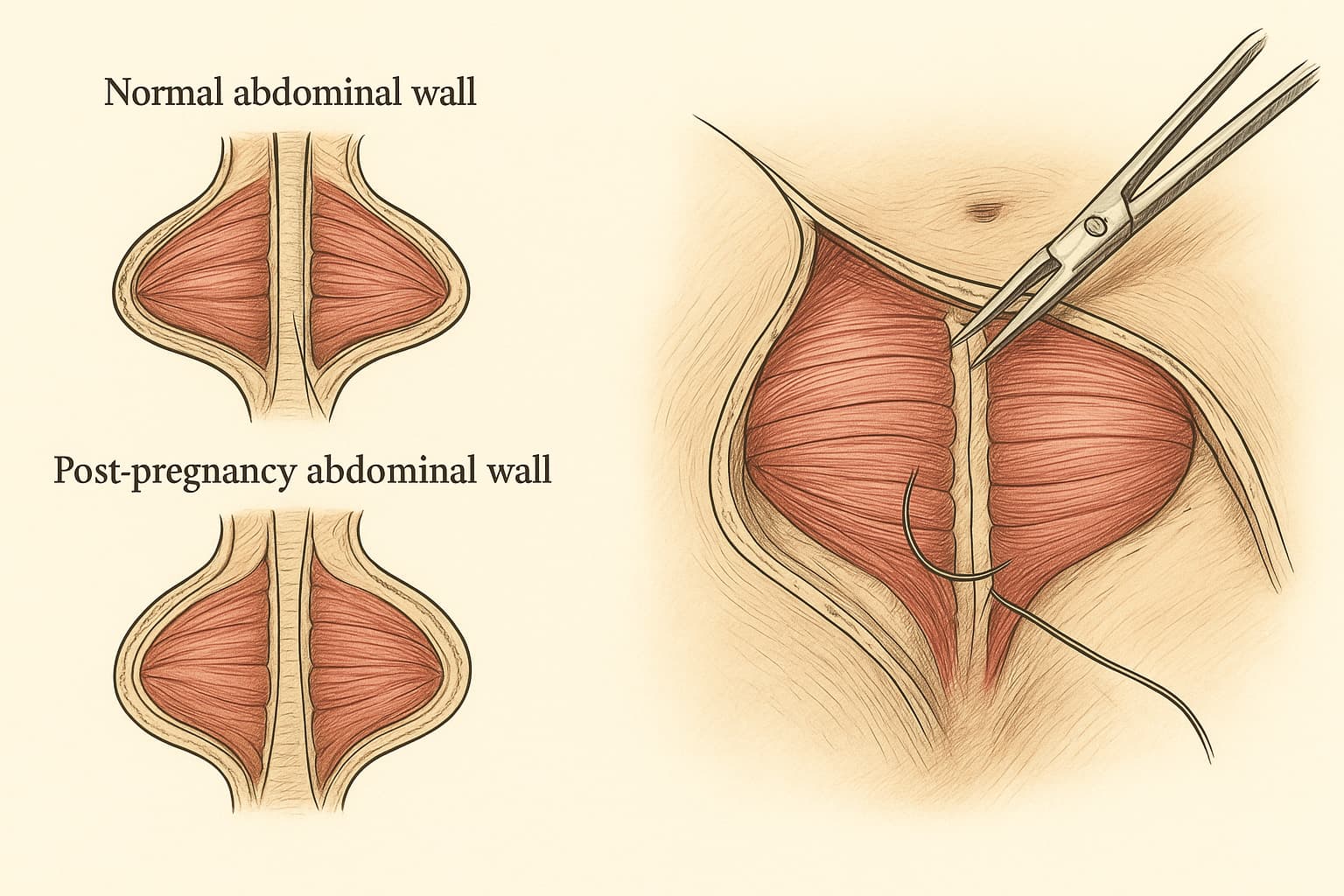
La diastasis recti It is related to a widening and elongation of the dawn lineExercise can improve core function, strength, and control, but it does not always correct marked structural diastasis or associated fascial laxity.
Changes in intra-abdominal pressure
During pregnancy, intra-abdominal volume increases, and the abdominal wall gradually adapts to this new pressure system. These changes can influence:
- respiratory mechanics,
- core stability,
- pelvic floor tension,
- posture and functional control.
After childbirth, the pressure system changes again. In some patients, fascial elongation, loss of tension, and abdominal bulging persist.
Skin laxity, skin redundancy, or stretch marks can coexist with these structural alterations, although their presence and intensity vary from patient to patient.
Why abdominoplasty can have a reconstructive component
In patients with diastasis recti or significant laxity, the goal is not solely to tighten the skin for aesthetic reasons. A full abdominoplasty can address different components of the abdominal wall:
- fascial laxity,
- diastasis recti,
- alterations in stress distribution,
- excess skin and adipose tissue,
- changes in abdominal contour.
Fascial plication: reconstructing the architecture
It is often said that during an abdominoplasty, "the muscles are brought together," but anatomically this explanation is incomplete. The repair primarily acts on the fascial structures that envelop and connect the abdominal muscles, approximating and reinforcing the midline when indicated.
Restore the functional core system
The abdominal wall participates in a coordinated system of pressure and stability. When the linea alba widens and the fascia loses tension, the mechanical efficiency of the core can be impaired. The repair aims to improve:
- pressure distribution,
- abdominal wall stability,
- coordination with the diaphragm and pelvic floor,
- trunk support.
Some patients also report functional improvement or a reduction in lower back pain after abdominal repair, although the outcome depends on the cause of the symptoms and individual anatomy.
Skin resection is one part of the procedure, not the only one.
Many patients focus on the scar. The incision is necessary, but the outcome also depends on the work done on the deeper layers and how the tension in the abdominal wall is redistributed.
The length of the scar depends on, among other factors, the following:
- amount of excess skin,
- previous pregnancies or surgeries,
- elasticity and fabric quality,
- contour target.
Why a limited repair is not always enough
In selected cases, a limited diastasis repair may be sufficient. However, when a more complex abdominal wall defect is present, the surgical plan may need to address several components, not just the midline.
- appropriate fascial repair for the case,
- redistribution of tensions,
- cutaneous redraping,
- umbilical repositioning when necessary,
- abdomen and waist contour.
The goal is to adapt the technique to each patient's anatomy and avoid overly simplistic approaches to problems that affect several layers.
The biology of tension: what influences abdominal contour
A flat and stable abdomen depends on how tension is distributed between fascia, muscle, skin and adipose tissue; not just on removing fat or tightening skin.
Horizontal and vertical tension
Fascia transmits tension along different vectors. Pregnancy and significant weight changes can disrupt this balance. Surgical repair aims to restore a more appropriate distribution of these tensions and improve:
- flatness,
- definition,
- firmness,
- midline stability.
Fascial quality changes over time
The quality and elasticity of fascial tissue can change with age, pregnancies, and weight fluctuations. When significant laxity is present, surgery aims to restore the architecture and tension of the abdominal wall in a controlled manner.
Navel reconstruction: a key detail
During a full abdominoplasty, the navel remains attached to the abdominal wall while the skin is repositioned and re-taped. Several elements are taken into account to achieve a natural appearance:
- depth,
- shade,
- position
- voltage,
- geometry of the incision.
Umbilical planning is an important component of the final result and must be tailored to each patient's anatomy and healing process.
How is recovery planned after abdominal repair?
Many patients are particularly apprehensive about abdominal wall repair. The level of discomfort and the pace of recovery vary depending on the extent of the surgery, the technique used, and individual characteristics. Measures that may be part of the postoperative protocol include:
- surgical techniques that preserve anatomical structures,
- analgesia strategies,
- closure tension control,
- compression systems when indicated,
- progressive medical follow-up.
Healing and collagen remodeling continue for months, so the evolution of the abdominal wall is progressive.
When can an abdominoplasty be considered?
Exercise and weight loss can improve body composition, strength, and core control, but they don't always correct significant fascial laxity, excess skin, or marked structural diastasis recti. Abdominoplasty may be considered when:
- there is diastasis with functional or aesthetic repercussions,
- Bulging persists despite training and weight control,
- There is a significant excess of skin,
- the abdominal wall has lost significant tension,
- The anatomy requires a correction that non-surgical treatments cannot achieve on their own.
Technical evolution of modern abdominoplasty
Depending on the patient's anatomy and the goals of the procedure, current planning may integrate:
- Advanced fascial repair,
- controlled voltage distribution closures,
- detachment adapted to the case,
- progressive tension sutures,
- vascular preservation,
- refined umbilical techniques,
- combination with liposuction when indicated.
Conclusion
An abdominoplasty should not be understood solely as skin or scar surgery. anatomy, fascia, musculature and tension distribution abdominal wall features are central elements of planning.
The treatment should be adapted to the alterations present in each patient and to the objectives that can be safely achieved.
If you are considering an abdominoplasty, a medical evaluation allows for an analysis of the fascia, muscle dynamics, skin quality, and body contour to determine what type of repair may be most suitable for you.
If you want to know the complete procedure, its indications, recovery, results and surgical options, please see our main page about Abdominoplasty at Cirumed.