


After pregnancy and breastfeeding, the breasts can change as much as the abdomen. Some patients lose volume, others notice sagging, and many experience both at the same time.
Therefore, within a Mommy MakeoverBreast surgery is not decided as an isolated procedure. It is planned in conjunction with the abdomen, waist, and, if applicable, the BBLto safely and consistently restore body proportions.
Fast answer
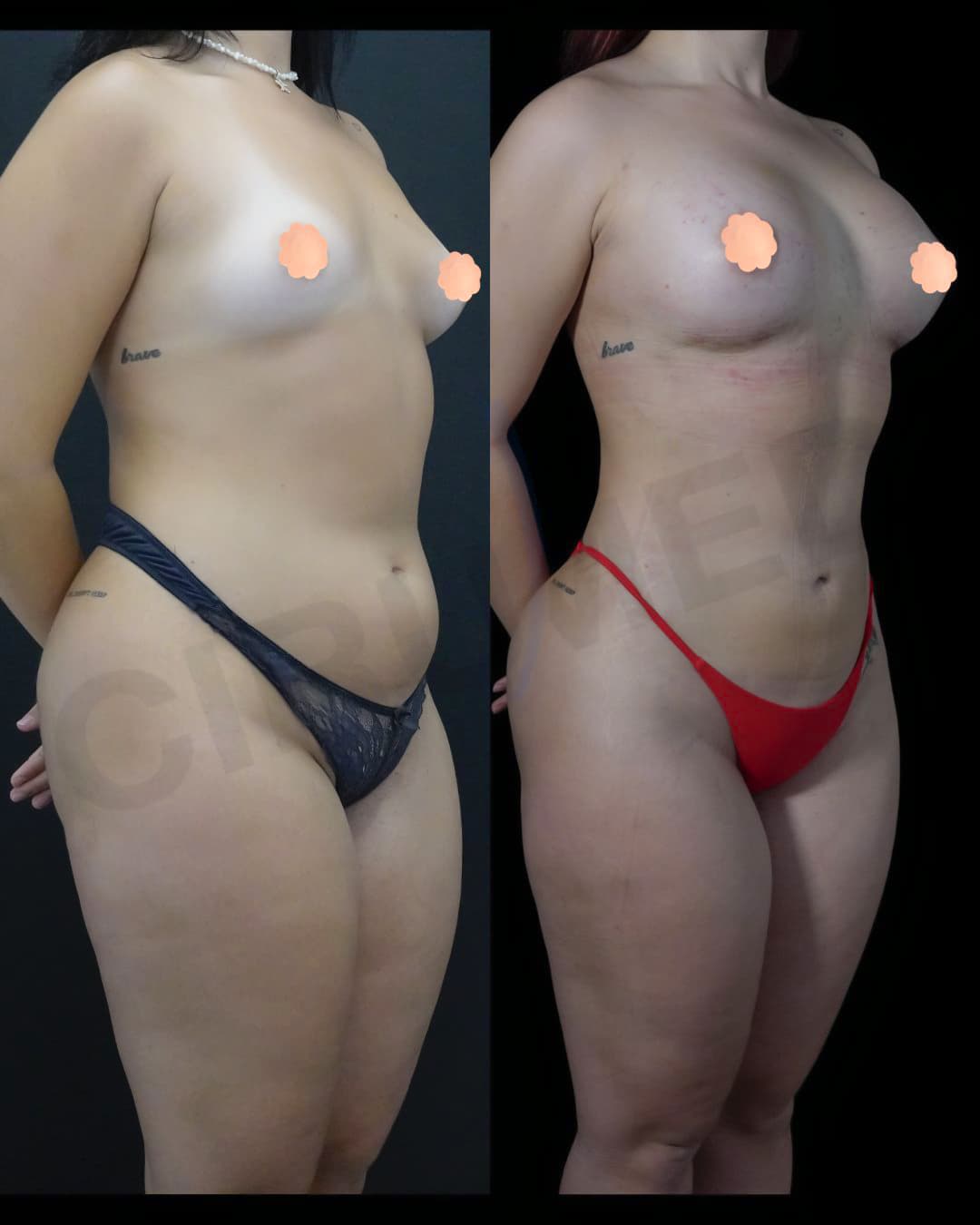
The breast portion of a Mommy Makeover may require lift, implants, own fat or a combinationThe lift corrects the sagging, the implant restores volume —especially in the upper pole— and the fat provides a moderate and natural increase.
The choice depends on three factors: skin quality, volume loss, and aesthetic goal. In many patients, the most balanced solution is to combine a breast lift with implants or a breast lift with fat transfer.
Quick facts
The essential things you need to know
- After pregnancy and breastfeeding, the breasts usually lose volume and sag.
- A breast lift repositions the breast, but does not add volume.
- The implant restores volume, but does not correct significant sagging on its own.
- Fat transfer allows for a more natural and moderate increase.
- Many patients need a combination, especially an implant lift or a fat lift.
- The decision is part of the overall plan of Mommy Makeover procedures combined with safety.
What changes in the breasts after pregnancy and breastfeeding
During pregnancy and breastfeeding, breasts increase in size. When this stage ends, the volume may decrease again, but the skin does not always regain its initial firmness.
The usual result is a less fuller breast, especially in the upper part, with stretched skin and a lower position. In some patients, volume loss predominates; in others, sagging. In many, both occur together.
This difference is important because it determines the technique. A breast that is empty but well-positioned should not be treated the same as a sagging breast with sufficient volume, nor should a breast that is both sagging and has lost volume.

Breast lift: when the main problem is sagging
A breast lift, or mastopexy, is indicated when the breasts have sagged and the nipples are lower than desired. Its function is to remove excess skin, reshape the breasts, and reposition them higher.
The key is understanding what a breast lift does and doesn't do. A lift improves position and shape, but it doesn't add actual volume. That's why, if the breasts are also underdeveloped, it may be necessary to combine it with an implant or fat transfer.
Within a Mommy Makeover, this decision is evaluated along with the abdominal surgery. For example, a patient who also needs tummy tuck You can benefit from a combined plan that improves chest, abdomen and waist in a single strategy.
Implants: when volume is lacking
Breast implants are used when the main change after pregnancy is a loss of volume. They are especially useful for restoring fullness to the upper pole, an area that many patients notice feels empty after breastfeeding.
However, an implant alone cannot sufficiently lift a breast with significant sagging. It can fill the gap, but it cannot reposition a breast that has descended. In these cases, the implant must be combined with a breast lift: the lift corrects the position, and the implant adds volume.
Therefore, the evaluation is not simply a matter of "implant yes or no." It analyzes whether the breast needs volume, positioning, or both.
Not sure which breast option is right for you?
Your own fat: a natural and moderate option
Fat transfer to the breasts can be a good option when the patient is looking for a moderate, natural increase without necessarily relying on an implant.
The fat is obtained through liposuction, which is often part of a Mommy Makeover, for example, from the abdomen, flanks, or lower back. It is then processed and used to add volume more subtly.
It's important to be honest: fat transfer is generally more limited than implants, and some of the transferred fat may be reabsorbed. Even so, in well-selected patients, it can be a very useful tool, especially when combined with a breast lift.
Not sure which breast option is right for you?
How to decide: lift, implant, fat transfer, or a combination
The decision depends on what has changed in each patient. Not all women need the same thing after pregnancy.
This approach avoids treating the breasts like a standard prescription. The surgery is tailored to the skin, the lost volume, the nipple position, and the desired outcome for the patient.
How it combines with abdomen, waist and buttocks
The goal of a Mommy Makeover is not to add surgeries without planning, but to combine procedures that reinforce each other.
The breast augmentation can be combined with abdominoplasty, muscle repair, 360 liposuction, and, if the patient desires and safety permits, with buttock augmentation (BBL).
The key factors are the total surgical time and the patient's health status. Therefore, at Cirumed, the plan is designed within safe limits, with an individual assessment and a clear strategy. You can learn more about this in our guide on What procedures can be safely combined in a Mommy Makeover?.
When to do it: breastfeeding and future pregnancies
In general, it's best to wait several months after finishing breastfeeding before considering breast surgery. The reason is simple: breast volume and tissue need to stabilize before proper planning can be done.
It is also advisable to have completed your family before a Mommy Makeover, because a new pregnancy can change your breasts, abdomen, and skin again.
If the possibility of future breastfeeding is important to you, it's advisable to discuss it openly during the consultation. In many cases, this can be taken into account when choosing the technique, although no absolute guarantee can be promised.
Related reading
These pages help to understand how the breast component is integrated within a complete body contouring surgery.
FAQ
What happens to the breasts after pregnancy and breastfeeding?
Many patients lose volume, especially in the upper breasts, and may also notice sagging, stretched skin, or a lower position. The combination of these changes determines the appropriate technique.
Do I need a lift, implants, or fat transfer?
It depends on what has changed. A lift corrects sagging, an implant restores volume, and fat transfer provides a moderate, natural-looking increase. Many patients require a combination of these procedures.
What is the difference between a lift and an implant?
A breast lift repositions the breasts and removes excess skin, but it doesn't add volume. An implant adds volume, but it won't correct significant sagging on its own. That's why they are often combined.
Can breast surgery be combined with abdominoplasty and BBL?
Yes, that's precisely the logic behind a Mommy Makeover. The decision depends on the total surgical time, the patient's health, and the team's planning.
Should I wait after breastfeeding?
Yes. It is advisable to wait several months after finishing breastfeeding to allow breast volume and tissue to stabilize before planning surgery.
Can breast surgery affect future breastfeeding?
In many cases, breastfeeding can be planned while trying to preserve the ability to lactate, but it cannot be guaranteed. Therefore, it's advisable to discuss this during the consultation if it's important to the patient.
Not sure which breast option is right for you?
Send us your photos via video consultation and you'll receive a personalized assessment. Dr. Aslani's team will explain whether a breast lift, implants, fat transfer, or a combination of both would be the best option for you.
We will also assess how the breast area fits into the complete Mommy Makeover plan, including the abdomen, waist, and buttocks if applicable.