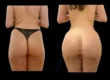


Clinical case · Dr. Alexander Aslani · Cirumed Clinic Marbella
Massive weight loss transforms the body in ways that diet and exercise alone cannot reverse. This case documents one of the most frequent and technically demanding anatomical patterns we see today at Cirumed: a young patient with 40 kg of weight loss who wanted to restore her gluteal contour and ultimately achieved the desired result without the need for skin excision. The procedure: Dual-plane buttock implants combined with strategic fat transfer to fill the loose skin of the lower pole.
The essential things you need to know
- Young patient after 40 kg weight loss with significant skin laxity and deflated and sagging gluteal contour.
- Procedure: cohesive gluteal implants in double submuscular + deep intramuscular plane, combined with fat transfer to the lower pole without skin excision in this borderline case.
- The GLP-1 weight loss wave (Ozempic, Mounjaro, Wegovy) is transforming body contouring practices. At Cirumed, we are seeing a significant increase in patients with substantial weight loss and excess skin.
- When implants and skin removal are needed, they should be done in two stages — the implant first, the skin removal 6 months later, when the implant has settled into its final position.
Clinical case: buttock augmentation after massive weight loss Dr. Alexander Aslani, Cirumed Clinic Marbella
The case: 40 kg weight loss and deflated buttocks
The patient had lost approximately 40 kilograms in the preceding period. The result was the typical anatomical pattern of massive weight loss: significant skin laxity in the lower gluteal pole, depletion of subcutaneous volume that had shaped the buttocks, leaving a deflated and sagging contour, and excess skin in the border zone: enough to be a real surgical question, but not so extreme as to require automatic excision.
The patient's aesthetic goal was clear: to restore the projection, fullness, and lifted appearance of her buttocks prior to weight loss, avoiding additional scarring as much as surgically possible.
The procedure: implants in a dual plane + fat grafting for skin laxity
In patients with massive weight loss, a fat-only approach almost never produces sufficient projection. Subcutaneous fat reserves are depleted with the weight loss, and the excess skin absorbs any modest volume transferred without producing a visible structural change.
Cohesive gluteal implants in a dual plane
Cohesive silicone implants are placed in a dual-plane pocket—submuscular and deep intramuscular—using a technique developed at Cirumed and published in Plastic and Reconstructive Surgery. This provides the structural posterior projection that fat alone cannot achieve in a deflated anatomy following weight loss.
360° liposuction for obtaining donor fat
Autologous fat was harvested via 360° liposuction from residual donor areas. In patients following massive weight loss, fat availability is reduced—therefore, donor area planning is critical to obtaining sufficient volume for transfer.
Strategic fat transfer to the lower pole
The processed fat was transferred strictly to the subcutaneous plane, never intramuscularly, according to the ASERF Task Force safety protocols. Strategic placement focused on the lower gluteal pole, the area where loose, sagging skin needed to be filled from below to restore its position and firmness.
Why fat can fill loose skin within certain limits
Subcutaneous fat transfer can re-expand a stretched skin envelope, but only within defined biological limits. Mild to moderate laxity responds well to fat grafting because the dermis retains some elastic rebound. Severe laxity does not respond once the dermis has lost its elastic structure; no underlying volume will restore tension. In this case, three key factors were favorable: young age, gradual weight loss, and the gluteal area, which tolerates fat grafting better than the abdomen or upper arms.
Long-term results of buttock augmentation after massive weight loss, Cirumed Clinic Marbella
The result shown is from long-term follow-up; the contour has remained stable. To see more real cases, visit our website. before and after gallery.
The GLP-1 wave and its impact on gluteal surgery
This case is part of a much broader clinical pattern we're observing in our practice. GLP-1 receptor agonists Ozempic, Wegovy, Mounjaro, Zepbound, and related drugs originally developed for type 2 diabetes are producing significant weight loss in millions of patients worldwide. And those patients are coming to body contouring clinics in rapidly increasing numbers.
More weight loss volume
Before GLP-1, post-bariatric patients were the main category of "massive weight loss." Now we see patients who have lost 30, 40, or more than 50 kg purely with medication, without surgery, and often in 12-18 months.
Younger profiles
The population with significant excess skin is shifting towards younger ages, because the pharmacological route is accessible without the eligibility filters of bariatric surgery.
More removal procedures
We are seeing a clear increase in the proportion of cases requiring formal skin removal (abdominoplasty, brachioplasty, thigh lift, and in some cases gluteal removal), although our surgical philosophy is to avoid removal whenever possible.
Why the gluteus presents a specific challenge in GLP-1 patients
In most cases of weight loss affecting other body areas—abdomen, arms, chest—the surgical question is primarily how to remove excess skin. In the gluteal region, the question is more complex: how to restore lost volume and manage lax skin simultaneously, ideally without adding visible scars in an area that patients typically prefer to be scar-free.
When is skin excision needed and why do it in two stages
Not all cases of massive weight loss can be resolved without skin excision. When the redundancy is severe enough that fat grafting cannot compensate for it, formal excision becomes necessary. The two available locations for gluteal skin excision are the infragluteal fold or the upper gluteal region.
The critical surgical principle: implants first, skin 6 months later
If both implants and skin excision are needed, they should not be performed in the same operation. The reason: gluteal implants settle between 10 and 20% over the six months following surgery, as the gluteal muscle—one of the most powerful in the body—adapts to the prosthesis. If skin excision is planned and performed at the time of implant placement, it is being planned in relation to the initial position of the implant, not the final one. Six months later, when the implant has settled, the excision may not be optimally positioned.
Time 1 Buttock implants
Dual-plane implant placement with fat transfer where possible. 6-month settling period.
Step 2 Skin excision (if necessary)
Designed around the final, stable anatomy of the implant, 6 months later. The position, tension, and location of the scar are optimized around the final, actual position.
Dr. Alexander Aslani Cirumed Clinic Marbella
- 16 years of specialized expertise in body contouring, over 7.000 specialized cases at Cirumed
- Dual-plane technique for gluteal implants published in Plastic and Reconstructive Surgery 2022
- Best Aesthetic Article of the Year 2020 PRS
- Contributing member of the ASERF Task Force on Gluteal Fat Grafting Safety
- Publications in PRS, Aesthetic Surgery Journal, PRS Global Open and Clinics in Plastic Surgery
- Read 962 verified reviews on RealSelf →
Are you considering a buttock augmentation after weight loss?
The anatomy following massive weight loss requires a different surgical approach than that of primary gluteal augmentation. The right plan depends on how much weight you've lost, how your skin has responded, and what your specific goals are. Dr. Aslani offers personally reviewed video consultations.
No commitment required. Also available for international patients.
Frequently asked questions about buttock augmentation after weight loss
Regarding the procedure and the candidacy
Can I get a BBL after losing weight with Ozempic or Mounjaro?
Yes, but the surgical approach differs from that of a primary BBL in a patient with stable weight. After significant weight loss, the donor fat available for transfer is often reduced, and the skin envelope may have lost elasticity. Hybrid approaches that combine implants with fat transfer are frequently more suitable than fat-only procedures, and in some cases, additional skin excision may be necessary. A proper assessment requires evaluating your weight loss pattern, current body composition, and skin quality.
How much weight loss is "too much" for a BBL or butt augmentation?
There is no fixed threshold. What matters is the residual donor fat available for transfer and the quality of the skin envelope in the gluteal region. Patients who have lost between 20 and 40 kg are usually good candidates for hybrid approaches. Above 40-50 kg, skin excision becomes more frequently necessary along with volume restoration.
How long should I wait after weight loss before having surgery?
Weight should be stable for at least six months before any body contouring surgery. This ensures that the resulting anatomy reflects your long-term baseline and not a transient state. Patients who are actively losing weight with GLP-1 medication should generally postpone surgery until their weight has stabilized, as further weight loss after surgery may compromise the outcome.
About loose skin and surgical planning
Will I need skin removal in addition to the buttock augmentation?
It depends on the degree of skin laxity. Mild to moderate laxity usually responds well to fat grafting, especially in younger patients with preserved skin elasticity. Severe laxity typically requires formal skin excision in the infragluteal fold or upper gluteal region. Determining which approach is appropriate for your case requires a direct examination.
Why do implants and skin removal have to be done in two separate operations?
Buttock implants settle approximately 10-20% over the first six months as the gluteal muscle adapts to the prosthesis. A skin excision designed at the time of implant placement is based on the initial, not the final, position. Six months later, when the implant has settled, that excision may not be optimally positioned, and the skin may become lax again. Therefore, the correct order is: implants first, six-month period, and then the skin excision designed around the final, stable anatomy.
Is buttock surgery riskier after weight loss than primary augmentation?
It is not inherently riskier in terms of major complications, but it is technically more demanding. Donor fat may be reduced, tissue planes may be altered by previous weight fluctuations, and the surgical plan must address both volume restoration and skin redundancy. Results are excellent when the procedure is properly tailored to the patient's anatomy, but planning is more complex than for primary gluteal augmentation.